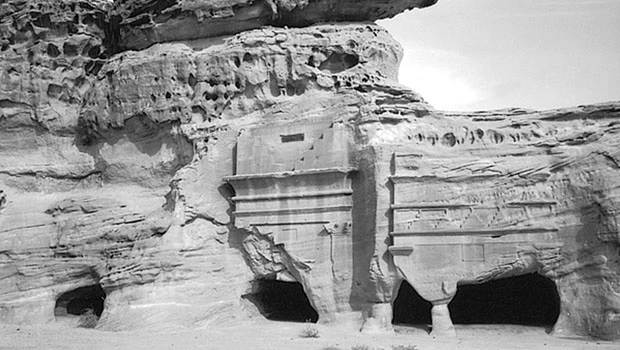
- Many of you reading this probably haven’t been to Madain Saleh, also known as Al-Hijr or Hegra.
- I must confess, neither have I.
I decided I would eventually visit the archaeological site near Al-Ula, some 400 kilometers north of Madinah, after sitting with the internationally renowned Brazilian photographer Humberto da Silveira and listening to his passionate description of the captivating location.
But then I saw his photographs.
That’s when I pulled out my Blackberry, checked my schedule, and picked a date. I had no idea the elaborate sandstone dwellings could be so stunning — even in basic black and white. I was mesmerized.
I was also partly ashamed that I hadn’t thought to take advantage of this beautiful splendor until now. What made it worse was the fact I so often travel for cultural expeditions; yet I had never made the attempt to visit one of UNESCO’s World Heritage Sites that was literally right in my backyard. With Madain Saleh no plane is necessary, just a willingness to be amazed and awestruck.
Madain Saleh consists of about 130 dwellings and tombs that extend over 13 kilometers of serene red desert. Once inhabited by the Nabataeans around 2,000 years ago, Madain Saleh is their southernmost and largest city after the Kingdom’s capital, Petra, located in present-day Jordan. The Nabataeans are of Arab origin and history tells of their monopoly on the incense and spice trade, which made them a rich civilization with many privileges.
Madain Saleh’s central location between the Roman and eastern empires made it a crossroads for other ancient civilizations and nomadic traders, who while on their passage through the Incense Route often left vestiges of their own. Later, it became a stopover for pilgrims to eat and rest before re-embarking on their journey to Madinah. Just like us today, these visitors must have marveled at the ornate stone-carving temples and highly crafted tombs. The setting itself is majestic on its own with its calming landscape and grand rock formations.
So if it is so magnificent why is not so popular? The truth is Madain Saleh is a pre-Islamic archaeological site. Before the Nabataean Kingdom in the first century, evidence of Lihyanite and Roman occupation was discovered through artifacts that had not been removed from their original place of deposition, revealing pages of history. But even before then, the pages of the Holy Qur’an reveal another tale of an earlier settlement by the tribe of Thamud in the third millennium BC.
According to the Qur’an (Al-Hijr 15:80), the people of Thamud were punished by Allah for their persistent idol worshipping. Thus, Allah struck the nonbelievers with an earthquake and bouts of fatal lightening. To this day, many Muslims believe that the place is cursed — an image the Saudi government is trying to counteract with its cultural incentives.
“The Saudi government is doing incredible things to protect and share Madain Saleh with all human beings, regardless of creed or nationality,” explains da Silveira.
An officially protected archaeological site since 1972, the Saudi gov- ernment is also doing its best to encourage both domestic and interna- tional tourism to the location. In 2008, UNESCO proclaimed Madain Saleh a copious site of cultural heritage thus becoming Saudi Arabia’s first World Heritage Site.
A site of patrimony, Madain Saleh is an archaeologist’s dream come true. From its well-preserved relics from late antiquity to its elaborately decorated facades, Madain Saleh is a rich chapter out of world history.
Just as the Nabataeans used various pictographs of snakes and eagles to communicate their archaic message, da Silveira is using a visual mode of communication to tell his message of history and heri- tage. A “visual historian,” da Silveira’s photographs, which constitute more as works of art, are an integral part of his one honorable objec- tive: to compile the highest-quality photographic evidence in the pur- suit to shed light on places of antiquity. He hopes that this will aid in the preservation and understanding of these ancient places and will also act as a means of documenting the practical realities of man- kind’s cultural development.
Madain Saleh stands out in our contemporary time as a piece of the past, welcoming us to witness first-hand the treasures left behind by the early civilization of the Nabataeans. So the next time you’re thinking about what to do for the weekend, why not plan an excursion of history and enlightenment?
There are a variety of accommodations to choose from when planning your trip to Madain Saleh. But make sure to request your free permit because you will not be able to get cleared through security without it. Tour operators can arrange your permits on your behalf, or if in Riyadh, you can do it yourself at the National Museum. Also, make sure to apply at least one week in advance.
The official book launch of da Silveira’s masterpiece, “HEGRA” is this summer and coincides with the Louvre’s most extensive archaeological exhibit on Saudi Arabia ever presented anywhere.
– www.madainsaleh.net