
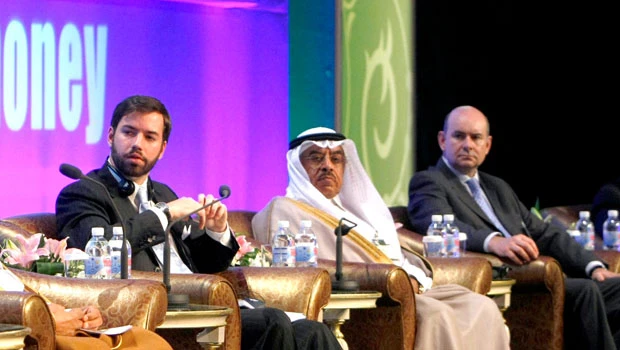
- RIYADH: A keynote speaker at the Euromoney Saudi Arabia Conference 2010, which opened on Tuesday in Riyadh, called for the Saudi government's intervention to boost small- and medium-scale industries in the Kingdom.
"The government's intervention is desired since it is the sponsor of these small and medium industries and also responsible for the national economic development," said Mubarak Al-Khafrah, chairman of the National Manufacturing Company (Tasnee).
He pointed out that mega projects could guarantee the necessary finance for their investments due to their high profitability and the backup received from large companies. The real problem is in finding finance for small and medium industries even though they are main generators of economies and job creators in industrial countries.
Al-Khafrah noted that industrial projects needed long-term credits. "Government should pump long-term deposits into the local banks for financing such industries and further funding the Saudi Industrial Development Fund, which should be transformed into an industrial bank to attract more investments."
Speaking about the Saudi economy, he said foreign direct investments in the Kingdom amounted to $38 billion in 2008, which is equal to 42 percent of the total investments attracted by countries in West Asia. The Kingdom will invest $400 billion in its infrastructure development project during the implementation of its five-year plan which began in 2009.
He also pointed out that the Saudi economy was facing a serious challenge regarding reasonable job opportunities for 11.3 million Saudi youths during the next decade. "Their age range is between 15 and 39 years and they represent 46 percent of the population.”
He added that efforts must be made in order to facilitate financing industrial and service sectors to help them grow well. He said Tasnee, the second largest Saudi industrial company, was able to achieve profits starting in the third quarter 2009. "During the first quarter of 2009, the company realized SR333 million, the highest quarterly profit in its history."
On behalf of Abdulrahman Al-Attiyah, secretary-general of the Gulf Cooperation Council, Naser Al-Kaud said the GCC countries had joined together to develop regional and member countries' economies with the implementation of common goals such as a unified currency, a GCC customs union, a free trade zone and the establishment of GCC central bank.
Dr. Jarmo Kotilaine, chief economist of NCB Capital said, "The Kingdom's economic growth is impressive when compared to economic contraction in most of the developed world. In its unwavering commitment to macroeconomic stability, the Saudi government effectively mobilized its surpluses to support economic activity. This proactive approach to policy-making helped the Saudi economy avert the worst of the crisis."
The Saudi economy is estimated to have expanded by a modest 0.15 percent in real terms in 2009, largely driven by the nonoil sector which expanded by 3.0 percent, he said, adding that the growth was on track to return to roughly four percent this year.