- <strong>The Baalbeck ruins are layers of history from ancient civilizations</strong><br /> I’m at the Palmyra Hotel, lying on a bed in room No.
- 30 — the same room in which the late French president, Charles de Gaulle, slept nearly 70 years ago during his visit to Lebanon.
The Palmyra is a colonial-era building built in 1874 by a Greek entrepreneur. Its 20-foot ceilings, dark and drafty corridors and 100-year-old decor give the place a haunting aura. The room and lobby walls display paintings and letters written by French artist Jean Cocteau — another conspicuous guest who stayed here over 50 years ago.
One of the green shutters just blew in casting a long shadow across my already darkened room. I can’t help but be on edge, considering I’m only one of three guests staying in this hotel of 25 rooms tonight.
“Don’t worry, I haven’t seen any ghosts in the 20 years I’ve been working here,” says Manhen Abbas, the hotel housekeeper. That offers little consolation.
I head outside and leave the musty hotel for the ruins across the street. They are the main attraction in Baalbeck, unless of course you’re there for more off the beaten track tourism (Baalbeck and its surrounding Bekaa Valley offers an ample supply of hashish and opium, both which are cultivated here.)
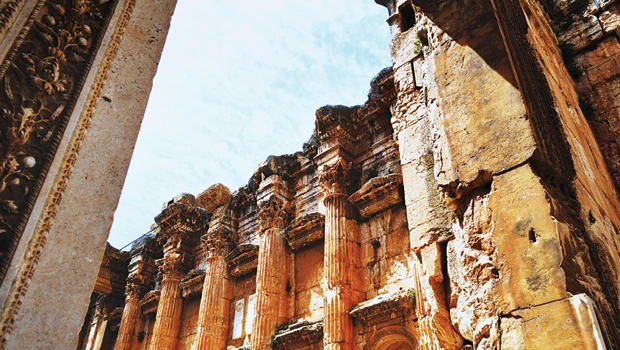
The Temple of Jupiter’s Corinthian columns, which I could see from my hotel balcony, look absolutely colossal when standing right next to them on the site. “No one is exactly sure how the Romans moved the heavy stones to build this temple,” says Hassan, my tour guide.
Though most of the ruins still standing are of Roman origin, the site was originally settled by the Phoenicians around the third millennium B.C. Hassan points out. Initially, the Phoenicians had built a temple honoring Baal from which the city gets its name.
Things were a lot bloodier then. Human-sacrifices were the norm and one account from ancient tablets paints a grotesque description of how Anath, the sister and wife of Baal, was idolized and often “waded up to the knees, up to the neck in human blood. Human heads lay at her feet, human hands flew over her like locusts,” the description reads.
Fortunately, the only hands you see these days are those of the few intrepid travelers holding up cameras snapping photos of loved-ones at this UNESCO World Heritage Site. And, what a site it is: layers upon layers of history being unearthed here just about everyday. The Arab ruins sit atop the Byzantine ruins, which were built over the Roman ruins and the Romans built their massive temples over the Phoenician structures that now lie below the ground.
At one point, Hassan takes me into the temple of Bacchus, which according to archaeologists is the most well-preserved structure in the Roman world. It is also larger than the Parthenon in Athens and the most beautiful, says Hassan. Though the temple roof was destroyed over time, the walls are still standing and are supported by intricately designed Corinthian columns that seem to hold up the blue sky as you stand alongside them.
It’s a wide-open space, large enough to house a party and that’s exactly what takes place at the ruins every summer. The Baalbeck International Festival, the oldest cultural festival in the Middle East, offers an array of performances in classical music, jazz, opera and theater. This summer, it will be held from June 24 to Aug. 7.
As the sun begins to set, I head back to the Palmyra. However, the electricity has gone out. Fortunately, I meet Ali, a local pharmacist whose pharmacy is just down the street from the hotel. He offers me a cup of tea and a few puffs of a water pipe as we sit outside his shop that overlooks the ruins in the starry night. I chat away until the early morning hours, grateful that I don’t have to spend a long night in room No. 30 and diminishing my chances of seeing any ghosts.
One thing is for sure, though, it will be a jam-packed summer. So, if you’re planning to visit Baalbeck this summer, make sure you book a hotel room as soon as possible.