
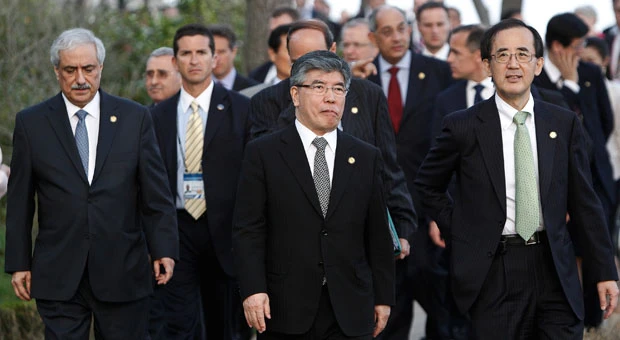
- BUSAN, South Korea: The Group of 20 finance ministers held talks Friday aimed at protecting a fragile recovery threatened by the euro zone crisis, amid divisions over the pace and scale of financial reform.
French Economy Minister Christine Lagarde said budgetary consolidation was the "number one priority" as the two-day meeting got under way, overshadowed by a crisis that has roiled financial markets and sent the euro plunging.
"I felt that our partners were somewhat reassured by the mechanisms we put in place," she told reporters, referring to the European Union's move to craft a 750 billion-euro ($913 billion) rescue plan.
The ministers meeting in South Korea's southern port city of Busan are engaged in a delicate balancing act as they try to continue stimulating recovery from the 2008-9 crisis while reining in massive deficits in some member nations.
Lagarde said ministers were focused on the need to restore budget discipline even if "some minority voices insist on the need for growth".
She added: "It is necessary to carry out three things simultaneously: Maintaining growth, fiscal consolidation and reforms."
The ministers were due to debate the need for regulatory reform to stop future re-runs of the downturn.
But officials said the meeting, held to prepare for a Toronto summit on June 26-27, was unlikely to reach a conclusion on tighter banking regulation or on a proposed bank levy.
A global banking tax is supported by European powers and the United States but resisted by some developing nations plus Canada and Australia, who argue that they should not have to pay to clear up a mess they did not create.
"Well-placed regulations can achieve the job.... We are not in favor of taxing the banks," Indian Finance Minister Pranab Mukherjee told AFP, saying his country's banks had withstood the turmoil.
South Korean Finance Minister Yoon Jeung-hyun told reporters the levy issue was unlikely to be decided before a Seoul G20 summit in November.
Yonhap news agency said members at Busan would only agree in principle to try to make the financial sector share the cost of government intervention.
"I hope we will reach a consensus on principles," Lagarde said.
Officials in Busan stressed the potential dangers ahead for the global economy.
"The recent events in Europe and volatility in the financial markets have clearly shown us the global recovery is still fragile," said Yoon at the opening session. "We can't afford to be complacent."
A government source from a leading G20 member said the euro zone crisis had swayed discussion on exit strategies from stimulus packages.
"As you know, many countries were moving to adopt exit strategies when the crisis took place," the source told reporters. "So there are an increasing number of delegates saying: 'Wait a minute. We need some time'."
While Europe's debt crisis will dominate the talks, a G20 official said ministers were unlikely to single out either the euro or the yuan — which China is under pressure to allow to rise — for specific discussions.
"This issue may come up but I don't think, as separate individual actions, it will be on agenda items," said Sakong Il, chairman of Seoul's presidential committee for the G20 summit.
There were indications that ministers would struggle to carve out a consensus on how to impose tougher restrictions on the banking sector.
"Further deliberation of this issue" is needed, said Sakong.
Britain's new finance minister, George Osborne, called for an end to the uncertainty over capital requirements for banks.
"One of the things I'll be pressing for is that the agreements that were reached last year — on capital, leverage and liquidity — are now concluded. We want to end the uncertainty," Osborne said in a statement.
[]