
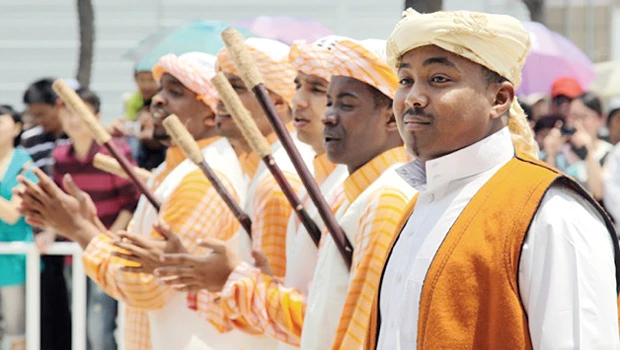
- Wahid Al-Tha’labi has left the city of Jeddah for six months, including his wife and seven-month old daughter, Noor, to don his traditional Saudi thobe (garment), raise his sword and dance while keeping an ever-present smile on his face.
- He has dutifully answered the call of his country along with 23 of his compatriots from the Arts and Cultural Society of Jeddah, part of the Ministry of Culture and Information.
Wahid, who sees his family online for an hour a day, says that serving his country and performing this service is his national duty. Representing his nation in a fashion that benefits it is what makes the separation bearable. This is a common theme among the members of this team that have come from all over Saudi Arabia to present vibrant performances full of color and movement. They are attracting tens of thousands of Chinese spectators through three daily performances that include traditional coastal dances from the various regions of Saudi Arabia, each carrying its own flavor, distinctive instruments and accessories. These whirlwind performances have amazed audiences and succeeded in setting the Saudi pavilion apart from the 200 plus participating nations, making it one of the most visited sites of this year’s Expo. This group of performers came to the Expo after taking part in the National Heritage and Culture Festival — known as the Janadria, in Saudi Arabia — and hail from various parts of the country. Mohammed Al-Sharif, a talented musician, has his origins in Madinah, Bassim Al-Saqami comes from Riyadh, Abdulla Al-Husseini from the Eastern Province, Saeed Al-Mallihi represents Jazan and Ibrahim Al-Issa is from Qunfudha.
The audiences of the Expo, whether Chinese or otherwise, have shown great interest in the traditional Saudi fashions. Bassim Al-Saqami expresses his pride in his country and his group when he sees the crowds’ reactions to their performances. Darwish Al-Ussairi says that the locals treat them like “movie stars,” swarming around them in hundreds and asking to have their photos taken with them as they take a closer look at their garments. The troupe, made up of mostly young men in their early twenties, all agree that the Chinese audiences have been the most enthusiastically positive, even though their shows have carried them across the globe to nine countries, including Spain and the UK.
Khaled Al-Jamali, artistic director and trainer of the troupe, which he formed two years ago, explains that he selected these young men not only for their artistic talent. The deciding factor, according to Al-Jamali, was their high morals and strict discipline, reflecting the true nature of Saudi youth to all that encounter them around the world.
These performers aren’t the only ones representing Saudi Arabia at this Expo, however. With an expected attendance of more than 70 million visitors, Saudi students studying in Shanghai have also volunteered their time to service their country. Working around their existing commitments and class schedules, they are helping organize crowds using their knowledge of Chinese.
Approximately 25,000 spectators visit the Saudi pavilion every day to get a glimpse of the country, and a total of roughly a quarter of a million have been through the pavilion as of May 14. The Saudi pavilion hopes to attract around seven million visitors by the end of the whole event, or ten percent of the Expo’s overall attendees. The pavilion, designed to resemble a boat, faces west toward Makkah and was named the “Moon Boat” by Dr. Mohammed Saeed Al-Ghamdi, the pavilion’s Executive Director. Along with traditional folkloric performances, visitors witness a spectacular show on one of the world’s largest immersion screens. A flavor of the nation’s geographic and cultural diversity is shown through a 15-minute segment of images of The Holy Mosque in Makkah, Empty Quarter (Rub’ Al Khali) desert expanses, exotic corals of the Red Sea and the Kingdom’s industrial and economic cities.
Wa’el Al-Omari, a student from Taif in Saudia Arabia, is currently studying International Finance and in charge of public relations for the Society of Saudi Students in Eastern China, a club of 40 members. “We are extremely privileged to have this opportunity to represent our country in a way that is fitting,” he says.
Also organizing the crowds of visitors outside the pavilion are Mohammed Suweilim, a student from Riyadh studying International Business; Mohammed Basloum, studying IT and hailing from Makkah and Abdulla Al-Ahmadi from Madinah — all dressed in traditional Saudi clothes and speaking fluent Mandarin. They direct crowds and answer questions, acting as an example of Saudi manners and civility.
Other Saudi nationals assisting at the Expo include Rania Biltaji from Saudi Aramco. “The level of interest and enthusiasm the pavilion is receiving fills me with pride,” she says. Salah Al-Dhahri and Sami Al-Saeed, also from Saudi Aramco, say that they are extremely grateful to their company for giving them this opportunity to represent Saudi Arabia in this immense global exhibition. Saudi Aramco will continue extending its support to the pavilion throughout the term of the Expo by sending groups of experienced personnel to assist in the management of the pavilion and handling the pavilion’s VIP guests as they provide them with an understanding of the Kingdom’s social, economic and environmental development.
Some of the pavilions more prominent visitors have included President of the People’s Republic of China Hu Jintao, foreign ministers of the UAE and Poland; the Indonesian minister of planning and the Columbian minister of energy as well as a number of Saudi ministers, including Minister of Petroleum and Mineral Resources Ali Al-Naimi, Finance Minister Ibrahim Al-Assaf and Minister of Health Dr. Abdullah Al-Rabeeah.