
- A majority of Muslims read the Qur’an in translation.
- This is due to growing Muslim communities in English speaking countries, a greater academic interest in Islam and the fact that less than one fifth of Muslims read Arabic.
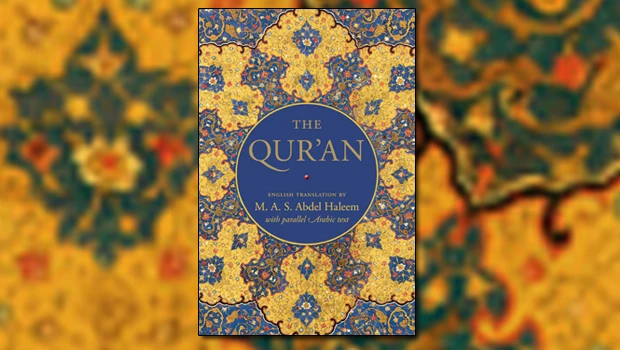
One of the most recent translations is the result of a seven-year effort by Muhammad A.S. Abdel Haleem, Professor of Islamic Studies at the School of Oriental and African Studies in the University of London — “The Qur’an: English Translation with Parallel Arabic Text.”
Abdel Haleem was born in Egypt where he learned the Qur’an by heart during his childhood. Educated at Al Azhar, Cairo, and Cambridge Universities, he is the Editor of the Journal of Qur’anic Studies and the London Qur’an Studies series.
Abdel Haleem’s translation of the Qur’an, approved by Al-Azhar in Cairo, the world’s leading authority on Qur’anic, Islamic and Arabic studies, first appeared six years ago, without accompanying Arabic text. Now, it is a remarkable bilingual edition, which strikes the reader by its novel layout.
Abdel Haleem acknowledges the challenge he faced during the preparation of the dual edition as he was not prepared to sacrifice the whole philosophy of his translation, which is based on discourse in paragraphs and not single verses.
During a speech he gave at the recent launch of “The Qur’an, English translation with parallel Arabic Text,” in London, Professor Abdel Haleem said:
“I could not follow the practices of others who put one Arabic verse facing its translation on a line-by-line basis. I had to keep the paragraphs and also put the Qur’anic material as it appears in pages in the conventional edition that has been handed down for centuries. This, and not single verses, is what pleases the Muslims. Here we were helped by the outstanding skill of Paul Luna, who managed to retain on every page the Arabic and English text so that they start and end on the same page…We chose a beautiful version of the Qur’anic calligraphy, written originally by a Turkish calligrapher, that finishes each page at the end of a verse without running on.”
Abdel Haleem’s translation is intended for those who do not know Arabic, unlike some of the existing translations, which are appreciated mainly by Arabists who already read the Arabic Qur’an. He firmly believes that the translation should be in English and not Arabic English with Arabic sentence-structure, Arabic cohesive idioms and Arabic modes of conciseness.
In the course of his speech, Abdel Haleem explained how the Qur’an relies on dialogue and rational arguments in making its points. The arguments run in swift succession and are interconnected, rhetorical and often interspersed with comments. In the translation, these comments have been separated clearly using punctuation, and the material is paragraphed in chunks of meaning rather than separating it according to the boundaries of the Arabic verses. That is because the Arabic verses have rhymes that cannot be expressed in English.
“Opting for translating separate verses results in misunderstanding the linguistic context. In both the Islamic and non-Islamic traditions, this has resulted in huge misinterpretation and mistranslation. Both Muslim extremists and anti-Islamic media rely on one strategy: wrenching a short statement out of context to justify violence and give the worst image of Islam… The more I read the Qur’an, the more I realize this. Separating the verses, also blunts and flattens the impetus of Qur’anic discourse, which to me is the soul of the Qur’an,” he added.
This dual edition includes a general introduction on the revelation, stylistic features, issues of interpretation and translations of the Qur’an along with summaries of each sura and an index. Furthermore, the verses are individually numbered to facilitate comparison with the Arabic.
Abdel Haleem recognizes the lack of footnotes and commentary which are kept to a minimum. His upcoming book, “How to Read the Qur’an,” will provide more explanation on the cultural aspects in Arabic and of the stylistics of the Qur’an.
The translation by Abdel Haleem has been praised for the precise use of English. It is also easily readable thanks to the use of contemporary English and the arrangement of verses in paragraphs which facilitates their understanding and respects the continuous flow seen on the pages of the Arabic original. It is essential, however, to emphasize that Muslims only recognize the Qur’an in Arabic and a translation cannot be a substitute, it is merely an interpretation of the meanings of the Qur’an.
The message of the Qur’an, the word of God, is intended for all times and places and addresses all people, regardless of class, race, gender or age. This dual edition is equally accessible.