
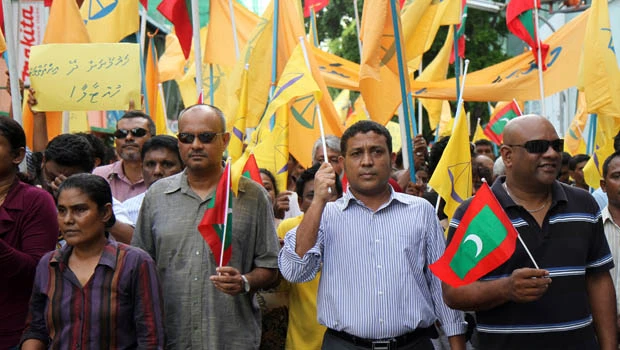
- COLOMBO: Two opposition politicians from the Maldives have been arrested for allegedly trying to “topple the government illegally” by paying independent lawmakers for their votes in Parliament, officials said Wednesday.
Lawmakers Abdullah Yameen Abdul Gayoom and Quasim Ibrahim were arrested on Tuesday and are being investigated for trying to bribe lawmakers to vote against the government in Parliament, according to government spokesman Mohamed Zuhair.
Police spokesman Ahmed Shiyam confirmed that the two lawmakers are being questioned on “trying to topple the government illegally” including through inducements for votes.
President Mohamed Nasheed’s 13-member Cabinet resigned en masse on Tuesday after accusing Parliament of blocking all of the government’s legislative initiatives. The struggle showcases how this tiny Indian Ocean archipelago is enduring tests to its 2-year-old democracy after decades of autocratic rule.
Gayoom is a brother of former President Maumoon Abdul Gayoom, who ruled the country for 30 years before being unseated by Nasheed in the country’s first-ever democratic election in 2008. Ibrahim was finance minister in the Gayoom regime.
The president and the Parliament are elected separately and now both seats of power are controlled by opposing parties, forcing a difficult cohabitation.
Nasheed’s Maldivian Democratic Party has only 32 seats in the country’s 77-member Parliament. The opposition coalition, led by the Dhivehi Raithunge Party, has 36 seats - three short of a majority. Nine others lawmakers are independents.
DRP deputy leader Umar Naseer dismissed the bribery charges as “completely false.” He said the two lawmakers, leaders of different parties of the DRP-led opposition coalition, are locked up, and no visitors are allowed. He said police have ignored two court orders asking the lawmakers to be produced.
Shiyam confirmed receiving the court orders and said police are appealing to a higher court for a review because, under the law, suspects may be kept for 24 hours for questioning before they must be produced in court.
Meanwhile, opposition lawmakers protested in Parliament on Wednesday against the arrests and the sitting was forced to be adjourned early because a tense situation arose, Speaker Abdulla Shahid said.
Attorney General Husnu Suood said it was becoming difficult to govern the archipelago of 330,000 Sunni Muslims.
“Every passing week, there is another attempt by opposition MPs to wrestle more control from the executive,” Suood said.
The president has no power to dissolve Parliament and the opposition lacks the required two-thirds majority to impeach Nasheed, who is also commander in chief of the armed forces.
Under the Maldives’ presidential system of government, the president handpicks his Cabinet and each nomination must be approved by Parliament, which can later seek to remove a minister through a no-confidence vote.
The opposition had planned to bring such a motion against the education minister on Wednesday, but the Cabinet resignation pre-empted the move.