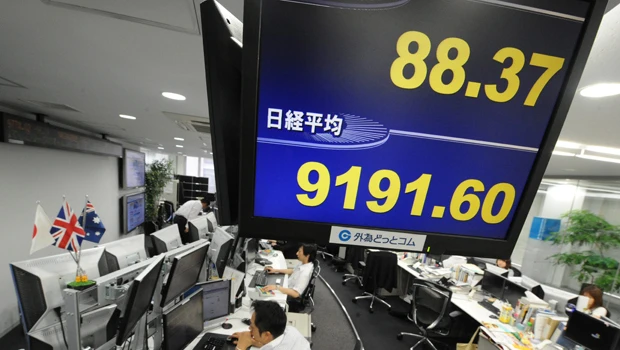
- TOKYO: Japan's Nikkei average fell 2 percent on Thursday, breaking a key support to hit a seven-month closing low, with market players citing a rise in risk avoidance underscored by falls on Wall Street, a higher yen and slower China manufacturing growth.
Market players said the Nikkei's next target is just above 9,000, a low tested in November and July 2009, after the index broke 9,200, near the 50 percent retracement from the Nikkei's March 2009 low to its high in April.
Charts were mixed, with the Nikkei's MACD continuing to slide after a bearish cross, though its slow stochastic was flattening in oversold territory.
A better-than-expected survey of domestic corporate sentiment, the Bank of Japan's tankan, initially helped limit declines but this effect faded after data for China's purchasing managers' index, which fell to 52.1 in June from 53.9 in May.
"The market appears to have more room to fall even though some technical indicators are overstretched," said Yutaka Miura, a senior technical analyst at Mizuho Securities.
"It's hard to think the Japanese stock market will be able reverse course and start climbing on its own. There needs to be a halt to the advance in the yen and the falls in US stocks. Worries about a slowdown in the economy and strengthening in the yen are working against exporters."
Investors are waiting for Friday's US Labor Department jobs report after US private sector employment rose by a paltry amount in June, underscoring concerns about a weak labor market.
The benchmark Nikkei shed 191.04 points to 9,191.60, its lowest close since late November. It fell as low as 9,147.68 at one stage.
The drop came after the index posted a 15.4 percent fall on the quarter to June 30, its worst quarterly performance since the fourth quarter of 2008, just after Lehman Brothers failed.
The broader Topix fell 1.6 percent to 828.39.
Japanese manufacturers turned optimistic about business conditions for the first time in two years, the Bank of Japan tankan survey showed, as solid exports to Asia supported the country's economic recovery.
On the technical front, the Nikkei remains under pressure after its 50-day moving average fell through its 200-day moving average, a formation known as a "death cross" that often signals further falls.
But its relative strength index (RSI) came in at 31, falling closer to oversold territory from 30 on down.
There are a large number of options on Nikkei futures at 9,200 and then 8,500, with one market player describing the situation as "gamma short," meaning that traders need to follow market moves in order to hedge their books and leading to selling in a falling market.
"This is a situation where selling invites selling," said Hideki Horikawa, senior adviser at Himawari Securities.
Some 1.8 billion shares changed hands on the Tokyo exchange's first section, after volume hit a four-month low of just above 1.4 billion on Monday. Declining stocks outnumbered advancing ones by more than 5 to 1.
EXPORTERS AT MULTI-MONTH LOWS
Among exporters, Sony Corp and other high-tech stocks hit multi-month lows on worries about a stronger yen and after US stocks booked the worst quarter since the market meltdown triggered by the collapse of Lehman Brothers.
In Asia trade, the dollar hit a two-month low around 88 yen. Many Japanese exporters have set assumption rates for dollar/yen at around 90-95 yen for the year to March.
Sony dropped 3.7 percent to 2,296 yen, after falling as low as 2,278 yen, its lowest in seven months. Sony said on Wednesday about 535,000 units of its Vaio brand personal computers globally may overheat and it has provided software on its website to eliminate the problem.
Kyocera Corp also fell more than 3 percent to hit a seven-month low, while Advantest Corp slipped more than 4 percent its lowest in nearly a year.
Honda Motor Co hit its lowest in about a year after Citigroup Global Markets Japan lowered its rating to "hold/medium Risk" from "buy/medium risk" and cut the target price to 2,720 yen from 4,170 yen. Its shares were down 3.3 percent at 2,512 yen after falling as low as 2,504 yen.
Mitsumi Electric fell 3.3 percent to 1,478 yen after a strike that began on Tuesday at the Tianjin Mitsumi Electric Co factory in North China crippled production there.
But Bridgestone rose 1.1 percent to 1,430 yen after Goldman Sachs hiked its rating on the tire maker to "neutral," citing higher-than-expected growth in tire production.