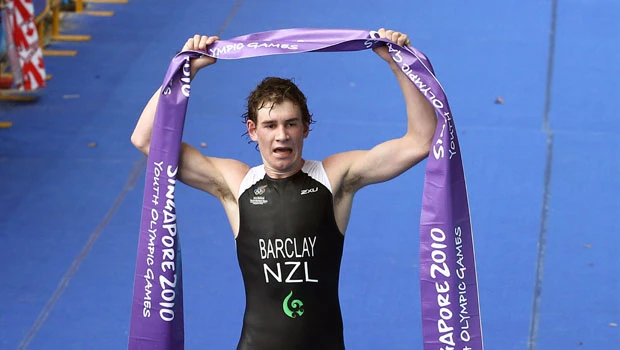
- SINGAPORE: New Zealand earned its first medal of the Youth Olympics when Aaron Barclay won the gold Monday in men's triathlon.
Barclay won the race — a 750-meter swim, 20-kilometer bike ride and 5-kilometer run — in 54 minutes, 41 seconds, 14 seconds ahead of Kevin McDowell of the United States and 23 seconds better than Alois Knable of Australia.
Barclay claimed victory in front of his parents, grandparents and Hamish Carter, who won the gold for New Zealand at the 2004 Athens Olympics.
"He was great," Carter said. "It's a fantastic result." The 17-year-old Barclay said he ditched his contact lenses, which correct a mild case of shortsightedness, before the race because they were bothering him.
"It's quite uncomfortable, especially on the bike as they dry out very quickly," Barclay said. "I've gotten used to racing like this." This is the first Youth Olympics, a 12-day event in which 3,600 athletes aged 14 to 18 from 204 national Olympic committees compete in 26 sports.
Youth Olympics organizers have sought to emphasize the educational and cultural benefits of bringing together teenage athletes from around the world so they are not keeping a medal tally.
In an unofficial medal tally, Russia leads with 11, followed by China with eight and the United States and Italy with five each after the second day of competition.
It's been an event of firsts for several countries.
Vietnam hoisted its first Olympic gold medal ever Sunday as weightlifter Thach Kim Tuan powered to victory in the men's 56-kilogram division.
The 16-year-old Thach edged Xie Jiawu of China in the combined clean and jerk and snatch competition.
Vietnam had previously won silvers in women's taekwondo at the 2000 Summer Olympics in Sydney and in men's weightlifting in Beijing in 2008.
Tuvalu, a Pacific island nation of 12,000 people, made its Olympic badminton debut at the Youth Games as Tiaese Tapumanaia lost 21-1, 21-4 to Chiang Mei-hui of Taiwan on Monday. Tuvalu was only recognized by the International Olympic Committee in 2007 and found out they could compete in Singapore earlier this month, team manager Tioti Toafa said.
"I just want to make a difference for my delegation and also make some friends," the 17-year-old Tapumanaia said.
Haiti's beleaguered boys football team lost its first match 9-0 to Bolivia on Monday as Rodrigo Medjido scored four goals. The Haitians only practiced for six weeks before the games as a 7.0 magnitude earthquake in January that killed at least 200,000 people damaged many of their homeland's sports facilities.
"After everything the players have gone through, coming here is like therapy," Haiti coach Pierre Sonche said.
"It's not about winning for us right now." Politics threatened to overshadow the games after an Iranian athlete cited injury before withdrawing from the boys taekwondo final against an Israeli athlete late Sunday.
The Iranian delegation said Mohammad Soleimani aggravated an injury and was taken to a hospital for treatment, meaning he was unable to face Gili Haimovitz or attend the medal ceremony.
Israeli officials said they expected Iran to refuse to compete and that the withdrawal was politically motivated.
Daniel Oren, head of the Israeli delegation, said he was thrilled at the gold medal but expressed frustration that the victory was not earned in the final.
International Olympic Committee spokesman Mark Adams said it is "my understanding is that he was taken to hospital and unable to compete." Iran in the past has stated that its policy is to withdraw from competing against Israel because it does not recognize the country. At the 2004 Athens Olympics, Arash Miresmaeili — a two-time world judo champion from Iran — refused to compete against Israeli athlete Ehud Vaks in the opening round of the 66kg competition. He said his decision was to show solidarity for the Palestinian cause.
Haimovitz's victory was Israel's first gold medal of the games.
Another potential issue was avoided Monday when both an Israeli and Iranian swimmer competed in different heats of the 200-meter individual medley. The Iranian failed to advance past the first heat.