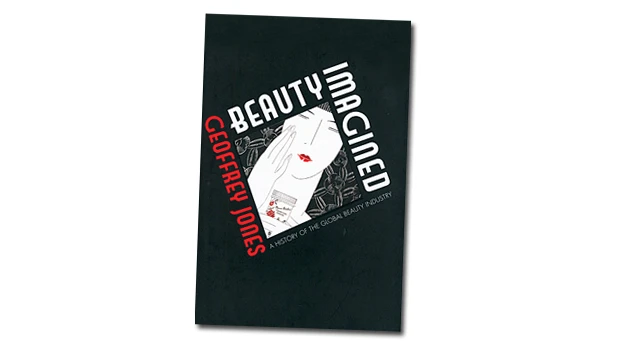
- Master in his field, Geoffrey Jones, Professor of Business History at Harvard Business School, reveals for the first time all there is to know about a multibillion dollar industry that touches us all.
- The phenomenal success of the French owned, L’Oreal, one of the world’s largest companies, tells us much about an industry that started modestly in France with the production of perfumes.
The growth of the fragrance industry was largely due to the presence of pioneering perfume houses investing in brand building thanks to France’s strong legal protection for trademarks and the emergence of innovative perfume-makers in Grasse using a new technology to extract essential oils. At the same time, a perfume industry took shape in the United States around the port of New York where importers of French essential oils were established.
Interestingly enough, until the 19th century, men and women used the same perfumes. After the Black Death, Europeans developed a fear of water and during 300 years, Europeans were mostly known for their strong body odor.
As people began to wash more, Western men used less perfume and preferred soap and eau de Cologne. Charles Armand Roger and Charles Martial Gallet, a merchant and a banker respectively, were among the first to realize that the perfume market was profitable. They set up the Roger and Gallet Company, which specialized in perfumed toilet soaps, and exists to this day.
At the same time, other firms concentrated their efforts on exclusivity, taking advantage of the fact that Paris was the capital of fashion and luxury. Charles Frederick Worth, an Englishman, moved to Paris and established the art of “haute-couture” (French for high dressmaking, and a term for the creation of exclusive fashions). The House of Worth was joined by other luxury firms dealing in jewelry, perfumes, chocolates and leather goods. Francois Coty, at the turn of the 20th century, was in the words of the author “a pioneer of the idea of a branded line of scented products” and although he still considered perfume a luxury, he wanted more people to buy it. He believed that a perfume “needs to attract the eye as much as the nose”. He was the first to package the perfume in an elegant bottle, designed by the well known Rene Lalique and as a result the shape of the bottle turned out to be an essential element of its marketing, often costing more than the perfume inside
By 1914, firms such as Coty, Guerlain, Wertheimer and their Bourjois brand, Roger & Gallet, were selling their products in France and abroad, giving birth to an era known as the “first global economy.” The ancient art of making perfume had been transformed into a modern industry, and there was a marked distinction between perfumes for men and women. New products to beautify one’s hair, skin, and face were also making their appearance, and Geoffrey Jones rightly points out that today’s biggest companies such as L’Oreal and Procter & Gamble, were originally involved in hair products. Eugene Schueller invented the first safe synthetic hair-color formula in 1907 and went on to establish the L’Oreal brand in 1909 and six years later, hair products were part of the beauty industry.
New developments in media and advertising created a market for consumer goods such as creams. Oscar Troplowitz, the second owner of Beiersdorf, “was amongst the first to understand the potential for increasing the emotional component of the claims made for a skin care brand” and he found the way “to emphasize the feminine nature of the new brand, suggesting to consumers that they could make themselves feel more feminine as well as healthy by using the cream.”
Troplowitz (in 1912, he launched the iconic NIVEA Crème, one of the world’s largest brand of all-purpose skin creams) was joined by a host of savvy female entrepreneurs such as Harriet Hubbard Ayer, Estee Lauder, Helena.
Rubinstein and Elizabeth Arden. These visionary women introduced their brands in beauty salons to wealthy customers; women over 35, revealing a serious change in the way people reacted to age. The age of 35 was no longer regarded as uninteresting by men, and brands began to sell creams and other beauty products which promised to make women more beautiful.
The growing demand for soap and the availability of running water created an important market for the mass production of branded soap. The French who had established one of the oldest soap industries never managed to establish mega brands. Three brands succeeded in launching branded soaps: the American Procter & Gamble, the British Lever Company and the German Henkel. American firms from 1945 till 1975 grew beyond their European counterpart thanks to a large domestic market and the post-war media revolution created by television. “By the early 1960s the American beauty industry was spending $152 million ($1 billion in 2008) on television advertising. This was more than the amount spent in any other industry except food,” says Geoffrey Jones.
During the 1970s, consumers were given a wider choice of products, including green products. The Body Shop was the most successful company of that era. The founder of The Body Shop, Anita Roddick, used natural ingredients and packaged her products in the cheapest containers because she claimed that the high cost of cosmetics was due to their expensive packaging. The Body Shop was highly successfu, especially with women. The seventies also saw the emergence of products geared to ethnic groups other than white. This movement continued with the development of global markets, and was well understood by big companies such as L’Oreal whose executive vice-president, Beatrice Dautresme explains, “The ethical responsibility of a company like L’Oreal is to present to people all the options they have in changing or enhancing their original look. Beauty is so diverse, because populations are so diverse.”
This quote introduces one of the books most interesting chapters on “Globalization and Tribalization”. The concept of “tribalization” was coined by the political theorist Benjamin Barber who noticed that the globalization of certain meg- products like a hamburger and a mobile phone, have provoked local, cultural, ethnic and religious reactions all over the world.
From 1990 until this day, the beauty industry has witnessed considerable changes; while some brands could not face up to the competition, two firms forged ahead, P&G and L’Oreal whose combined grip of the world market accounts for 23 percent. P&G who until the 1990s was still not fully committed to the beauty industry, underwent a major shift in its core strategy. This was made public during an important speech entitled “Redefining Beautiful” delivered by Ed Artzt, P&G chief executive in 1992. The talk explained, “why a 155-year-old soap and detergent company would want to venture into the world of fashion and glamor.” Artzt believed the beauty care was the most “dynamic sector” with “the greatest potential for growth” and he predicted that the beauty industry would “become an increasingly technology-driven industry.” A view shared by the author, who envisions “consumers in rich countries gaining access to tools which significantly delay the physical signs of aging into their eighties, while those less wealthy would continue to wrinkle with age”.
L’Oreal and P&G owe their leadership to their quasi-perfect understanding of the different needs between the global and local markets. Consumers around the world welcome the positive sides of globalization, but not at the expense of their traditions and beliefs. French and American brands are still the most admired and longed for, but consumers from different countries expect a choice of products highlighting their differing beauty ideals. L’Oreal is now choosing local celebrities to represent its brands: in Egypt, Hend Sabry is the face for L’Oreal while Michele Yeoh represents the brand in Malaysia.
The beauty business is still growing strong and becoming more diverse. Beauty is no longer confined by an age limit: Today women in their fifties are considered attractive. Advertising and packaging are still powerful marketing tools in an industry based on desire and luxury. This explains partly why LVMH, the French luxury goods company, headed by the brilliant Bernard Arnault, is so successful. The other reason is due to the particular structure of this financial holding company, still partially owned and managed, by the members of the original families who founded the companies. Arnault alleges he became convinced of the global potential of the Dior brand during his first trip to New York. He discovered that his taxi driver did not know the name of the French president but he had heard about Christian Dior.
Today, consumers willingly spend $330 billion a year on beauty products without knowing their real manufacturing cost, which is infinitesimal. In return, the beauty industry makes people feel good about themselves, and gives them the opportunity to look more attractive. Geoffrey Jones has written a formidable history of the Beauty Industry that reads like a novel. Beauty Imagined, A History of the Global Beauty Industry (Oxford University Press) is poised to become a classic of the genre. It should be read by anyone involved in the beauty business.