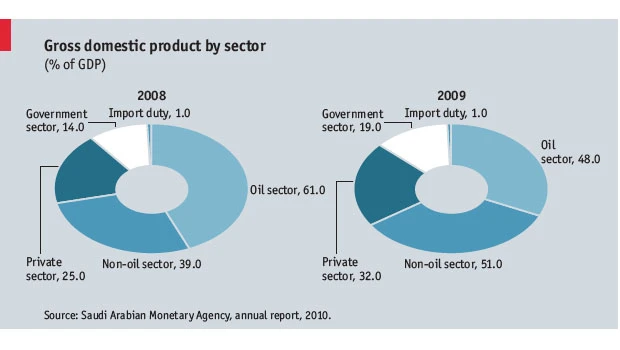
- JEDDAH: Saudi Arabia's economy is forecast to grow by an average of 3.7 percent a year in 2010-14, a slowdown from the annual average of 4.9 percent during the 2003-08 oil boom, but a recovery from 0.6 percent in 2009, when growth was dragged down by oil production cuts, the Economist Intelligence Unit (EIU) said in a special country report.
Growth in the nonoil private sector is projected to pick up over the forecast period, averaging 3.9 percent, as it recovers from a tightening of bank lending and as foreign direct investment (FDI) rises. Government spending, subsidized credit and public-sector contracts will support growth in this sector, the report said.
In terms of demand components, private consumption is forecast to expand, underpinned by strong population growth and by expansionary fiscal and monetary policies.
The economy will be heavily supported by extensive government spending and by a public sector that continues to absorb a large proportion of job market entrants. Therefore, government consumption will rise in 2010-11 before falling slightly in the remainder of the forecast period as private-sector growth accelerates.
The government will also drive strong increases in investment, which is likely to grow faster than any other expenditure component over the forecast period. Private investment growth will be stimulated by a number of projects already planned or under way. Some $373 billion of public investment is planned in 2010-14. Foreigners will be an important source of investment, and inward FDI has remained relatively strong despite the weak global climate. Export volumes largely depend on oil production policy and are expected to grow steadily over the forecast period. Import volume growth will be stimulated by demand from ongoing construction projects and a reliance on imports to meet many consumer needs, the EIU report said.
The EIU sees inflation to average 5.7 percent in 2010, up from 5.1 percent in 2009 but broadly in line with the 6.1 percent year-on-year figure recorded in August. Inflation slowed following the 2009 global and local economic slowdown but is now likely to increase steadily, mainly driven by rises in food, rental and electricity prices.
Housing shortages are expected to stem the slowdown in rental price rises and higher international food prices are likely to drive inflation in 2010-11.
A weakening dollar, and thus Saudi riyal, will add to the risk of imported inflation during the forecast period. These factors suggest that inflation will be higher in 2010-14 (5.6 percent) than in 2005-09 (4.4 percent).
Saudi Arabia's current account is forecast to remain in surplus in 2010-14. Oil revenue will remain the primary factor determining current-account trends, and changes in oil prices and production will continue to be the main risks.
The EIU said international oil prices are expected to average $78 per barrel in 2010-14. Revenue from oil exports and from the main nonoil export, petrochemicals, will remain lower than in 2007-08, but with lower world commodity prices also helping to ease the cost of imports, the trade balance is expected to remain comfortably in surplus. This should be sufficient to offset persistent deficits on the services and current transfers accounts. Income from investments abroad has been sustained through the global economic slowdown and there is a small surplus on the income account. Rising domestic fuel consumption, weak global demand for oil and weakening international oil prices will lead to stagnant export earnings in 2012-14 and a contraction in the current-account surplus. The current-account surplus is forecast to average 7.8 percent of GDP in 2010-14, although it will narrow to 4 percent in 2014.
Having completed a large-scale expansion of crude oil production capacity to 12 million barrels per day, Saudi Aramco will focus on ramping up output of gas, refined products and petrochemicals. The government is also increasing spending on health and education, backing major new rail and infrastructure projects, and plans to invest in food production abroad, the EIU report said.