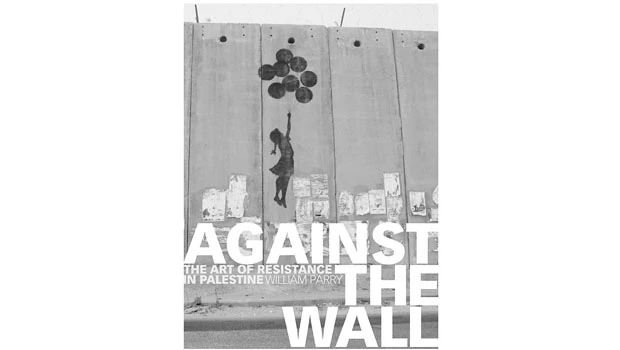
- This stunning book captures the reality behind the Israeli war.
- Artists and activists are transforming this symbol of oppression into a living canvas of resistance.
It has attracted the attention of famous street art artists like Ron English, American born despite his name, and the elusive Bansky. They have joined hands with Palestinian graffiti artists, professionals and amateurs to create an awareness about the existence of the Wall and how it is completely disrupting people’s lives. English is grateful for the opportunity to travel to Palestine and experience things firsthand: “The American media is very biased and we rarely get the truth about much of anything abroad. I wish there was a way we could get more Americans to see what their tax dollars are doing to her people around the world.”
The Wall is three times the height of the Berlin Wall and it will be 709 km long when it is finished — the distance from London to Zurich. Most of the wall, about 85 percent, is built on the West Bank and that represents a 10 percent annexation of Palestinian land. The mysterious but prolific British graffiti artist, Bansky, said the “wall is illegal under international law and essentially turns Palestine into the world’s largest open prison.”
Bansky, probably the most famous graffiti artist alive, has created a global awareness about the Wall, a symbol of injustice. His singular artwork is done in a distinctive stenciling technique with the use of computers for some images due to the secretive nature of his work and his unknown identity.
“Bansky’s images in particular are genuinely appealing and they communicate to a mass audience via the media and Internet with flabbergasting economy and efficiency. That ability to challenge Israel’s narrative and to influence the Western public’s perception of the Wall and the broader conflict is as rare as it is invaluable, ” said William Parry.
The idea for the book came while Parry was wandering through Bethlehem. Moved by the sheer volume of artwork, he realized the importance of these murals and the need to document this artwork on the Wall for posterity.
Some Palestinians, however, have criticized the beautification of the Wall. Back in 2005, while he painted the Wall, Bansky remembers this conversation:
Indeed, some Palestinians are suffering too much from the impact that the Wall is having on their lives to enjoy the artwork. This prison Wall is literally strangling the West Bank’s communities and most of all, it is isolating them from Jerusalem — the spiritual and cultural capital. On a day-to-day basis, the Wall is separating families from their communities, their places of worship, their schools and hospitals. They can only reach them through military check points which are humiliating and time consuming. Palestinians now say that they are refugees in their own land.
Bethlehem, a popular tourist destination, is being aggressively colonized by the Israelis who have established 35 illegal colonies with plans to expand. The Palestinian Authority merely controls 13 percent of the entire Bethlehem governorate. Bethlehem is actually losing its historical heritage and identity shaped by 2,000 years. Graffiti along a section of the Wall separating Rachel’s Tomb from Bethlehem reads: “Dead city.” The author is particularly appalled by the Christians’ lack of reaction.
“It’s difficult to understand how hundreds of millions of Christians around the world tolerate what is happening to Bethlehem under Israeli occupation. Muslim and Christian heritage sites here and elsewhere are under threat as Israel rewrites the region’s history in an attempt to emphasize Jewish heritage to legitimize its colonization. The Palestinian Christian community that remains in Bethlehem (and which is shrinking rapidly), is bewildered by the international Christian community’s silence and inaction,” wrote Parry.
In Jerusalem, unless one makes an effort and ventures in Palestinian neighborhoods, one cannot see the artwork on the Wall. Two cities co-exist in Jerusalem. Tourists are ushered to the clean and prosperous city of Jerusalem, managed by the Israelis. The Palestinian neighborhoods are neglected. Streets are badly lit and filled with potholes and rubbish. Visitors have to insist and make a formidable effort to witness some of the Wall’s most eye-catching dramatic art.
Work by Bansky is very much in demand. The owners of a building in the Northern West Bank whose Wall had been painted by the mysterious artist, realized the value of this piece of art. They literally cut out Bansky’s artwork and sold it in the West for $200,000 in December 2009.
One of the last paintings in the book shows a prickly pear cactus coiffed with the traditional Palestinian headgear, “igal” and black and white checkered “keffieh.” The cactus which survives the most difficult conditions and re-grows when it is cut, has become the symbol of Palestinian resistance.
“To exist is to resist” is the rallying cry for all the Palestinians who have become refugees in their own land, like the Amr family. Their house is caught between the Wall and electric fences on three sides and hostile settlers on the other. Their house is also regularly searched by the Israeli army. Hani Amr was reprimanded by the Israeli commander for subjecting his family to such treatments.
“Why make us come and search your home?” he was told.
Hani answered back: “You do it, stop coming. It doesn’t matter how much you terrorize our family, we’re not leaving this house.”
The book ends with photographs of the village of Ni’lin, which opposed the construction of the Wall that would occupy 40 percent of its farmland. Since the pictures have been taken, the Israeli army has built a fence and a concrete wall but the demonstrations albeit fewer (one or two a month instead of four to five in the past) are still taking place.
In spite of people’s ignorance and growing disinterest in their cause, Palestinians are continuing to fight for justice with the only thing they are left with: their lives and the belief that throughout history, brutal occupation has always been overcome.
Parry undoubtedly forces his readers to make up their minds and realize the changing status of the Palestinians who have become refugees in their own country, detained behind the largest prison Wall in the world.
However guilty we may feel for not doing anything or far too little, at the end of the book, we are left with touching pictures of Palestinian children. Robbed of the innocence we equate with childhood, they are full of life and despite their young age, they have an innate sense of what politics is doing to their country.
English acknowledges this in the foreword: “... between these two powerful vehicles of communication, a spectacular act of destruction or a spectacular creation of art that spoke eloquently of your anger and alienation, which would you choose? Which speaks louder and longer? Violent resistance? A mural? Don’t laugh. Little boys are making these decisions every day.”
The young generation embodies the spirit of a bold graffiti written for the Israelis: “The Wall is in your head,” and the book ends with a courageous young boy waving a Palestinian flag at dusk in a field in Ni’lin.