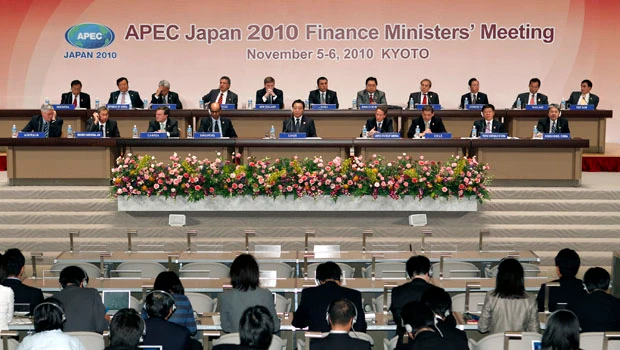
- KYOTO: Finance ministers from the Asia-Pacific region agreed Saturday to avoid using their currencies as trade weapons and embrace steps to shrink global trade gaps, joining the swelling chorus of countries calling for deeper cooperation to safeguard world growth.
The two-day gathering of finance chiefs from the 21-member Asia-Pacific Economic Cooperation, or APEC, forum wrapped up ahead of twin summits of global leaders next week in Asia that will focus on boosting a global economy yet to fully recover from the 2008 financial meltdown.
APEC members said in a statement they will move toward a system in which exchange rates are determined more by markets and the underlying strength of economies and refrain from devaluing their currencies to gain a competitive advantage.
They also promised to step up cooperation and “pursue the full range of policies conducive to reducing” excessive and unsustainable trade imbalances.
Countries which import more than they export should boost domestic savings and protect nascent economic recoveries, the statement said. Those which export more than they import, including many Asian countries, should reduce their reliance on overseas demand and adopt reforms to bolster their home markets.
The APEC agreement broadly echoed promises made by finance ministers and central bank chiefs from the Group of 20 nations two weeks ago at a meeting in South Korea and highlights growing efforts by countries to ensure the global economy builds a stronger foundation for more balanced growth after the crisis.
Leaders from the G-20 major advanced and emerging economies -- including President Barack Obama, Chinese President Hu Jintao and Japanese Prime Minister Naoto Kan -- will meet in Seoul, South Korea, next Thursday and Friday.
About half will then travel to Yokohama, Japan, for the APEC leaders’ summit starting Nov. 13.
The economy will be a top priority as countries seek ways to form a united front against threats faced by the fragile global recovery. Growth is slowing around the world, and currency tensions have led to new strains between governments.
The Obama administration says China’s currency, the yuan, is undervalued, giving Beijing an unfair trade boost by making Chinese goods cheaper in the US and elsewhere.
Beijing has accused Washington of using easy monetary policy to devalue the dollar.
Meanwhile, emerging economies like Brazil charge that both the US and China are keeping their currencies weak to the detriment of the developing world.
US Treasury Secretary Timothy Geithner had pressed his G-20 colleagues to commit to keeping current account surpluses and deficits below a certain percentage of gross domestic product over the next several years.
Ultimately, the G-20 could only agree that progress would be “assessed against indicative guidelines to be agreed,” reflecting the opposition of some export-reliant countries such as Japan.
Geithner sought to clarify his position Saturday, saying his proposal was intended to “build a framework for cooperation” that reduces risks to growth and provides an “early indication” if a country’s policies are likely to lead to problems.
He said he was not pushing a specific numerical target, contrary to widespread media reports.
“No reasonable person who understands economics could suggest that you could best achieve this objective by trying to impose quantitative limitations or targets,” Geithner said.
Participants said the discussion Saturday included the global effects of “quantitative easing,” a policy used by some central banks to increase money supply which drew renewed attention after the US Federal Reserve decided to sink $600 billion into government bonds to invigorate a sluggish economy.
Governments have expressed concern that lower US interest rates will result in more money flooding into their markets seeking higher returns, pushing up exchange rates and hurting exports by making their goods more expensive.
Chinese Vice Finance Minister Wang Jun, standing in for his absent boss Xie Xuren, offered guarded support, saying that a stronger US recovery would be a “great contribution to the world economy.”
He noted, however, that quantitative easing policies “have already attracted attention from emerging economies,” and that China would “continue to follow closely the development of such issues.”
The APEC finance ministers also released a growth strategy for the region that they will submit to the leaders’ summit. It calls for more sustainable and balanced growth and sound fiscal management. It also urges financing for infrastructure, small businesses and green technologies.
APEC is comprised of countries that border the Pacific Ocean, including advanced economies such as the US, Japan and Australia and emerging economies such as China, Vietnam and Mexico. They represent 41 percent of the world’s population and 54 percent of world GDP.
It operates on a consensus basis, with commitments that are voluntary and nonbinding.
Geithner travels next to India, where he will join President Obama for part of a four-day US trade mission being billed as a way to create American jobs.