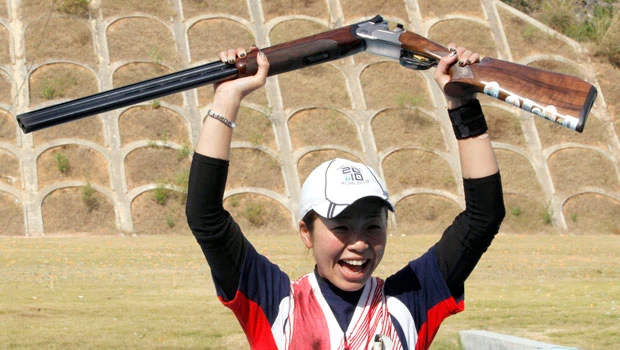
- GUANGZHOU, China: Seema Tomar didn’t grow up in India playing with dolls like her friends did.
- She played with guns.
“I love guns,” she said. “I just love the feel of shooting them.” At the Guangzhou Shotgun Center, Tomar feels right at home.
Qataris in full length black dresses with shawls covering their heads and intense expressions on their faces walk around in the halls with their weapons cracked open and slung over their shoulders. Chinese shooters sit chatting around an arsenal that, in the wrong hands, could be used to start off a considerable firefight.
Though it rarely gets much attention, shooting is one of the most venerable of Olympic sports — going all the way back to 1900. And despite the headaches — testy customs officers, the ever-rising cost of ammunition, national laws banning the use of firearms altogether — shooters at the Asian Games say no sport can compete with the thrill of wielding a heavy, locked-and-loaded gun.
Like most shooters, former world champion Khalid al Mudhaf of Kuwait said he will never forget the first time he pulled a trigger.
“I started shooting with my father when I was a little boy,” he said as the sound of shotguns rang out through the air at the trap venue, which is far away from the other Asian Games sports at a rustic range surrounded by forest-covered mountains. “We would go out and shoot birds. Kuwait is a small country, but we have some great shooters. We are very proud of that.” Al Mudhaf also has some strong feelings about people who think guns are inherently bad and should be banned — as they are in much of Asia, meaning the competitors here must often skirt regulations in order to train and, more delicately, transport their weapons from one country to another to participate in international events.
“Cars kill more people than guns,” he scoffed. “The most dangerous thing in the world is a car. Everything in life must be used for good. We here know how to use our guns. There are no accidents.” Trap shooting, in which shooters fire at clay pigeons flung into the air from alternating stations, is considered one of the most exciting forms of competitive shooting.
Unlike rifle and pistol events, where competitors stay motionless for hours on end, trap has the element of the fast-draw and requires quick reflexes and split-second reaction time.
Host China is one of the world’s top shooting countries, and the Chinese crowd seemed to appreciate the spectacle.
When each bright clay target was hit, bursting into a pink cloud of dust as the sound of the shot echoed off the hills, the several hundred spectators would clap and cheer enthusiastically.
“Some people say rifle and pistol is boring,” said Mario Dasalla, the Philippine shooting team’s leader. “Trap is more exciting.” Dasalla said that unlike many other sports, which are constantly concerned with expanding their fan base, shooting has a reliable pool of talent in the ranks of the world’s military and police forces, which is important because many nations frown on the idea of having more of their average citizens armed.
He said while gun laws in the Philippines are not as strict as in some other countries — Japan, for example, has a virtual ban on handgun ownership — he still runs into problems.
“During elections there is a total ban on guns,” he laughed. “But most of the time it’s not so bad.”