- DOHA: The surprise choice of Qatar to host the 2022 World Cup has left many Asians and Americans bemused if not piqued, but the Gulf state secured the honor after years of investment in sports.
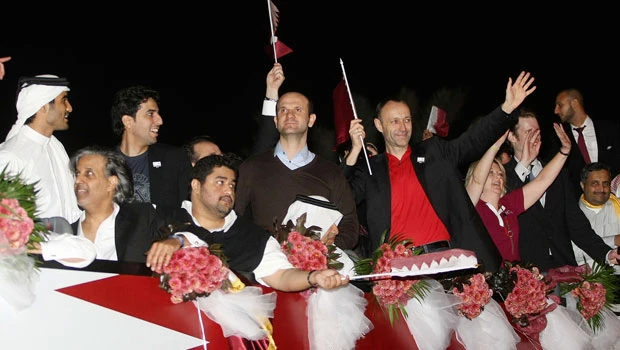
Massive celebrations erupted in Qatar after world football's governing body FIFA announced Thursday that the Gulf emirate had trumped over more fancied bids from Australia, Japan, South Korea and the United States. The festivities lasted into the wee hours on Friday.
Newspaper commentators highlighted that, while tiny, the nation of just 1.7 million people was bringing football's showpiece event to an Arab and Muslim country for the first time.
Another recurring theme is the ability of Qatar to honor its commitment to organize the 2022 World Cup in the best conditions. Emir Sheikh Hamad bin Khalifa Al-Thani, who headed Qatar's delegation in Switzerland along with his wife Sheikha Mozah bint Nasser Al-Missned, issued a personal assurance the emirate could handle the big occasion.
"Qatar is capable of great achievements even if it is a small country," he said. "I promise the sports facilities will be of optimum quality and the pride of all Arabs."
The emirate has earmarked $100 billion to develop its infrastructure, with the ambition of establishing itself as a tourist center.
In sport, the country has a wealth of experience. It organized FIFA's U-20 World Cup in 1995, as well as the 2006 Asian Games, which many have judged to have been the continent's best.
Doha has also staged an ATP men's tennis tournament since 1990, and has hosted glitzy season-ending WTA Championships for women over the past three years.
Qatar also organizes the MotoGP, the world's elite motorcycle competition, and hosted this year's football Asian Cup.
Officials have promised to begin work immediately on more than a dozen new stadiums it needs to build in as many years, before dismantling and transferring them to developing nations. The Gulf state has pledged to construct a modern transportation network, including a metro, and accommodation facilities.
It also faces the unprecedented task of providing cooling systems for stadiums as the World Cup will be staged in summer when temperatures surpass 40 degrees Celsius (104 Fahrenheit).
Many critics in rival bidding nations have raised doubts as to whether the emirate will be able to carry it all off, including US President Barack Obama, who described FIFA's decision as "wrong."
Even extremists have chipped in, speculating that Qatar will "not exist by 2022 because Al-Qaeda will have already established a caliphate," according to SITE, a US group that monitors extremist online forums.
But addressing security concerns, the president of the bid committee, Sheikh Mohammed Al-Thani, the emir's son, assured that "in terms of security, Qatar will host an immaculate World Cup."
The country though faces the hard task of convincing skeptical fans who fear the desert nation will hold a sweltering and boring tournament. Many fans wrongly believe Qatar has draconian social restrictions or the violence that plagues Afghanistan and Iraq.
Twitter was alive with such fears immediately after Qatar was awarded the 2022 tournament. Some fans suggested Qatar would keep women out of stadiums.
They might be stunned to find a largely safe, cosmopolitan capital where celebrity British chef Gordon Ramsay has set up shop, malls are filled with designer goods and the skyline rivals any in the United States. Women are free to work, drive and cheer on their favorite football team, as they did during last month's Brazil-Argentina friendly.
Still, this country of 1.6 million is no Paris or Rio or even neighboring Dubai — and Qataris seem to want to keep it that way. Most understand, though, that the country will have to open up further with the World Cup coming and find a balance between the modern and traditional.
Mohammed Al-Sayegh, 16, said he was initially against his country bidding for the World Cup, but now supports the bid as a way to boost the country's standing on the international stage.
"We want to take the World Cup but we can't take everything," he said. "We can show the world that we can preserve our culture even if we host such a big event."