- Located in southwestern Syria, in an oasis at the base of the Anti-Lebanon Mountains, is a city that has long been praised for its beauty and lushness.
- Referred to as “the Pearl of the East” and “the City of Jasmine,” this remarkable city is in fact Syria’s capital, Damascus.
A living museum since approximately 5,000 BC, Damascus is the oldest continuously inhabited city in the world. This alone assures you that the city is unique in a way no other city could be.
Tourists who visit Syria are always impressed with its rich history, culture, hospitable people and delicious food. Unfortunately, however, not many North Americans are aware of what it has to offer.
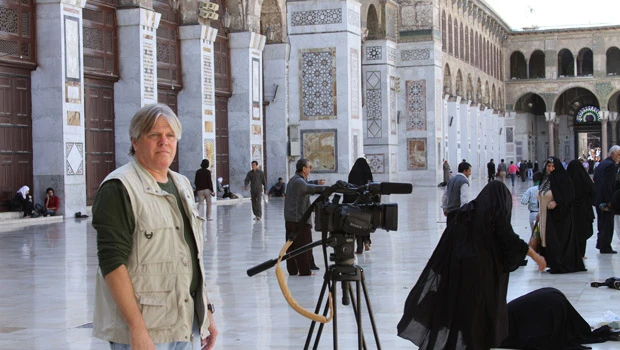
This is precisely what inspired American filmmaker, Kevin Murphy, to produce a documentary film on the city of Damascus after he visited Syria for the first time in October 2010. As a result, he spent 10 days filming Damascus and its neighborhoods.
“Syria is a very interesting country,” said Murphy who is also the founder of the production company, Eclipse Films. “I was aware that so many interesting sites were present and thought that this would not only be a great topic but a great learning experience as well. British and European people have been visiting Syria for a while and I want to encourage Americans to do the same.”
Before he arrived in Syria, all Murphy really knew was what he had read in books and online, mainly in regards to Biblical and Roman history.
“These are the topics that I think most people in North America would associate Syria with in its history. However, there is more to be found than I realized and I was glad to have a really good guide, as there is so much to see in and around Damascus,” said the film producer who is originally from Sandy Springs, Georgia, but currently resides near Phoenix, Arizona.
Murphy’s documentary film titled, “Damascus,” covers the history and daily life of the city with a run time of 55 minutes. Scheduled to be released this spring for screening in various film festivals in the US, Canada and Europe, the film will also be available for purchase on Amazon.com in early March.
“My film examines the history not only of Damascus, but also the events that led to the formation of modern day Syria. So, it should give viewers a good general overview of what Damascus and the rest of Syria is all about. It also depicts the coming and going, day-to-day activities of the citizens, especially the youth — Syria’s future,” he said.
Murphy highlights the city’s most prominent landmarks including: The Umayyad Mosque, Sayyida Ruqayya Shrine, Souk Al-Hamidiyeh and Hejaz Railway. He also devotes a portion of the film to the “new” part of Damascus where he focuses on the new shopping and residential areas, restaurants and places to stay with a brief look at the Four Seasons Hotel and the area surrounding it. Other areas he includes are the neighboring Christian villages of Maaloula and Sednaya as well as the ancient Roman city of Palmyra.
Even though “Damascus” will appeal to audiences all over the world, Murphy intends to target it at North Americans.
“I think when most Americans think of visiting the Middle East they tend to think of Egypt with the Pyramids, Luxor and museums and perhaps Jordan to visit Petra — all of which are interesting places. However, one of the goals of this film project is to show potential visitors that Syria is a great addition to their itineraries. There is something here for all kinds of travelers,” he said.
Murphy does not get into politics or controversial issues, however, as history, people and good filming are his principle topics. “I try to produce projects on topics that have not really been done very much before and in this case, to give an audience insight about a country that many people have heard of but do not know much about,” he explained.
When asked about his filming experience in Syria, he said it was a very positive one. “This was a very enjoyable film to make and one I had wanted to produce for some time. The people in Syria were very friendly and helpful during the production as they were pleased that I had come to film the city. They also pretty much went about their way paying no real attention to me while filming, which is great as it provides the viewer a normal view of life. For this reason, I have every intention of returning to film in Aleppo and Latakia this year,” he said.
This was not the first time Murphy has been to the Middle East, however. In fact, he has already produced documentaries for educators and students on Jordan and Tunisia, titled “Jordan, A Historical Review” and “Roman Africa, Tunisia.”
Furthermore, his parents lived in Riyadh, Saudi Arabia for 13 years in the 1970s and early 1980s when his father, who worked for Lockheed Aircraft, was transferred there. Consequently, he spent a part of his teenage years in Riyadh before he headed to Switzerland for high school. However, even then, he always visited during the holidays.
“Because of my experiences growing up in the Middle East and visiting the countries in the region, I decided to focus on this area, especially since very little accurate information on these countries is available in the US. I find the Arab world very interesting and I have always had good experiences when traveling and working in the region. There are so many interesting things for visitors to see and do,” he said.
Murphy always had an interest in film production; however, he didn’t really get involved with it before the late 1990s.
“I wanted to pursue film journalism in college. However, because the employment situation in the video industry was not very good at the time, I got my degree in business,” he explained.
He then received training in Clinical and Surgical Administration in the US Navy and worked at various Navy hospitals. After his time in the Navy, he returned to the private sector to work in Perfusion Technology at the heart surgery room in Saint Josephs Hospital in Atlanta, Georgia.
“I always knew in the back of my mind, however, that sometime into the future I would find my way into the film world,” he admitted.
In the mid-1990s, he decided it was time to start his own production company to produce educational and historical documentaries. Consequently, he left the healthcare field in 1994 and started Eclipse Films in 1998, and taught himself all aspects of production from filming to editing. He now works with his wife, Alicia, who is involved with the research, on-site photography and post-production.
“Since forming Eclipse Films, I have never looked back. It has been hard at times, but I have no regrets. I enjoy producing films and hope to be able to keep it going,” he said, adding that he was also involved with forensic video analysis three years ago.
Other films he has produced were on Albania: "Albania, A Civilizations Journey" and "Butrint”; Britain: “Battersea, Its Past, Its Future" and "The War and East Anglia" and Germany “Germany Today, Tomorrow?”.
“Like all of these projects, the goal is to learn as much as possible about these topics and educate viewers,” he said.
As for other future projects, Murphy said he would like to continue a series on the Middle East and Africa. He would also like to produce a separate film about Riyadh that examines the changes that have taken place from the time he visited as a youngster to day-to-day life in Riyadh today.
“I find my reward comes from documenting life in this part of the world,” he said.