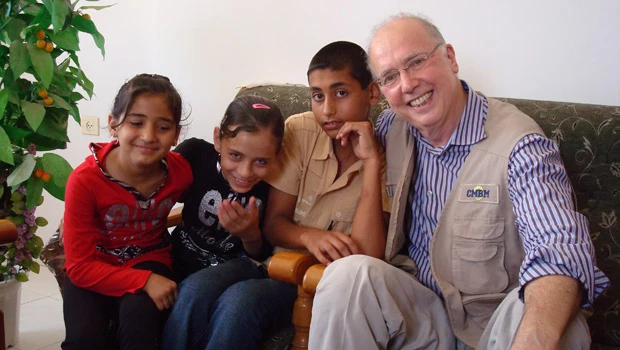
- When young people grow up in traumatic urban environments, the experience frequently leaves them with psychological scars similar to the emotional damage seen in the survivors of war and disaster.
Since 2005, Dr. James Gordon, a Georgetown University medical doctor, has taught health care providers worldwide his techniques to reduce anger, ease family tensions and ultimately give patients a sense of control in an out-of-control environment.
As head of the Center for Mind-Body Medicine (CMBM), Gordon and his team have used the program, which combines psychological self care, mind-body approaches and group support, to help traumatized populations in postwar Kosovo, post-Katrina New Orleans, as well as in Gaza and Israel. It was also used with New York City firefighters and their families after 9/11.
The program is now being implemented on an increasingly large scale with US military returning from Iraq and Afghanistan and their families. The center was also recently awarded a grant from the Department of Defense to test his techniques on soldiers returning from Iraq and Afghanistan with post-traumatic stress disorder and major depression.
“This model is welcomed by people of all ages and races around the world because it is educational, non-stigmatizing, and demonstrably beneficial. It can easily be taught and can be used by all people of all ages on their own,” explained Gordon.
Twenty years ago Gordon began researching the ways that so-called “mind-body healing techniques” such as psychotherapy, yoga, guided imagery, meditation, bio-feedback, relaxation, sound nutrition, and light exercise enable patients to effectively deal with chronic illness.
“I became interested if this same model could be used with those who have gone through the worst situations imaginable,” he said.
In the fall of 1998, at the start of the war in Kosovo, Gordon and a medical colleague went to this troubled region in the former Yugoslavia to see how the psychosocial model for healing developed by his newly created clinic, the Center for Mind-Body Medicine, might be helpful to a large population in crisis.
Six years later, Gordon’s model for healing the trauma endured by civilians living in this Balkan war-zone has been trained to over 600 health care workers in Kosovo and has become a cornerstone of a new nationwide community mental health system.
The value of the techniques applied in Kosovo by CMBM is confirmed by several studies, which conclude that the healing gained by war-traumatized children resulted in an 80 percent reduction in their symptoms of post-traumatic stress disorder (PTSD).
Further appreciation of Gordon’s efforts in Kosovo was highlighted in the April 2004 issue of Journal of Traumatic Stress, which stated: “This program may represent a significant advance in therapeutic approaches to traumatized adolescents…It may also represent a promising approach to addressing PTSD in entire populations that have been affected by wars, epidemics and other disasters.”
When news of CMBM’s success in Kosovo reached the Middle East, it drew interest from many local healthcare professionals.
“Remarkably, I received communications at the same time from a Palestinian psychologist and an Israeli psychologist,” noted Gordon. “And, they said almost the same thing; they were both completely overwhelmed by the current situation and by the disturbance and aggression of children. Both asked me if I would come and train them.”
He added that there was an equally urgent need for his services on either side of the Israeli-Palestinian divide. However, he felt that the need in Gaza was so tremendous and the situation grimmer that they needed his help there the most.
Since his first visit to Gaza in 2002, Gordon and his training staff returned 18 times, often visiting the troubled region two or three times a year.
Both Palestinians and Israelis were more baffled than suspicious when he visited the region to offer his services, he said. “At first, people thought I was coming there just to see what’s happening. But, I kept coming back. Then, I think they thought I was crazy.”
However, he said it soon became clear to health care professionals on both sides of the political divide — including members of Hamas, Islamic jihad, members of the Israeli far Left, and ultra-Orthodox Jewish settlers — that his intentions were earnest. “They began to accept me and what my colleagues and I could offer.”
Gordon and his team worked with thousands of traumatized children and adults in Gaza. Data on 500 adults and 500 children showed an 80 percent decrease in PTSD symptoms, in spite of the ongoing conflict with Israel and the armed conflict between Palestinian factions. The decrease in symptoms was maintained after a seven-month follow up with the children and a 10-month follow up with the adults. The findings also showed highly significant improvements in depression and helplessness after a series of nine weekly mind-body group sessions.
These gains, said Gordon, are without medication and have largely been maintained months after their training despite ongoing conflict and severe economic hardship.