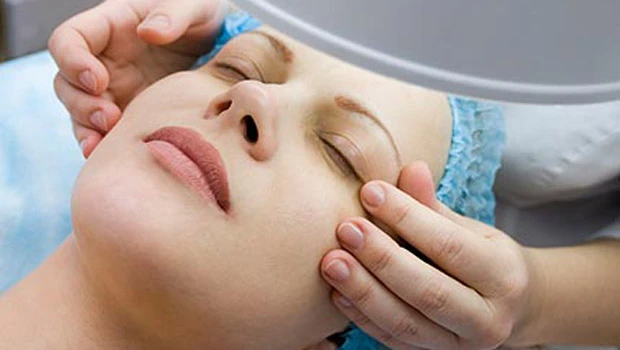
- Many women dream of having smooth skin with a natural glow, especially if they have weary skin, dark spots and pimple scars.
- The best solution to achieve healthier skin is to get a peel at the dermatologist.
Peels can be classified in two categories: Chemical and dermal. Both techniques are used to improve and smooth the texture of one’s skin and give a natural glow. Essentially, they remove the most superficial layer of the skin to reveal newly regenerated skin that is usually smoother and less wrinkled than the old skin.
Furthermore, there is microdermabrasion, which is a machine-assisted skin exfoliating treatment. It is a painless, noninvasive skin transformation procedure that uses a combination of a fine harsh tip or fine crystals to abrade the skin as well as a vacuum suction device to remove the dead skin cells. Microdermabrasion is best used to improve skin surface conditions such as mild photoaging (sun damage), fine lines, age spots and very superficial scarring. It has a low risk treatment with minimal side effects and rapid recovery time compared to other more invasive resurfacing methods.
Although the face is the most commonly treated area, peels may also be utilized to treat other skin areas including the neck, chest, back and hands.
Arab News spoke to Dr. Sami Sawan, a Derma-cosmetic consultant at Jeddah’s IMC hospital to answer some frequently asked questions on peels.
Peels can be used to improve the look and feel of skin that is dull in texture and color. It can also reduce fine lines and wrinkle under the eyes and around the mouth, improve the appearance of scars, treat some types of acne, reduce age spots and freckles as well as reduce melasma (dark facial lesions).
However, more severe wrinkles do not respond well to chemical peels or microdermabrasion. They may require other kinds of cosmetic procedures, such as laser resurfacing, soft tissue filler or botox treatments. A dermatologic surgeon can help you determine the most appropriate type of treatment for your individual needs.
Ideally, good candidates range between the ages of 16 and 65. While there is no maximum age limit, mature skin over the age of 70 may have a slightly higher risk of bruising with microdermabrasion. As a result, peeling is more advisable for this age group.
Traditionally, peels were used for fair skinned patients, because the older generation of peeling products had the risk of hyper or hypo pigmenting if used on darker skin types. However, with advances in medicine, it is now possible to use peels on even the darkest skin types. Microdermabrasion is also used on all skin types — the lighter the skin type, the deeper your doctor can proceed. However, there is always a risk of hyper pigmentation if your doctor goes too deep with the abrasion especially if you have a dark skin type.
Both chemical peels and dermal abrasion are useful for patients with the need for mild to moderate upgrading, but they are not suitable for patients who are seeking drastic results as seen in surgical procedures.
Prior to the chemical peel and depending on the type and depth of the peel you have agreed to with your doctor, he/she may ask you to stop taking certain drugs and prepare your skin with topical preconditioning medications.
Each type of peel has its different protocol, but generally, chemical peels are performed in your doctor’s office as a day care procedure. The skin is thoroughly cleansed with an agent that removes excess oil and the eyes and hair are protected.
During the procedure, most patients experience a stinging sensation. These chemicals produce a controlled wound, enabling new, regenerated skin to appear. Cold air may be used to ease the stinging sensation.
Depending upon the type of chemical peel, a reaction similar to a sunburn occurs following the procedure, such as redness and scaling for a week. Mild peels may be repeated at one to four-week intervals until patient and doctor satisfaction is achieved. Always remember, however, that after the chemical peel, it is important to use a broad-spectrum sunscreen every day.
On the other hand, typical microdermabrasion sessions need no recovery time and most people can immediately return to daily activities after a session.
The darker the skin type, the higher the risk of developing temporary or permanent pigmentation and scarring in certain areas of the face. Nonetheless, most complications can be treated if treatment starts as soon as the complications appear.
If you have a history of cold sores, your dermatological surgeon will give a prophylactic medication to prevent a herpes outbreak.
Home kits are generally weaker than in-office, professional treatments. To avoid complications, these kits and creams are designed not to reach the depths that are reached in your doctor’s office, thus resulting in less flattering and less obvious results.