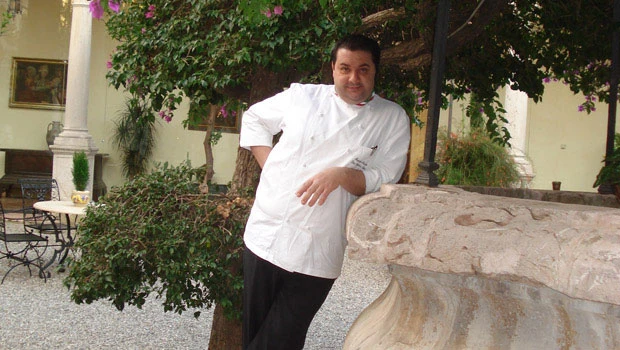
- Jeddah’s fine diners will be given the opportunity to experience Michelin-starred cuisine when Massimo Mantarro, the young culinary architect behind the menu at the Principe di Cerami, one of Sicily's premiere dining experiences, comes to Qasr Al-Sharq Hotel on March 24 till March 29 to honor the opening of the hotel's new restaurant, Aromi.
Mantarro will be showcasing the magic that earned him and his restaurant located in the Grand Hotel San Domenico Palace in the ancient seaside town of Taormina, Sicily, a Michelin one-star rating. The chef has designed a menu for the week-long event that borrows from his work back home designing one of the best eating experiences in a region known internationally as a foodie's paradise.
The event helps inaugurate Aromi, the signature restaurant originally based in the Hilton Molino Stucky in Venice but now has a home in Jeddah's Qasr Al-Sharq Hotel. It offers contemporary Italian cuisine with a Venetian twist on a Versace platter. Located in one of the supreme hotels of the Kingdom, Qasr Al-Sharq (a Waldorf-Astoria hotel), Aromi offers locals the latest in Italian high cuisine. Draped in gold pillars, with mountain chandeliers, cascading steps and Arabesque details throughout, a rich and sensuous journey envelopes this new Italian fine-dining experience.
The hotel itself is a palace fit for a king, offering luxury and opulence to all who pass through its doors. Qasr Al-Sharq's luxury demands a restaurant that is no less extravagant. Aromi, which replaced Bice earlier this year, has a culinary philosophy that reflects contemporary Venetian cuisine while respecting Italian gastronomic culture and maintaining the right balance between tradition and innovation.
Chef Mantarro's Principe di Cerami is the most prestigious of San Domenico Palace restaurants. Open from April to October, the elegant eatery is the realm of the man responsible for making Principe di Cerami the first one-star Michelin restaurant for the hotel chain.
The eatery has also been included in the new category of "potential two star" — an explicit invitation for the restaurant to continue on a road that could soon lead to an upgraded rating of the world's most important fine-dining guide.
Sicilian gastronomic tradition shines through at Principe di Cerami, and will also shine during Massimo's stay in Jeddah.
Massimo started his studies at the professional cuisine school of Giarre and later started his career working with some of the most famous Italian chefs at the Don Alfonso in Sants'Agata sui due Golfi, Restaurant Duomo in Ragusa and Mulinazzo in Palermo — all two-star Michelin restaurants. In 2009 he began a collaboration as professor with Parma's Alma Italian Kitchen School. A year later he spread the Sicilian magic around the world, including one month in Japan at Monte Bussan Company. In October 2010 he was crowned Italy's best emergent chef by the Italian gastronomic guide Gambero Rosso.
Despite the accolades, Massimo Mantarro asks no more than to be left to proceed on his journey exploring the gastronomy of his homeland, including its light and exciting modern Mediterranean flair in which the consistencies and the combination of ingredients vary while working delightfully with Sicily's traditions. Mantarro's use of aubergine, a mainstay of Sicilian cooking, is the perfect demonstration of his ability to transform the island's cuisine while remaining faithful to its essence. Mantarro's aubergine and tomato mousse is gourmet heaven while his cream of broad beans with ricotta-stuffed savoy cabbage, favignana tuna roe and peperoncino pistils is an ode to the 100 percent Sicilian dish that the taste buds would relish.
The Aromi menu will offers a spicy twist to Principe di Cerami's during the chef's stay in Jeddah. Prices have been brought down up to 25 percent to modify peopl's perception about fine dining without jeopardizing the quality and taste. Aromi imports the finest and first quality ingredients such as the truffle, the Nova Scotia lobster, Dover sole, Angus beef and Atlantic sea bass.
The prestigious Michelin guide has its roots in something very non-culinary: rubber car tires, for which Michelin is known worldwide. The restaurant guide was started in France in 1900 by André Michelin as a way to promote culinary travel throughout the country -- and subsequently sell more tires. The first Michelin guide not only recommended restaurants but also offered car maintenance tips and locations of petrol stations, hotels, garages for car repair and, of course, where to buy Michelin tires. The guides were free of charge until 1920 when the Michelin brothers looked to establish a more prestigious brand for the guide, which was showing up discarded on garage workbenches and other less-prestigious places. In 1926 the guide marked remarkable restaurants and made their mark by associating their listings with a a star. In the 1930’s, two and three stars were added. Today Michelin published a red guide that focuses mainly on hotels and restaurants while the green guide offers an in-depth historical and geographical description of places.
Michelin stars are not awarded lightly; they are given in accordance with the type of establishment chosen for the honor. The pinnacle of recognition for any chef is to be awarded one or more Michelin stars.
Michelin stars fall between one and three and are awarded to only a small number of the world’s prestigious restaurants.
A three-star Michelin ranking is exceptional. As of late 2009, there are 26 Michelin three-star restaurants in France, and a total of just 81 in the world.
Factors that derive the exclusivity of a restaurant and experience of any cuisine are mainly the quality of the raw products, overall quality of culinary techniques and flavor, the originality of the cuisine being offered, the overall theme of the restaurant and consistency between reviews.