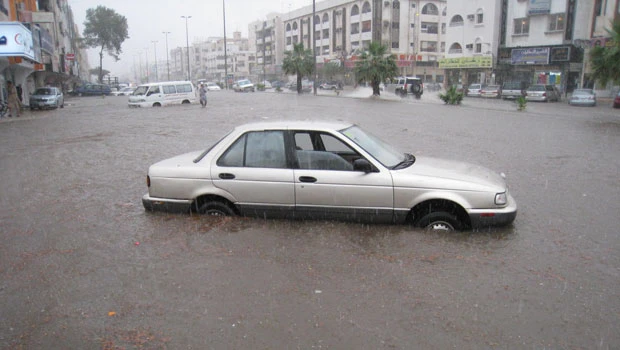
- A US engineering expert suggested on Monday that Saudi Arabia could prepare more effectively against calamities such as the flooding disasters that hit Jeddah this year and in 2009.
James F. Thompson, a chief executive for technical and management support firm AECOM, told delegates at the Jeddah Economic Forum (JEF) that it was important for the Kingdom's decision makers to test their preparedness for every worst case scenario.
"I would also encourage the community of Jeddah to have several sessions whereby you actually stage, electronically that is, these different kinds of disasters," he said.
"For example, the floods occurring again and challenging and testing your preparedness and challenge and test your response."
Thompson added that decision makers in the US were already electronically preparing for worst case disaster scenarios and sometimes had to defend whether their methods actually worked.
"The answer is yes, you can prepare for the worst, you should prepare for the worst, and you should come up with systems which routinely test and train yourselves to be prepared and to respond to these natural disasters. There are mechanisms in place that we use routinely in all of the communities we operate in to train and prepare for such scenarios," he said.
President of the Saudi Geological Survey Zohair Nawab, who had given a keynote presentation at the third JEF session of the day on how to deal and prepare for calamities, responded to Thompson's recommendation by calling on the Jeddah Chamber of Commerce and Industry to hold a complete session on such catastrophes and to involve all concerned parties responsible for disaster management.
Surprisingly, the recent floods in Jeddah were barely mentioned in Nawab's presentation, which focused mainly on climate change and how it would inevitably lead to more calamities in the future.
He said that there was a need to cut down on pollution from heavy industry, adding that the Kingdom needed to make a political decision to reduce calamities.
Controversially, Nawab suggested that people's ignorance during the heavy rain in Jeddah was partly to blame for the disaster, adding that they chose to stay outdoors so they could enjoy the spectacle, potentially at the cost of their own lives. However, when challenged, he did concede that there was a need to raise awareness among residents about how to safeguard themselves against such calamities.
He added that infrastructure to protect against calamities was being built, but warned that if another flooding disaster hit Jeddah before work was completed, it would be another unmitigated catastrophe.
When challenged on what Saudi Arabia was doing to prepare for possible earthquakes, especially in light of the recent disaster in Japan, Nawab replied: "We have no instructions to conceal the facts. We have been monitoring earthquakes from at least 80 stations and have developed scenarios for dealing with them. Jeddah has been affected by earthquakes, but they are small and no one can feel them."
He praised Japan for the response to its current crisis, adding that the authorities' handling of the disaster was something the Kingdom could learn from.
"We have to learn to coexist with earthquakes and prepare for them. We're not perfect, but hope you will bear with us."
Thompson and Nawab were joined by other experts, including Claudia Bettiol, a research fellow at Rome's University of Tor Vergata who said social cohesion needed to be reset and a connection between a city and its citizens reestablished following any sort of calamity.
Tobias Koch, an expert in the Kyoto Protocol's concept of carbon finance, and Alberto Ravagni, CEO of SOFC Power, were the other participants in the session.