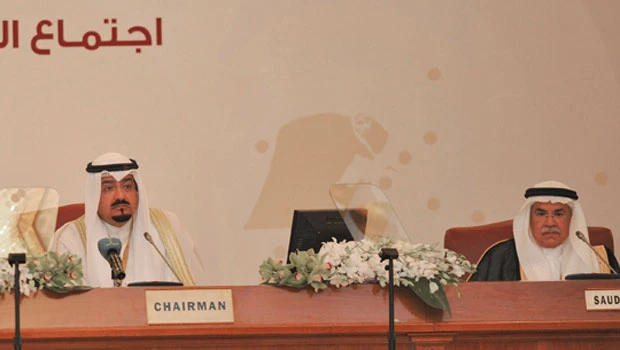
- JEDDAH: Minister of Petroleum and Mineral Resources Ali Al-Naimi said Monday the world economy was still fragile.
- "The recovery remains patchy, in many countries unemployment remains at unacceptable levels," Al-Naimi told a meeting of Middle Eastern and Asian energy officials in Kuwait.
Costly oil could place a major strain on consumer countries with convalescent economies, OPEC (Organization of Petroleum Exporting Countries) ministers said Monday, in their clearest statements yet they see reduced demand for their crude, Reuters reported.
Brent crude earlier this month rose above $127 a barrel, its highest level in more than two and a half years. However, oil prices slipped more than 2 percent Monday. Benchmark West Texas Intermediate crude fell $2.72, or 2.5 percent, to $106.94 per barrel in late morning trading on the New York Mercantile Exchange. In London, Brent crude lost $2.20 at $121.25 per barrel on the ICE Futures exchange.
"If oil prices surge further they could threaten recovery of the global economy which is already complicated and difficult due to a variety of risks. Certainly if current oil prices were witnessed a year or two ago that would have created major downside risks. Those downside risks today are still with us but have subsided somewhat," John Sfakianakis, chief economist at Banque Saudi Fransi, said.
He said besides the inflationary pressures confronting emerging market countries, there is a danger of a slowdown in the global economy if oil prices keep on rising further from current levels and stay very high.
"The ratio of oil expenses to global GDP (gross domestic product) above 4 percent (current global levels) has historically been a sign of economic hardship," Sfakianakis added.
However, Paul Gamble, head of research at Jadwa Investment, said: "The global economic recovery is progressing reasonably well and is far less reliant on government support than it once was. Nonetheless, there are certainly a number of concerns and higher oil prices would aggravate these."
For example, he said, inflation is already rising in many emerging markets, compelling central banks to raise interest rates and take other measures that will slow their economies.
He said high oil prices also hit the spending power of consumers in leading global economies and, if sustained, could potentially disrupt their recovery. Furthermore, there are worries about debt problems in the euro zone, the impact of the recent natural disaster in Japan and the US debt position. The latter was reflected in the downgrade in the outlook for its credit rating earlier Monday.
"At these high price levels, spending on oil imports could represent a significant economic burden for many import dependent countries," Reuters quoted Kuwait's Oil Minister Sheikh Ahmad Al-Abdullah Al-Sabah as saying in a speech at the meeting.
Saudi Arabia in the past has said $70-$80 a barrel is appropriate for producer nations that need to invest in new supply and yet not too high for consumer countries.
Other ministers maintained the view OPEC is not interested in prices so high as they destroy consumption. "One hundred and twenty dollars oil does not interest us in the short-term if it undermines long-term economic growth and leads to a collapse in demand and prices in future years," UAE Energy Minister Mohammed bin Dhaen Al-Hamli said in a speech on Monday.
OPEC ministers have repeatedly said, however, there is little they can do to lower prices given that the market already has ample supply.
OPEC Secretary-General Abdalla El-Badri said OPEC is expected to invest $290 billion in oil exploration and production projects until 2015. He said Iraq alone would invest $120 billion in the oil sector. El-Badri said events such as the tsunami and nuclear disaster in Japan and political events in North Africa had their impact on the global oil market.
"The rise in oil prices during the past weeks were mainly due to apprehensions about the global economy," he said, adding that the world oil market was able to cope with new events in terms of quantity and quality.
Calling on consumer nations to counter speculative activity, El-Badri said speculators had added a $15 to $20 risk premium to the price of crude.
Saudi Arabia, which has said it has spare capacity of more than 3.5 million bpd, increased its output in February to make up for the lost Libyan barrels.
Jarmo T. Kotilaine, chief economist at the National Commercial Bank, said: "It is doubtless the case that Saudi Arabia has ramped up its production sharply in recent months, largely as a result of temporary disruptions in countries such as Libya. Any expectation of normalization of supply by such producers would under the circumstances risk a price correction.
“The fact that OPEC has not revised its quotas reflects a conviction that the current demand-supply balance is close to correct. The way forward is a balancing act. No one wants prices that result in demand destruction. Yet the outlook in the energy-hungry emerging markets is increasingly one of policy tightening and slower growth. In the West, economic risks are still numerous. There is little in the current environment to give OPEC a compelling reason to significantly loosen its policy.”