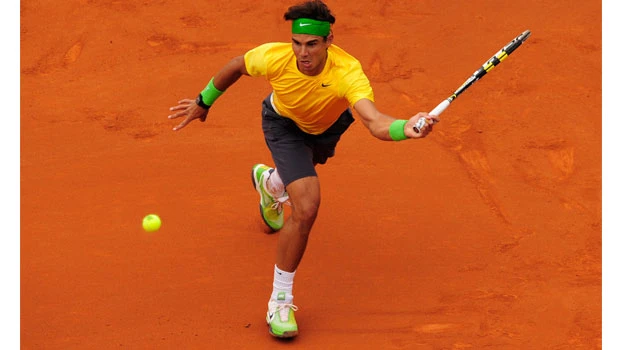
- BARCELONA, Spain: Rafael Nadal opened his bid for a sixth Barcelona Open title with a dominant 6-1, 6-1 win over Daniel Gimeno-Traver on Wednesday.
The top-ranked Nadal hammered his fellow Spaniard with hard groundstrokes, cruising to victory after breaking Gimeno-Traver’s first two service games.
Nadal, who sat out last year’s event after winning five straight titles from 2005 to 2009, will face Santiago Giraldo of Colombia in the third round of the outdoor clay court event.
Earlier, fourth-seeded David Ferrer made quick work of Carlos Berlocq to win 6-2, 6-2, and will meet Victor Hanescu, after the Romanian player beat 14th-seeded Kevin Anderson 6-4, 6-4.
Two-time finalist Ferrer saved two break points to hold his serve in the third game, while Berlocq struggled with his serve throughout the first set, committing four double faults.
“I think I began a little more nervous than usual, but that is logical since it is the first match,” Ferrer said. “Fortunately I was able to handle it and I hope to do better tomorrow.”
In the second set, Ferrer also saved the only two break points he faced while breaking twice for an easy win on the outdoor clay court.
The 2001 champion Juan Carlos Ferrero downed lucky loser Mischa Zverev, who took the place of the injured Andy Murray, 6-4, 7-5.
The former No. 1 hit three aces in his second match since returning to the court after undergoing wrist and knee surgery in October.
“I was a little worse physically due to being tired from yesterday, but I held up well and came out with the win,” said Ferrero, who will play Simone Vagnozzi in the next round after the Italian bounced the 16th-seeded Juan Monaco 6-3, 6-2.
Also on Tuesday, 11th-seeded Albert Montanes rallied to oust Benoit Paire 6-7 (3), 6-1, 6-4, while Japan’s Kei Nishikori downed lucky loser Rui Machado of Portugal 6-1, 6-4.
The singles champions at the French Open will each receive $1.7 million, up from about $1.4 million last year.
Organizers say total prize money for the clay-court Grand Slam tournament is going up to $25 million from about $20.7 million in 2010.
Women gained parity in prize money at the tournament four years ago.
The French Open will be held from May 22-June 5 at Roland Garros.
Wimbledon announced a day earlier that its singles champions will each receive $1.8 million and that total prize money will be $23.8 million.
Meantime, several of the world’s top tennis players are likely to avoid leading tournaments in Britain because of the UK government’s policy of taxing their endorsement income, according to the man who runs Wimbledon.
Wimbledon’s total prize fund and the kudos of the tournament mean there is no risk of any player staying away from the grand slam but the pre-Wimbledon Queens event and the ATP finals could suffer, Wimbledon’s CEO Ian Ritchie told Reuters in an interview.
“Of course we have no problem with players being taxed on prize money but there is no doubt that the tax on endorsement income is a big disincentive,” Ritchie said.
“There are plenty of places wanting to take the ATP finals. We want to keep that here, and we want the best players at Queens but it seems individual sports are the only events where sportsmen are taxed for endorsement income.”
Government rules state that sportsmen and women competing or even just practicing in the UK are taxed a proportion of their income from endorsements and sponsorships even if those deals have nothing to do with Britain.
The rules are the reason triple Olympic champion sprinter Usain Bolt stayed away from last year’s London Diamond League meeting while there are also fears they could affect some of the country’s smaller golf tournaments.
“Of course we understand that people might wonder why, at a time of economic difficulty when everyone is making sacrifices, we should be trying to do this for multi-millionaire sportsmen,” Ritchie said.
“But I think the overarching view is that what will happen is that these guys will choose not to come — it is definitely on the players’ radar — and so the public are deprived of a chance to see them and the UK economy also misses out on what are huge benefits.
“We all want to see big sporting events come to this country but this is a negative that could and should be addressed.
“We reckon the money gained on tax is about 7 million pounds a year but inward investment on Tour Finals alone is 100 million so it’s a matter of balance.
“We also find it somewhat incongruous that team events aren’t charged in the same way.”
Ritchie said tennis officials have been lobbying the UK government for two years on the issue but have yet to receive any reply.