- Whenever Lebanon surfaces on our travel calendars, Beirut is where we end up going, but is that all what beautiful Lebanon has to offer?
A short drive south of Beirut is all that is needed to reach Tyre. A once glorious capital of the Phoenician civilization, Tyre makes up for a great one-day excursion for archaeology buffs and day-trippers alike.
In time long before online trading and e-commerce, the trade of most of the Old World found its way through to the warehouses of Tyre, once the focal point of international business. The period between 1200 and 800 BC often marks the golden age of the Phoenician Civilization when the city-state ports in homeland Levant, like Byblos in the north and Tyre in the south, had already developed into world-class trading centers. Yet, that wasn’t enough for the ambitious Phoenicians, so they ventured into far-and-away lands, establishing trading outposts in Greece, Crete, Corsica, Tunisia and even Spain. By assuring a quasi-monopoly of the important maritime commerce, the business-oriented Phoenicians succeeded in virtually turning the vast Mediterranean Sea into a big trading hub.
As a result of extensive trading, Tyre flourished and prospered, and in no time took over Byblos’ leading role as the Phoenician capital. In addition to trading, Tyre was famous for an exclusive purple-colored dye known as the Tyrian Purple. Extracted from the meat of two shellfish species — Purpura pelagia and Purfura lapillus — Tyrian Purple was of a higher grade versus other dyes. It comes as no surprise that it fetched much higher prices. This peculiar dye was said to be exclusively reserved for royal blood and, in a few occasions, nobilities as well. Today, however, things have dramatically changed. Phoenicia’s grip on the Mediterranean trading routes is long gone, and so is the exquisite Tyrian Purple.
As I approached modern day Tyre, or rather Sour as it is locally known, I was greeted by a traffic buildup long before the city’s main entrance. Maybe Tyre had lost its former prestige in the region, but sure enough, the fourth largest Lebanese city still reserves its due status, at least on the local front.
Today, Tyre is an important and often busy port. As a traveler, I was more interested in Tyre’s renowned ruins, which had well deservedly earned the city a place in the UNESCO World Heritage List, rather than its port. There are a number of small archeological pockets scattered around Tyre. However, if you are short on time, one can give them a miss in favor of a lengthy and extended visit to Al Bass — a vast complex of archeological ruins and the city’s biggest one single attraction.
Going through Al Bass main entrance, one follows a cobbled footpath, which practically takes you throughout most of the site. For the immediate section, the footpath is lined with hundreds of freestanding stone sarcophagi on both sides. This is the famous Tyre Necropolis. Discovered in 1962, the funerary complex contains a large number of sarcophagi that range in date between the second century BC and the fourth century AD. Some of the stone sarcophagi are in pretty good condition; they are adorned with inscriptions and sculpted reliefs, which depicts scenes, extracts and icons inspired by Greek mythology as well as the Homeric epics. Those sarcophagi can be mostly found on the left-hand side (direction south) of the cobbled footpath.
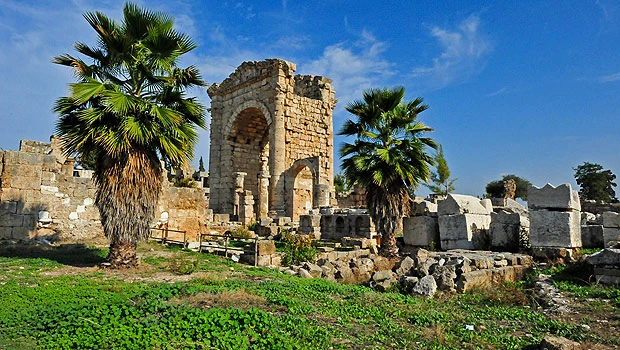
Following the cobbled footpath further leads to a triumphal arch, which dates back to the second century AD when it was used to mark the Roman entrance to Tyre. From here, the footpath drops in level and it actually turns into a colonnaded street courtesy of the erected columns lining its southern side. From the triumphal arch, if you take a turn to the left instead of going further, you will come to the ancient arena for chariot racing: the hippodrome. Hippodrome, as a word, is actually a combination of two Greek words: hippos (which means horse) and dromos (which means course). Chariot Racing is a death-defying sport that was practiced by the Greeks, the Romans as well as the Byzantines. The idea behind the game is straightforward: charioteers board their chariots and start racing against each other in a certain racecourse. The design of the racecourse, however, involves sharp turns at each end, which often result in breathtaking spills and dramatic collisions. Those very same spills and collisions are what deemed the sport exciting for the audience and deadly for the participants. The hippodrome here in Tyre is 480-meters long and often seats up to 20,000 spectators. It is believed to be one of the largest hippodromes ever built throughout the vast Roman Empire. Today, visitors can still see the seating sections around the track as well as the central area of the racecourse. The median, in the center of the track, is a narrow strip, often referred to as spina and is marked at either ends by stone turning posts, better known as metae. Once you find these posts, or rather what remains of them, you will get an idea of how hair-raising sharps those turns were. Some mosaic traces covering the spina are still visible; nonetheless, they are in a deteriorating condition.
Perhaps Tyre lacks all the flashy glamour Beirut enjoys, but instead, it holds firm to its nostalgic history of a once great Phoenician civilization.
Almost every national airline as well as low-cost carrier operating in the Middle East flies to Beirut. From the Lebanese capital, you can rent a car or hire a taxi to go to Tyre.
Tyre is a perfect one-day trip out of Beirut. Your accommodation back in the capital will do just fine.