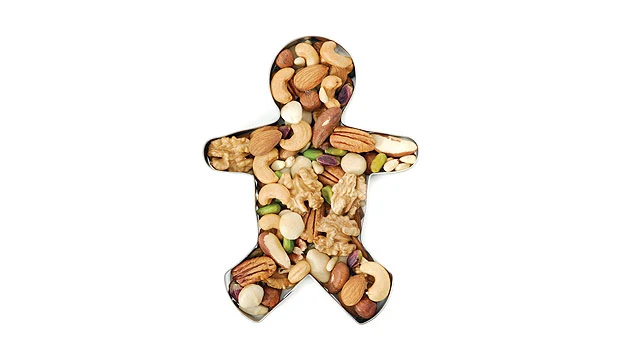
- You must be wondering why I am writing about nuts and seeds again.
- Well, because their importance surpasses all expectations from one category of food.
Nuts and seeds are usually mentioned together, because they have similar components and benefits; and their healthy fatty acids and nutrients complement and reinforce each others’ effects in the body, brain, cells, liver, eyes, joints and nervous, vascular, hormonal and immune systems.
The seeds I am discussing here are not the same ‘aromatic’ seeds I wrote about earlier this year in the series of “Herbs and Spices to Heal and Rejuvenate.” These little ones are found inside the pumpkin, watermelon, sunflower, flax and hemp. They are added to nuts, cereals, salads, rice and meat dishes, and snack bars to increase their nutritional value. While today’s seeds are associated with nuts as they yield complementary essential fatty acids; the others are connected to spices, which have powerful flavoring properties and are used in cooking or as remedy and infusion for their medicinal qualities.
Nuts and seeds are nutrient-rich plant-source fats. They are very important for physical and mental health. Though their fats come in the form of oils, they are still called essential fatty acids (EFAs). Why are they called “essential” fats? That is because the body requires them, but cannot produce them. Thus, their consumption becomes necessary, in balanced amounts, in order to supply cells, heart, brain, organs and systems and also to protect from free radical oxidation and saturated and trans fat damage.
As they differ in their chain of fatty acids, they are split into two types, monounsaturated fatty acids like in olives, macadamia and avocados (omega-9) and polyunsaturated fatty acids like in nuts and fish (omega-3 fat) and seeds (omega-6 fat).
Essential fats have special properties. One of them is that they convert into hormones, which seem to have an important role in the regulation of many body and brain functions like in the cells, neurons, organs and systems. EFAs have different roles according to organ and system. For examples in the brain, they make neurotransmitters to promote communication among neurons through electrical signaling in between synapses, increasing mental alertness; enhancing memory and protecting from depressive disorders like mood swings, anxiety and mental degeneration. They also supply the hormonal, digestive, vascular and nervous systems with the desired fats to operate adequately and prevent imbalances, cancer and autoimmune disorders.
EFAs are important factors for the cardiovascular system. They raise the “good” high density lipoprotein (HDL) to sweep out the “bad” low density lipoprotein (LDL) from the bloodstream. They also maintain the elasticity of arteries to increase blood flow and lower blood pressure. By protecting the vascular system from cholesterol buildup, clots and blockage, they prevent heart attacks and strokes.
According to a study, a small serving of nuts (67 grams) was found to lower total cholesterol by 5.1 percent, LDL by 7.4 percent, and triglycerides by 10.2 percent. The higher the lipid counts were in the patient; the more effective the nuts became. And the less overweight the person was; the better results nuts gave in lowering overall cholesterol. However, more research is needed to understand why obese individuals do not benefit from nut cholesterol lowering effects as much.
Moreover, a healthy Mediterranean diet of olive oil, fish, vegetables and fresh whole fruits is pivotal in supporting nut-cholesterol-lowering effects. While low saturated and trans fat and refined sugar and carbohydrate diets are also beneficial; LOW “essential” fat and HIGH carbohydrate diets are harmful to overall health.
Apart from their favorable effect on total cholesterol count and preventing heart disease complications, nut consumption has been shown to have other interesting features. Nuts in reasonable portions do not contribute to weight gain; they in fact help burn visceral fat around the waistline. Plus their long-term benefits seem to lower risk of diabetes type 2, most probably due to their anti-inflammatory characteristics.
Nut oils are also needed to lubricate the joints, skin, eyes and intestines. In small quantities, they enhance the metabolic rate, promoting weight loss. A good way to have them is in their raw form 15 to 30 minutes before meals to curb voracious appetites as they are very filling.
Nuts and seeds are abundant in antioxidants and nutrients, making them indispensable to general health. Their unrefined oils offer lavish amounts of the protective vitamin E, an antioxidant, which prevents fat and cell oxidation in the body. Along with their polyunsaturated fatty and amino acids, E maintains the elasticity of blood vessels, muscles and skin and acts as a natural blood thinner.
Furthermore, their vitamins, carbohydrates, minerals, amino acids, essential fatty acids and antioxidants, comparable to none, act in a synergy to energize and protect the functions of different organs, cells and systems. Aren’t they after all the seeds, which are the source of plant life, the flora, the ideal food for humans and animals?
Nuts and seeds yield large quantities of oil. Because they keep their liquid form even at room-temperature or even refrigerated, their polyunsaturated fatty acids are usually called oils, whereas saturated animal fats and butter remain hard unless heated. Their advantage is that they retain fluidity in the body as well.
Most cooking oils are nut and seed oils from peanuts, macadamia, walnuts, sunflower, safflower, sesame, hemp and flax. Margarine is made from vegetable oils that are solidified by hydrogenation. The process of hydrogenation turns healthy oils into trans-fats, very damaging to the arteries and health. Cooking at very high temperatures, refining and processing nut and seed oils alter their configurations, transforming them into harmful trans fats, too.
According to a recent Spanish study, diets abundant in trans-fats like in fast and fried foods were linked to depression, increasing the risk by 50 percent. Similar results were found in other European countries when fast foods were consumed regularly. Federal health organizations in certain American states have banned the use of trans-fats in fast food eateries and restaurants due to their carcinogenic effects.
Why do we need nut and seed unrefined oils? Well because in the body, they do not solidify and do not turn into hardened fatty plaque, blocking cerebral vessels and coronary arteries like saturated fat and hydrogenated trans-fats do. They, in fact, liquefy the blood and breakup blockages and dissolve blood clots, preventing artery cholesterol buildup. According to Chinese tradition, you are recommended to drink warm water or liquids during or after meals to prevent fats from hardening in the digestive tract.
In my next article, I shall go through the health benefits of the most common and used nuts and seeds in detail. I shall also continue exploring the interesting aspects of these little crunchy bits. I must confess, I have a weakness for raw and roasted nuts and seeds (not fried). You should also include them in your diet, but in limited quantities. Yummmmy, what a delicious and filling snack!!!