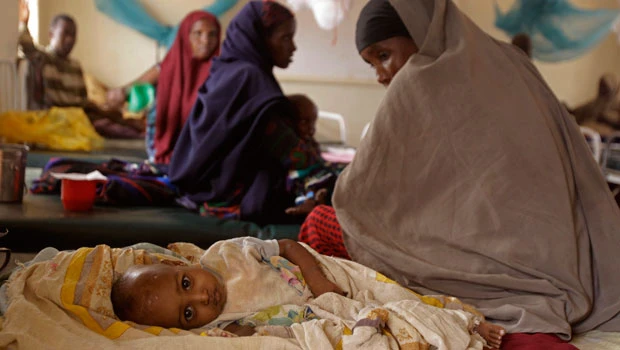
- MOGADISHU, Somalia: Al-Qaeda-linked militants in Somalia vowed to keep most international aid workers away despite a worsening famine, as the UN warned that 800,000 children could die in the region from starvation.
Frustrated aid groups said they want to deploy more food assistance inside Somalia but don’t yet have the necessary safety guarantees to do so. The anarchic country has been mired in conflict for two decades and its capital is a war zone.
Friday’s renewed threat from Al-Shabab means only a handful of agencies will be able to respond to the hunger crisis in militant-controlled areas of southern Somalia. And the largest provider of food aid — the UN World Food Program — isn’t among those being allowed inside.
World Food Program (WFP) officials said the areas of southern Somalia controlled by the Al-Qaeda-linked al Shabaab, which imposed a ban on food aid in 2010, were among the most dangerous to operate in worldwide.
“There are 2.2 million people yet to be reached. It is the most dangerous environment we are working in in the world. But people are dying. It’s not about politics, it’s about saving lives now,” Josette Sheeran, WFP’s executive director, told agency staff and reporters in northeastern Kenya.
The drought gripping the region straddling Somalia, Kenya and Ethiopia is the worst for 20 years and is affecting some 10 million people, the United Nations says. In southern Somalia, 3.7 million people risk starvation.
WFP was among several groups ordered out of rebel-held areas last year who were now preparing to return. A WFP official briefing Sheeran said the agency was considering food drops from aircraft in regions inaccessible by land.
Aid groups also face land mines in the border areas where al Shabaab clashed with Kenyan and Ethiopian forces earlier this year, said Regis Chapman, WFP Somalia’s head of program.
Sheeran visited the pastoralist village of El Adow some 100 km from the Somali border. A Reuters witness said cattle carcasses littered the arid lands surrounding the settlement.
More than a quarter of the children in the area are malnourished and a third of adults receiving food handouts, UN data showed.
The UN fears tens of thousands of people already have died in the famine, which has forced Somalis to walk for days in hopes of reaching refugee camps in Kenya and Ethiopia.
UNICEF, one of the few groups that does operate in Al-Shabab-controlled areas, said it was gearing up to deliver “unprecedented supplies” across the region.
“If we are to save lives, we need to act now, to bring in massive quantities of medicines, vaccines, nutrition supplies into the region as quickly as we are able and then get them out to the children who need it most,” said Shanelle Hall, director of UNICEF’s supply division.
Somalia is the most dangerous country in the world to work in, according to the UN’s World Food Program, which has lost 14 relief workers in the past few years. WFP pulled out of Islamist-controlled southern Somalia after the rebels demanded cash payments and other concessions.
The militant group Al-Shabab began to ban aid agencies in 2009, fearing the groups could host spies or promote an un-Islamic way of life. Earlier this month, Al-Shabab appeared to indicate it would soften its stance amid the hunger crisis.
But on Thursday, spokesman Sheik Ali Mohamud Rage said aid agencies the group had previously banned are still barred from operating in areas under its control. He called the UN’s declaration of famine in parts of Somalia this week are politically motivated and “pure propaganda.”
A spokesman for the World Food Program in Nairobi called Al-Shabab’s new stance “frustrating” but said WFP is trying to resolve the impasse.
“We are appealing to all parties for immediate access to save lives. We want to go in there. We’re ready to move. We think a huge operation is needed. We’ve got all options ready to go, land routes, air lift, whatever it takes,” said spokesman David Orr.
The United Nations estimates that more 11 million people in East Africa are affected by the drought, with 3.7 million in Somalia among the worst-hit because of the ongoing civil war in the country.
Somalia’s prolonged drought devolved into famine in part because neither the Somali government nor many aid agencies can fully operate in the areas controlled by Al-Shabab.
On Wednesday, the UN declared a famine in the Bakool and Lower Shabele regions of southern Somalia. WHO’s representative for Somalia warned Friday that the conditions for declaring a famine are expected to be reached soon in two further parts of southern Somalia — Juba and Bay.
Melissa Fleming, a spokeswoman for the UN refugee agency, said waiting until people cross into neighboring Ethiopia and Kenya would mean many Somali women and children will starve to death before they reach the camps.
The World Food Program said Friday it will begin providing food for 175,000 people in the Gedo region of southwest Somalia and to 40,000 people in the Afgoye corridor northwest of the capital, Mogadishu.
The UN food agency also plans airlifts of aid to Mogadishu, WFP spokeswoman Emilia Casella told reporters in Geneva. WFP also says it is “scaling up” efforts to reach those in what are believed to be newly accessible areas in the militant-held south.
In Britain, Prime Minister David Cameron urged European countries to commit more aid to famine-hit countries in Africa. Britain already has spent about $146 million.
“Other countries are not doing as much and frankly they need to do more,” he said after meeting with members of the Somali community in Birmingham, England on Friday.