
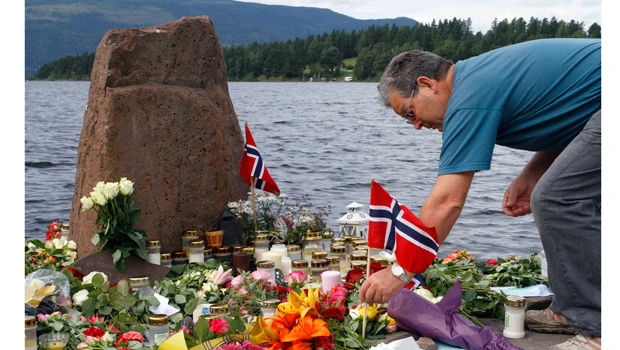
- OSLO: Norwegian police have begun releasing the names of those killed in last week’s twin attacks, a bomb blast and a massacre at a youth camp that killed at least 76.
The release of the first four names on Tuesday is likely to bring a new collective shock to an already-reeling nation. Although only names, ages and hometowns are listed, the information adds a could distress casual acquaintances who did not already know of the deaths.
The first release of names listed three who were killed in a bomb blast in Oslo’s government quarter and one killed at the island youth camp. Ages ranged from 23 to 61.
The man who confessed to the massacre that has rocked Norway is unaware of the impact of the attacks and asked his defense counsel how many people he had killed, the lawyer said Tuesday, adding that his client is likely insane. That chilling question furthers the emerging portrait of Anders Behring Breivik: The judge in his case described him as very calm, a police officer said he was merciless in his spree, and his lawyer added Tuesday that he was very cold, but saw himself as a warrior and savior of the Western world.
Breivik has confessed to last week’s bombing in the capital and a rampage at a Labor Party retreat for young people that left at least 76 people dead, but he has pleaded not guilty to the terrorism charges he faces, claiming he acted to save Europe from what he says is Muslim colonization.
Defense counsel Geir Lippestad said Breivik took drugs to “to be strong, to be efficient, to keep him awake” during the 90-minute attack at the camp. It is too early to say if Breivik will use an insanity defense, he said. Lippestad said in an exclusive interview that he did not answer Breivik’s question about the death toll.
The brutal assault has stunned peaceful, liberal Norway — but also appears to have brought its citizens together.
About 150,000 people filled the streets of Oslo on Monday, laying roses feet deep in the street as they mourned the dead and vowed that Norway’s commitment to democracy could not be shaken.
Lippestad said his client, who claims he is part of an organization with several cells in Western countries, has been insulated from the effects of his crime. “He asked me if I was shocked and if I could explain to him what happened,” Lippestad said. “He didn’t know if he had succeeded with his plan.”
But Lippestad said in an earlier news conference that his client felt the “operation” was going ahead as planned and had assumed he would be taken down by police sooner than he was. About 90 minutes into his rampage, a SWAT team reached him, and he surrendered.
The attacks began with a bombing outside the building that houses the prime minister’s office in Oslo. Then, Breivik opened fire on an island retreat for the youth wing of the Labor Party, leaving dozens dead and hundreds of terrified young people scrambling to escape, many diving into the water to try to swim away.
While Breivik says he acted alone and police believe he didn’t have any accomplices, he claimed that several cells of his terror organization exist abroad, including two in Norway, Lippestad told reporters. It was his first press conference since taking the case.
Though Breivik has been charged with acts of terrorism, Lippestad told the AP he could also be charged with crimes against humanity. Although the stiffest sentence in Norway is 21 years, the lawyer said his client would never be set free.
“His reason (for the attacks) is that he wants to start a war against democracy, against the Muslims in the world, and as he said he wants to liberate Europe and the Western world,” said Lippestad.
Asked how his client looks up himself, he said: “As a savior, some kind of savior.”
Two psychiatric experts will evaluate Breivik to determine whether he is mentally ill, said Lippestad, adding that it’s too early to say whether that will be his defense.
“This whole case has indicated that he’s insane,” he told reporters.
Earlier, Norway’s justice minister told reporters that employees from his department are still missing.
There is a particular focus on identifying the dead since authorities dramatically lowered the death toll Monday, apparently because they counted 18 bodies twice in the confusion following the massacre. They initially said 86 people died on the island, but now say the figure is 68.
“The Justice Ministry has people who are missing, we have people who are very hard hit by this and we are without offices,” minister Knut Storberget told reporters.
Storberget also offered a defense of the police in response to a question about the mounting admissions of missteps.
Police have acknowledged that they took 90 minutes to reach Utoya island. They weren’t able to deploy a helicopter because the entire crew had been sent on vacation. Victims who called emergency services from the midst of the massacre reported being told to stay off the line because authorities were dealing with the Oslo bombing.
“I feel the police have delivered well in this situation. I also feel they’ve delivered especially well on the points where there’s been criticism raised,” said Storberget.
Oslo police chief of staff Johan Fredriksen responded to the criticisms with more heat.
“We think it is unworthy that single players have brought political and resource questions into this situation that we are in right now,” he said at a news conference. “We don’t want to take part in that debate anymore.”
“We can take a lot, we’re professional, but we are also human beings,” he said.
When asked if police would open an investigation into their conduct, Storberget indicated that such a probe was for the future.

