
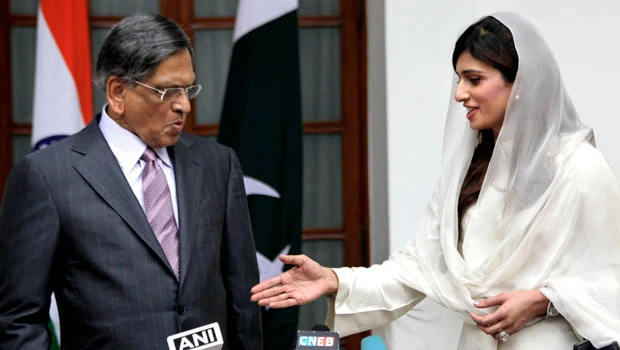
- NEW DELHI: Indian and Pakistani foreign ministers hailed a “new era” in ties between the nuclear-armed rivals on Wednesday and agreed to fight terrorism and boost trade and travel, a step forward in reducing tension in the world’s most dangerous region.
Peace talks between Indian Foreign Minister S.M. Krishna and his Pakistani counterpart, Hina Rabbani Khar, were surprisingly positive, but analysts cautioned in raising hopes until there was progress on resolving the status of disputed Kashmir and eliminating cross-border militancy.
“This is indeed a new era of bilateral cooperation between the two countries,” Khar, Pakistan’s first female and youngest-ever foreign minister, told the media after two and a half hours of talks in New Delhi, standing next to Krishna.
Peace across the heavily militarized frontier between India and Pakistan is crucial for the United States to draw-down troops and stabilize Afghanistan without sparking off a proxy war between New Delhi and Islamabad in that country.
“The fact that there is no train wreck is a positive augury,” said Uday Bhaskar, director of strategic think-tank National Maritime Foundation in New Delhi.
Pakistani foreign affairs expert Hasan Askari Rizvi said the two sides had skirted confrontation over the most controversial issues dogging ties for years, such as terrorism and Kashmir, and had been able to conclude the talks on a positive note.
“They haven’t entered the minefield. They stayed out and they made a good statement,” Rizvi said.
India and Pakistan in February resumed a formal peace process broken off after the 2008 attack on India’s financial capital of Mumbai by Pakistan-based militants, which killed 166 people.
Importantly, they agreed to work more closely to fight militancy, which has plagued both countries, and to bring to justice perpetrators of militant attacks. “We have agreed that terrorism poses a continued threat to peace and security and reiterate the firm and undiluted commitment of our two countries to fight and eliminate this scourge in all forms,” Krishna said.
“We have also agreed the need to strengthen cooperation in counter-terrorism to bring those responsible for terror crimes to justice.”
The United States has also stepped up efforts to bridge the divide between the neighbors, coming at a time when ties between Washington and Islamabad have soured over the US raid that killed Al-Qaeda leader Osama Bin Laden.
US Secretary of State Hillary Clinton visited New Delhi last week and urged them to work on ties as well as stabilizing the volatile region.
Both sides kept their cool in the aftermath of a triple bomb attack in Mumbai this month that killed 24 people and injured more than 130. Police have yet to identify the suspects but security analysts suspect the home-grown Indian Mujahideen.
Krishna said the two countries had agreed to ease travel restrictions, boost bus services frequency and double the number of days goods could be traded across a United Nations-drawn Line of Control dividing Kashmir between them.
“I can confidently say our relations are on the right track,” he said.

