- MOGADISHU: Somali refugees caught between famine and civil war appealed to international aid organizations to ramp up the distribution of emergency relief supplies that has been jeopardized by heavy fighting in the capital Mogadishu.
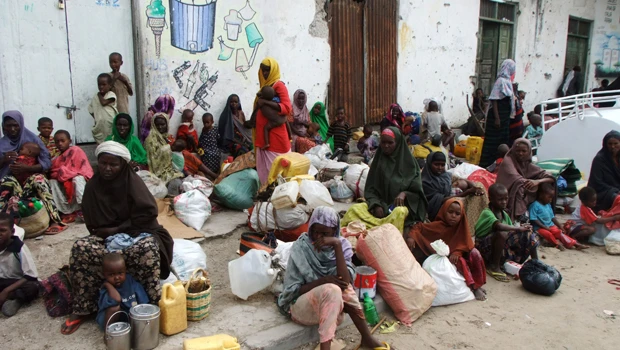
Hundreds of drought-hit Somalis are streaming into squalid camps in and around the rubble-strewn city every day, defying the orders of militants who control much of the worst-hit areas to stay put, only to walk into a war zone.
The start of Ramadan two days ago coincided with a jump in suicide attack threats made by the Al-Qaeda-linked Al-Shabab movement, which has waged an insurgency against a government it sees as a puppet of the West.
UN staff in Mogadishu said they had for the moment been restricted from moving outside the heavily guarded airport perimeter and so have had to rely on locals to deliver urgently needed food and shelter.
“Doctors came to us this morning and said two of my children are malnourished and anemic. We were given a few days worth of food but we have no shelter, not even plastic sheets,” said mother-of-seven Hawa Omar within sight of the airport.
About 400,000 Somali refugees — almost 5 percent of the country’s entire population — are camped out in Mogadishu and its outlying areas. Up to 100,000 refugees arrived in June and July alone, the United Nations says.
The UN’s refugee agency, UNHCR, said it was able to distribute relief through local networks but acknowledged its work assessing the needs of new arrivals had been slowed.
“The plan was to start the assessments in about 10 other settlements in the coming days but all the movement’s been restricted since the offensive started,” Andy Needham, spokesman for UNHCR Somalia, told Reuters in Nairobi.
Drought, conflict and a lack of food aid have left 3.6 million people at risk of starvation in southern Somalia. The drought, the worst in decades, has affected about 12 million people across the Horn of Africa.
The United Nations’ World Food Program (WFP) welcomed Washington’s move on Tuesday to relax rules imposed on charities operating in Al-Shabab-controlled regions of Somalia, aimed at boosting the amount of relief reaching those areas. After Washington placed Al-Shabab on its list of known terrorist outfits, aid groups whose operations accidentally benefited the militants risked prosecution.
“Certain organizations will be more relaxed. It should enable aid to get closer to those who need it most,” said WFP spokesman David Orr, whose organization was among several banned from southern Somalia in early 2010.
Al-Shabab has given conflicting signals about whether aid programs would be allowed to resume and there are fears food aid in particular could end up in rebel hands.
“It (the US move) doesn’t remove what would be our concerns about how aid is used and how it’s distributed. We would want to be in a position where we could monitor and assess the distribution of aid to make sure (of) where it is going,” Orr said.