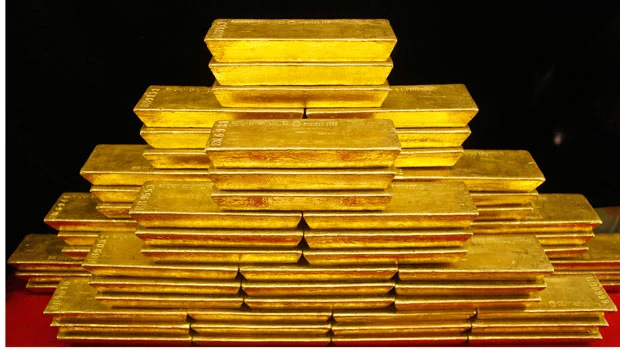
- JEDDAH: Gold soared to an all-time high of $1,715.01 an ounce on Monday as investors sold off other commodities from oil to grains, fleeing riskier assets after the downgrade of America's prized AAA credit rating stoked growth fears.
Global stocks took another pounding as worries over the downgrade of US debt outweighed relief at the European Central Bank's purchase of Italian and Spanish bonds to help the two countries avoid devastating defaults.
The Saudi stock market also fell Monday with the Tadawul All-Share Index (TASI) dropping 0.33 percent to 6,057.79 points.
Said Al-Shaikh, senior vice president and group chief economist at the National Commercial Bank, said: "Saudi investors are also worried about the consequences of the US downgrade on the Saudi economy given that the Saudi riyal is pegged to the dollar and on the prospects of the US economy and its impact on demand for oil."
"The uncertainty in the financial markets is keeping gold prices underpinned. It's essentially safe-haven buying," Reuters quoted Ong Yi Ling, investment analyst at Phillip Futures, as saying.
Jarmo T. Kotilaine, chief economist at the National Commercial Bank, said: "Gold is soaring again because the global economic uncertainties are in sharp relief with the pressures in the euro zone and the way in which its debt-ceiling debacle highlighted the political stalemate in the US. In short, we are looking at an exceptional cluster of deeply entrenched problems with no easy near-term solutions."
At the same time, Kotilaine said, as people look for safe havens, the options are limited with question marks hanging over the world's two leading currencies.
Spot gold was set for a second consecutive trading rally, up 2.5 percent from Friday at $1,704.19 an ounce by 1135 GMT, having hit a record $1,715.01 earlier and having traded at all-time highs in sterling and euros.
According to data from the Commodity Futures Trading Commission, which collects information on holdings of futures and options, and to ETF data collected by Reuters, investors bought over 18 million ounces of gold, or 30 percent of total identifiable investment demand in 2010, in the last month alone, compared with about 8.4 million in the year to early July.
"This is a reaction to the downgrade of the US long-term credit with negative outlook by S&P last week. Obviously investors are worried about the status of the dollar in the long-term," Al-Shaikh said.
In addition, the US Treasuries that used to be the safest assets are no longer treated as AAA, he said.
Treasury Secretary Timothy Geithner, however, said US Treasury debt is as safe as it was before the S&P downgrade, urging European leaders to ensure there is an "unequivocal financial backstop" for euro zone governments facing fiscal and debt problems.
In his analysis of the capital markets, Kotilaine added: "We can expect some flows into currencies such as the Japanese yen, the Swiss franc, the Canadian and Australian dollars, and some of the smaller European currencies but with the number of blemishes growing on most alternatives, gold now once again has particular appeal as the ultimate, time-honored hedge."
The global uncertainty is driving up investment demand for gold and the metal is further supported by growing central bank interest, especially in emerging economies. As the debate about redrawing the global currency system grows louder, the expectations are growing that gold will be at least part of the solution. Gold still remains vulnerable to short-term sell-offs and changes in policy. However, expectations are minimal that economic policy in the world's leading economies will regain credibility any time soon, Kotilaine added.
The prospect of an even longer period of low US interest rates prompted Goldman Sachs to raise its longer-term forecast for the gold price. Goldman said it had lifted its forecasts to $1,645, $1,730 and $1,860 on a three-, six- and 12-month horizon, respectively. Goldman had previously forecast the gold price peaking at $1,600 an ounce in mid-2012.
Meanwhile, gold in euros hit a record 1,195.66 euros an ounce, bringing gains in the last month alone to over 12 percent, while gold in sterling hit a peak of 1,043.76 pounds, for a gain of 9.3 percent in the same period.
"Before the downgrade, our view was that cash gold could average $1,800 per ounce by year end. This view will likely now prove to be too conservative," analysts Colin Fenton and Jonah Waxman said in a note to clients.
"Gold is the main beneficiary of flows of funds triggered by the US downgrade and the broader deterioration in the global economy. The downgrade means that the US, a traditional safe haven, is now viewed as less safe, while other potential beneficiaries such as Japan and Switzerland, are intervening to prevent their currencies from rising too far. This means money is being put into gold. The prospect of US interest rates staying lower for longer, and possibly a third round of quantitative easing, is adding to gold's attraction," Paul Gamble, head of research at the Riyadh-based Jadwa Investment, said.
In other precious metals, silver got a lift from the strength in gold as it can sometimes act as a cheaper safe-haven proxy for investors.
Spot silver was last up 3.7 percent on the day at $39.72 an ounce, while platinum rose 0.8 percent to $1,725.74 an ounce. The ratio of gold to platinum earlier fell to around parity for the first time since late 2008.
Palladium was last down nearly 1 percent at $734.45. The palladium price has fallen by more than 14 percent in the last 6 trading days, since hitting a five-month high.
The European Central Bank's risky decision to buy Italian and Spanish bonds helped ease stocks selling pressure in Europe, but only temporarily, The Associated Press reported.
In Europe, Britain's FTSE 100 index of leading British shares was down 2.7 percent at 5,102 while France's CAC-40 slid 3.6 percent to 3,227. Germany's DAX tumbled a further 4 percent at 5,989.
On Wall Street, the Dow Jones Industrial Average dropped 538.87 points, or 4.71 percent, to 10,905.74. The Standard & Poor's 500 Index slid 71.11 points, or 5.93 percent, to 1,128.27. The Nasdaq Composite Index slumped 152.01 points, or 6.00 percent, to 2,380.40.
Earlier in Asia, the repercussions of S&P's downgrade weighed on stock markets. Among the major markets, Japan's Nikkei 225 stock average closed down 2.2 percent 9,097.56, while Hong Kong's Hang Seng fell the same rate to 20,490.50. South Korea's Kospi ended 3.8 percent lower as did China's main exchange in Shanghai.
In the currency markets, the euro was down 1 percent at $1.4166 while the dollar was down 0.8 percent at 77.63 yen. The US dollar also hit another record low against the Swiss franc.
Fears over the global economy are having a major impact on oil markets too. Brent crude dropped $5.63 to settle at $103.74 a barrel, substantially below the 200-day moving average of $106.89 that it had managed to settle above on Friday.
US crude traded down $5.57 to settle at $81.31 a barrel, the lowest close since Nov. 23. It then dropped as low as $80.17 a barrel in post settlement activity.
US oil is down around 7 percent this year compared with a rise of 15 percent last year while Brent has gained 13 percent against an increase of 22 percent last year.