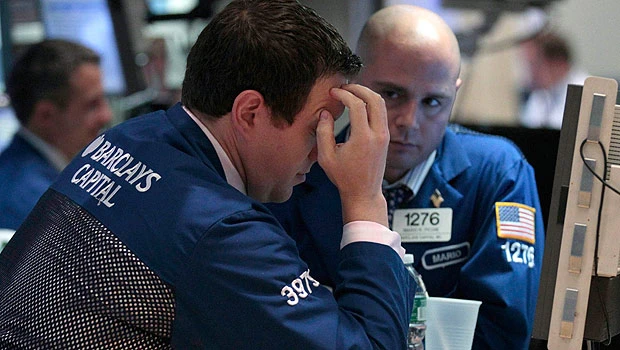
- JEDDAH: A sell-off in global stocks gathered pace on Friday, reflecting mounting concerns the US economy may be heading into another recession.
Major European share markets also closed lower, ending another turbulent week.
Nervous investors fled to the safety of core government bonds, Swiss francs and gold, which hit a record high, with many seeking to unwind holdings of riskier assets such as stocks, commodities and higher-yielding currencies before the weekend.
“Poor economic data from the US has heightened concerns that the US economy may be slipping back into recession and pulled down stock markets across the world. This has been aggravated by ongoing tensions in the euro zone, with the spreading debt problems placing particular pressure on the region’s banks,” Paul Gamble, head of research at the Riyadh-based Jadwa Investment, said.
Commenting on the Saudi bourse, the only stock market open on Saturdays, Gamble said: “It is probable that the TASI (Tadawul All-Share Index) will fall sharply on Saturday.”
Reuters reported that European shares extended steep losses from Thursday, when they suffered their biggest daily slide in 2-1/2 years, with key indexes in Britain, France and Germany deep in the red. Britain’s FTSE 100 lost 0.7 percent to 5,056, while Germany’s DAX fell 2.1 percent to 5,483. France’s CAC-40 was down 1.2 percent at 3,041.
Shortly after midday, the Dow Jones Industrial Average was down 27.40 points, or 0.25 percent, at 10,963.18. The Standard & Poor’s 500 Index was down 0.20 point, or 0.02 percent, at 1,140.45. The Nasdaq Composite Index rose 4.89 points, or 0.21 percent, at 2,385.32.
Gamble said measures of volatility have been very high in recent weeks, as investors have been paying much more attention to individual data releases, and the markets have tended to rally after big sell-offs.
“Our view is that while the odds of a recession in the US have narrowed, it is more likely that there will be a period of weak growth. Until investors have adjusted to this outlook, further major declines are likely.”
Gamble pointed out that oil prices are still at comfortable levels for the Kingdom and the government “will dip into its huge savings to finance spending, if it needs to, so public spending (the main engine of economic growth) will not be affected.”
Nonetheless, he said companies exposed to the global economy, particularly the petrochemicals sector, will be hit.
“A broader impact on confidence will also impact on the market and could damage business confidence,” he said.
Commenting on the latest market trends, Jarmo T. Kotilaine, chief economist at the National Commercial Bank, said the basic indicators in the US are negative and the European situation defies easy, obvious solutions. “There is considerable concern about the global economy,” he pointed out.
The MSCI world equity index was down 1.3 percent. It has matched the losses in European stocks since the start of the month, with $1.4 trillion being wiped off valuations Thursday and early Friday — equivalent to the size of the Spanish economy.
Earlier, Asian shares took a beating, with major indexes in China and Japan losing more than 2.5 percent.
Tokyo tumbled 2.51 percent, hit by the double-whammy of global fears and the persistently strong yen, with the headline Nikkei index at down 224.52 points to 8,719.24.
While investors fled stocks, spot gold hit a record high of $1,881 an ounce, putting it on track for the largest weekly gains since February 2009. The metal has rallied nearly 14 percent so far this month — its best month since September 1999 — benefiting from a deluge of safe-haven flows.
“There is a growing recognition that there are no obvious answers to the global crisis. The global crisis is a structural crisis with no obvious appropriate solutions. In the absence of other credible alternatives, investors are turning to ‘sound’ alternatives such as gold,” Kotilaine said.
Oil prices fell, with Brent dropping to as low as $105.06 a barrel.
It has lost more than 9 percent this month, the worst slide since a near 15 percent drop in May 2010.