
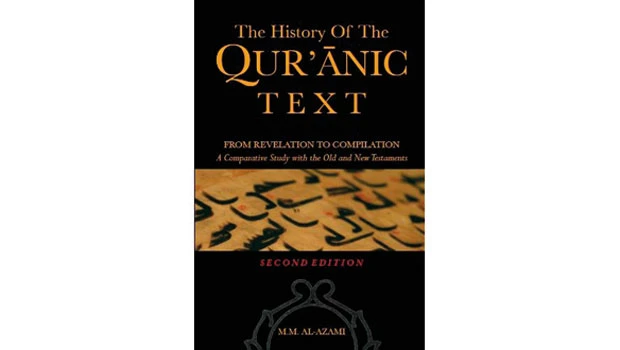
- The book answers yesterday’s thoughts and tomorrow’s wonders
Alhamdolellah there is no dearth of old and new literature available on the Holy Qur’an and its text. However, the present work by Muhammad Mustafa Al-Azami is significant in that it is also a comparative study with the Old and New Testaments. It doesn’t need to be emphasized that scholars have had serious reservations about the health of certain Biblical scriptures in its various versions, and Al-Azami has cited copiously from both Testaments to make his point. Obviously this is not intended to belittle the importance of a Divine Revelation but it illustrates how human “ingenuity” works to distort such revelations.
As such there is no wonder that among the “scholars” there are those who question the validity, accuracy and the linguistic purity of the Holy Qur’an revealed to Prophet Muhammad (peace be upon him) some 1432 years ago.
Those who raise questions display little awareness that Arabic is a far richer language not only in vocabulary but also in grammatical possibilities. Again, English is hardly comparable in this respect. Although precise and logical, Arabic grammar is free from many limitations found in that of other languages, allowing for much wider expression. For this reason — undoubtedly — it was the most suitable of human languages for the revelation of the Last Message of Allah.
The other objection regarding the compilation of the Holy Qur’an is that it took some 50 years to collect and put together the entire Revelation as a volume. Al-Azami tackles this in his preface: “To suppose that the lapse of fifty years proved ‘damaging’ to the Qur’anic text — while the Old Testament, suffering from a severely disjointed oral tradition and a vowel-less text for two millennia, deserves a more hearty benefit of the doubt — is totally unscientific.”
It must be noted to “scholars” with suspicious minds that the established practice at the dawn of Islamic literary history was that any religious text — Hadith, Tafsir — had to be transmitted by those who had learned it directly from its source, they in turn teaching it to the next generation. Full records were kept allowing future researchers to peer into the pedigree of every conveyed aspect of knowledge.
On the contrary, despite the Old and New Testaments “having been penned anonymously,” they are accepted as the word of God by Western scholars and academics. In this regard, examples have been cited of “deliberate textual corruption” from the Old Testament.
Scholars — including Professor Driver from Oxford University — dated the Dead Sea Scrolls to sixth and seventh centuries, before others dated it back to the first and second centuries.
The author — using both Western and other established research methodologies — has established that the Holy Qur’an as revealed to Prophet Muhammad (peace be upon him), is beyond doubt the Divine Revelation and that it exists today as it was revealed over 14 centuries ago.
Those who might find flaws with human research would perhaps be convinced by what the Holy Qur’an states: “Those who follow the Messenger, the unlettered Prophet, whom they find mentioned in their own [Scriptures], in the Torah and the Gospel … (7:157).”
It is obvious from the above that even the corrupted texts of the Old and New Testaments contained clear reference to the forthcoming Prophet. Such references were seen by many of the Prophet’s Companions and successors but have since been largely cleansed. This is referred to in Tafsir Ibn Kathir and Abdullah Yusuf Ali’s translations of the meanings of the Holy Qur’an.
Detailing the method, process and commendable effort by Caliph ‘Uthman bin ‘Affan (Allah be pleased with him) in one of the chapters, the author concludes that the efficacy of ‘Uthman’s endeavors is clear in at least two ways: “First, no Muslim province remained but that it absorbed this Mushaf into its bloodstream; and second, that a span of fourteen centuries has not been able to corrupt or dent the skeletal text of his Mushaf.
This is truly a manifestation of the Holy Qur’an’s miraculous nature; any other explanation fails.”
This fact alone should convince suspicious scholars. Later caliphs commissioned and dispatched further official copies but nothing was ever sent forth which contradicted ‘Uthman’s universal standard.
The author concludes his well researched, documented and produced work with a warning. He refers to “Western intervention in Islamic curriculum; forced auditing and closures and directives which call for purging the Qur’an of all references to Jihad or anything unfavorable toward Christians and Jews.”
They say pre-warned is pre-armed but what is the solution? What course of action can the followers of the Holy Book take to protect and preserve their own religion, culture and legacy?
The author suggests: “What lies ahead is a mystery kept with Allah, but the least we must do is to understand the principles of our religion and the essentials which do not vary with time. Among these must be our reverence for the Qur’an and Muslim views on the Holy Book must remain firm; it is the Word of Allah, constant, immaculate, unalterable and inimitable.”
The Qur’an preserves the immutable and eternal revelation of Allah, the Lord of the universe; it is the final source of universal guidance for mankind. As we learn from history, the Islamic civilization was inspired by the Qur’anic revelation. The future of human civilization depends — in many ways — on a proper understanding of the final revelation of Allah and also on mankind’s ability to live up to it.
The History of the Qur’anic Text is a commendable addition to existing Qur’anic literature. The language, layout and production are comparable to publications of reputed publishing houses in the West. However, most Muslim publications fail to reach the masses because of the inability of the publishers to plan and organize a worldwide marketing strategy. This area needs to be addressed by the UK Islamic Academy Leicester and others engaged in this noble business.