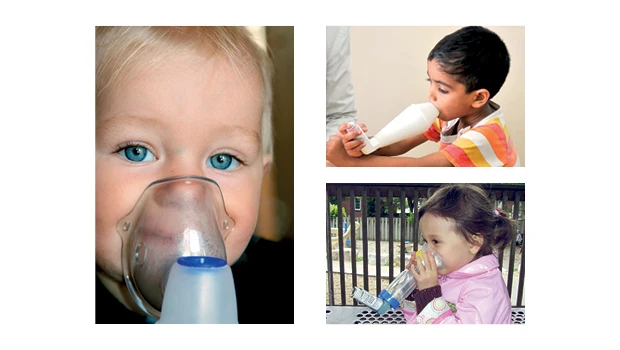
- Most children with asthma develop symptoms before the age of six, and many begin wheezing before one year.
- It is important to diagnose infant asthma because if left untreated, inflammation can cause permanent damage to the lungs, says Dr.
Asthma affects an estimated 300 million individuals worldwide. The prevalence of asthma is increasing, especially in children. Annually, the World Health Organization (WHO) has estimated that 15 million disability-adjusted life-years are lost and 250,000 asthma deaths are reported worldwide. Approximately 500,000 annual hospitalizations (34.6 percent in individuals aged 18 years or younger) are due to asthma. In the United States, asthma prevalence, which has increased from 1980 to 1996, showed a plateau at 9.1 percent of children (6.7 million) in 2007.
Helmi defines asthma as a chronic disease of the lungs that causes the airways to swell, tighten and generate a huge amount of mucus. According to her, children are more likely to develop asthma if there’s a family history of allergies and asthma. “Researchers are sure of this fact, especially if a child’s parents have asthma and certain allergies,” she said.
Helmi said that if a baby has a cold and is wheezing, the mother might wonder if the problem is asthma, although it’s not always clear. More important than getting a firm diagnosis is making sure the child gets treated for any breathing problems. “Asthma can be difficult to diagnose in children under the age of five, especially in infants, because other conditions have related symptoms,” she said.
Pregnant mothers who use hairdryers, hair dye, microwaves, vacuum cleaners or who are near any kind of smoke could be putting their babies at risk of asthma, claims Helmi. “Pregnant women should stay away from any kind of threat that can harm the child like X-rays, smoke produced by cigarettes or cooking, hairdryers, microwave fans, coffee grinders and chemical cleaning products,” she says. “Researchers have already shown that this type of magnetic energy and chemicals can increase the risk of miscarriage and some types of cancer.”
Just as in adults, infant asthma symptoms can vary from child to child. In infant asthma, babies may have all the classic adult asthma symptoms from wheezing, chest tightness, and cough to shortness of breath. Additionally, poor feeding, sweating or appearing uncomfortable may be symptoms of infant asthma, says Helmi.
She says one of the most important abilities as a parent of a child with asthma-like symptoms is to know when it is needed to call a doctor or head to the emergency department. “If a mother suspects wheezing and the child has never wheezed before, it is important to promptly see a health care provider to figure out what is causing the wheezing,” she added.
When asked if a mother can stop her baby from getting asthma, Helmi said that asthma seems to be connected between the child’s genes and the child’s environment, both before and after birth, and especially in the first year.
“I highly recommend mothers to breast-feed their babies for it may reduce the risk of asthma in early childhood. However, as yet, there is no evidence that breast-feeding protects against asthma for longer than this,” she said. “In addition, mothers should avoid potential allergens in their daily diet such as cheese, nuts, shellfish and eggs during pregnancy and breast-feeding. They should also keep their babies away from smoke, pets, dust and chemicals.”
Infant asthma is treated with many of the same medications as adult asthma. “A doctor can explain how to give the medication to the baby, and he/she might prescribe a reliever inhaler with or without medicine. For babies and young children, the doctor might prescribe an reliever inhaler that is attached to a small spacer chamber, which is attached to a face mask. The inhaler is pressed by the parent or doctor to dispense the medicine into the holding chamber, and the baby’s own breathing then draws in the medicine from the spacer via the face mask,” she explained.
If the baby has been treated with asthma medication and got better on this treatment, then the doctor may ask the mother to continue with this method. The mother will need to have the child checked regularly by the doctor, as changes in treatment are likely as the baby grows.
“If the baby continues to cough or wheeze despite a trial of asthma medicine, this may mean that the baby needs to be reassessed as another condition may be causing his/her symptoms,” said Helmi.