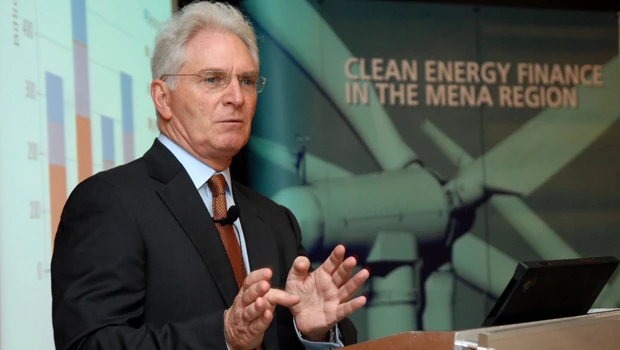
- DUBAI: The critical need to a build a clean energy finance business cluster in the MENA region was the focus of a recent discussion of experts in Dubai.
“It is an exciting time for the clean energy sector in the region,” Nasser Saidi, chief economist at Dubai International Financial Centre (DIFC) and chairman of Clean Energy Business Council (CEBC).
The Middle East and North African region needs to wean itself away from its near total dependence on fossil fuels, he said. He said Saudi Arabia had not yet established a renewable energy target although a target of 10 percent of electricity consumption by 2020 has been provisionally mentioned by officials from Saudi Aramco.
Saidi pointed out that the government established the King Abdullah City for Atomic and Renewable Energy in 2010 to oversee all clean energy development in the country.
The economist’s remarks came as the DIFC hosted its latest economics workshop for this year titled "Clean Energy Finance in the MENA Region".
DIFC is the financial and business hub connecting the region's emerging markets with the developed markets of Europe, Asia and the Americas.
The event, held in partnership with the Clean Energy Business Council and the International Project Finance Association (IPFA), and with the support of Bloomberg new Energy Finance (BNEF), brought together important players and industry professionals as well as government officials in the clean energy sector.
The speakers discussed issues of financing and de-risking for clean energy and clean tech finance, recent industry developments as well as the necessary regulatory and legal frameworks for clean energy (CE) in the region.
They also discussed the growing role of the private sector in building this new industry.
Speaking at the event, Nasser Saidi, chief economist at DIFC and chairman of CEBC, said DIFC has critical mass of industry and financial players, with supportive legal, regulatory and market infrastructure.
“Developing a clean energy finance cluster within DIFC will help provide end to end solutions including project management, financing and providing financial infrastructure,” said the economist.
“DIFC is committed to the development of this strategic sector, which is evidenced by working closely in collaboration with CEBC and its members to deliver this event," he added.
CEBC is an association of leading local and international organizations participating in MENA's emerging low carbon energy sector and clean technology.
They are unique in the region as an industry body for the clean energy sector.
With their reach across the MENA region, CEBC is a comprehensive forum intended to harness the capacities of both the private and public sectors at a local and regional level while benefiting from international knowledge, experience and best practices.
After a welcome address by Nasser Saidi, the event commenced with three presentations titled "Meeting MENA Power Demand with Clean Energy" by Sami Kamel, general manager marketing, GE Power and Mohammed Nawaf Al-Ta'ani, general manager, Arab Renewable Energy Commission; "Sizing the Market Opportunity — Masdar's Market Survey" by Frank Wouters, director of power, Masdar.
Wouters spoke about the major work being conducted by Masdar on sizing the potential market across the region.
The focus of the discussion then moved to policy and regulation with "Legal and Policy Frameworks for Clean Energy in the Region" by Karim Dahou, senior policy analyst at the Directorate for Financial Affairs, OECD and John Cunneen, executive director, Authority for Electricity Regulation-Oman.
The regulatory presentations were followed by three sessions that discussed opportunities of financing and developing the clean energy sector in the region.
While the MENA region has significant clean energy resources in solar and wind, growing populations and industry create a significant demand for power generation.
Governments in the region are under pressure to meet that demand without increasing pollution or environmental impact, while fossil fuel subsidies are a growing burden on budgets and are leading to consumption and production distortions.
The clean energy sector is in the very early stages but is fast growing.
Given its climate and location, the region is becoming a center for CE investment and trade, research and development.
It is also an emerging center for international policy with the IRENA headquarters and the UAE's Masdar.
In this rapidly developing market, the private sector, through various initiatives including CEBC and DIFC as well as IPFA, can help the governments of the region create a thriving sector.
Curbing the growth in energy demand via subsidy reform has several important energy security implications.
In net-importing countries, lower energy demand would reduce import dependence and thereby spending on imports.
For net-exporting countries, removing subsidies would boost export availability and earnings.
For all countries, it would improve competitiveness of renewable energy compared to conventional fuels and technologies, further diversifying energy mix.
Saidi then discussed the initiatives of different countries.
He pointed out that there are several renewable energy projects in the region.
The UAE has a renewable energy target of seven percent by 2020, he said.
Saidi added that the country has also established Masdar, a renewable energy agency, which is responsible for encouraging and developing projects within the country as well as overseeing investments in clean energy. He said Dubai in particular aims to generate five percent of total power supply from alternative energy sources by 2030.
As per North Africa, he said Morocco has a renewable energy target of 42 percent of total electricity capacity by 2020, while Tunisia's strategy is outlined in the Tunisian Solar Plan.
Finally, Egypt has a renewable energy target of 20 percent of electricity consumption to be developed from clean energy sources by 2020.
Renewables tend to be a more labor-intensive energy source than the still-dominant fossil fuels, which rely heavily on expensive pieces of production equipment.
A transition toward renewables thus promises job gains.
Future perspective was also discussed during the workshop.
MENA and the GCC will increasingly focus investments in Renewable Energy and technology leading to greater job creation as well. The role of DIFC in promoting clean energy comes clear through the establishment of MENASA center for New Energy Technologies & New Energy Finance.
The CEBC have then provided a wrap up of the key outcomes, which they announced will also be available on their website.
Other speakers at the event included Aaron Bielenberg, senior associate, Latham & Watkins; Alexios Pantelios, clean energy global product lead, International Finance Corporation; Karim Nassif, associate director, Infrastructure Finance Ratings, Standard & Poor's; Steve Mercieca, associate director — Project & Export Finance, Standard Chartered; Jon Nash, Partner, Vinson & Elkins; Richard Palmer, Advisor Structure Finance & Capital Markets, Mubadala; Michael Wilkins, managing director, Environmental Finance, Standard & Poor's; and Nauzer Nowroji, head of power division, Zubair Corporation.