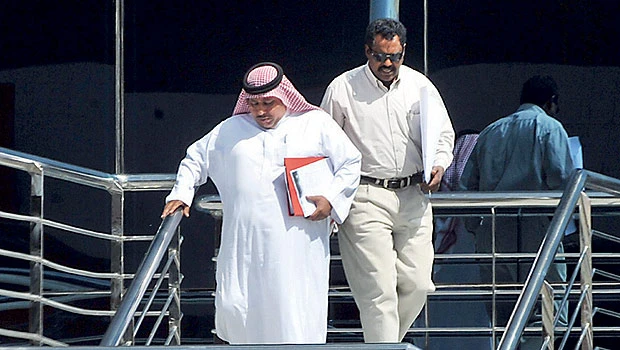
- The Saudi administrative investigation department is investigating an Asian worker who remitted some SR800 million.
The Asian worker was caught red-handed while conducting several bank wire transfers through Saudi banks. He managed to wire the money to various destinations in Dubai, Malaysia, India and Syria by depositing checks in different bank branches. Three other suspects were involved in this operation.
In the beginning, the Asian worker was suspected of working for a big commercial company with huge trade transactions and money transfers to various states. Yet, it transpired that this expatriate was an employee at a restaurant. After some preliminary investigations and interrogations, the suspect confessed that he received for each transaction SR150 from another expatriate employee working at a restaurant in Riyadh. He said he did not know the recipient states or organizations. He only transported the money and completed the transaction at a bank. He had been doing these transactions for almost three years.
The biggest transaction was the last one, in which he wired some SR97 million to a commercial company in Dubai. He insisted that he had nothing to do with it except receiving his share for conducting the operation from the same expatriate worker.
On the other hand, the Saudi Attorney General accused the Asian worker of money laundering, a crime that can lead to a 20-year prison sentence and deportation from the country for good.
The successful money transfer of SR800 million through Saudi financial institutions has pushed experts to call for more monitoring of expatriates’ money transfers. Undoubtedly, concerns have been raised over how easily a normal restaurant employee was able to transfer this amount of money, especially with regard to the possible existence of mafias and gangs of money laundering. These gangs are still working in the country and exploit Asian expatriates to perform such huge transactions.
This operation has triggered a call for new regulations. Experts now argue that all employees (whether Saudi or not) in private sectors must have bank accounts. This would allow for an easier process for the ongoing monitoring of money transfers, particularly those that exceed monthly salaries and allowances. Keeping an eye on this kind of transactions is a measure to protect the national economy from irregular money transfer and intercepting money laundering. It should be pointed out that the bodies and gangs that conduct money laundering exploit expatriates to do the dirty jobs. They pick expatriates that do not understand the value, danger, and punishment of conducting such operations. Expatriates illegally residing in the country or those who hold fake work permits cannot transfer money through official financial institutions. For this reason, they transfer this money through individual bank accounts of other expatriates after giving them some worthwhile commission. Yet, an expatriate who agrees to play this role does not know that those who asked him to transfer the money are indeed breaking the law. Therefore, he is only being exploited to carry out money laundering as documented by security forces who kept an eye on the affair. Officers managed to dismantle these operations and it transpired that there are gangs that exploit expatriate workers to do the dirty jobs. Some of these gangs were caught. In fact, some of the exploited expatriate workers who were used by the gangs for money laundering cooperated with the police and helped capture these gangs.
Reports reveal that some Asian expatriates are working in the Al-Batha region, where they work on an irregular basis, especially with regard to quickly transferring huge amounts of money. Many of them were caught doing this kind of transaction. For each SR1,000 they transfer, they receive SR50.
These operations have a negative impact on the Saudi national economy, because they are taking place outside the banking system. They contribute to increasing the amount of money transferred annually, which hits the mark of SR100 billion a year. This figure is the official declared one, but irregular transactions are worth some SR10 billion. It is the latter that hurt the Saudi economy. Saudi officials are being urged to enhance protection procedures and measures and to take punitive action against those caught laundering money.
This case raises the following question: What are the expected monitoring measures against money laundering that are done in huge part by Asian gangs? These measures include activating the regulations of fighting money laundering, fighting funding of suspected activities, immunizing the banking system, raising the efficiency of workers in the banking system, countering all acts of commercial gloss over on expatriates and irregular deals, as they are the main source of money laundering. Another measure is to embrace all expatriates in the Ministry of Labor’s Nitaqat program in terms of behavior and performance and in terms of reducing the average of irregular and criminal deals to the lowest point possible.
Additionally, there is a need to limit the hiring of foreign expatriates to only technically trained ones. They must be subject to legal and financial obligations when they sign a contract for work. Also, transferring sponsorship should not be allowed. Therefore, any expatriate who seeks to transfer sponsorship should be deported. It is of great importance to think of mechanisms that compare the expatriate’s financial suitability to the size of the money transfer. Banks should ask for a permit from the expatriate’s work to transfer a certain amount of money.
Experts draw attention to the fact that the banking system is the first line of defense to counter money laundering. Therefore, there should be a focus on the banking system in order to raise its efficiency in such a way that can contribute to the security of the country and the national economy.
Fahd bin Jum’a, an economic consultant, said the foreign transfer of money would reach a mark of SR105 billion in 2012. He added that the irregular transfer of money that falls under the category of hidden economy money, which is not transferred through banks but through illegitimate ways such as commodities, is about SR228 billion a year.
Jum’a stated that the Ministry of Labor’s acquaintance of depositing all salaries of expatriates in banks is a long overdue step. Such a step aims to protect the rights of all parties. This can be organized in a way to know what is being transferred through legitimate channels. This should be equally applicable to Saudis, so as to avoid making them a bank for expatriates’ transfers.
Jum’a also demanded that all commercial stores be committed to sell through tellers. Each commercial store should open a bank account to deposit all sales directly. This kind of measures would of course provoke monitoring bodies to take many measures that would eventually limit the number of money laundering deals. Many bodies would withdraw from the black market.
Yet, the task of fighting those who gloss over money laundering will remain the key mission that should be dealt with. This can close off the widest window for such operations. It turned out that the small stores have bank accounts and what is being deposited in these account is way higher than the volume of their commercial work. For this reason, this step should not be belittled.