- The Saudi photographer talks us through some of his favorite shots
DUBAI: Saudi photographer Naif Yousef Al-Shamary bought his first camera in 2007, when he was 16. But his love affair with the lens began long before that, thanks to his late father, who, he says, “had a rare artistic sense” — he painted, practiced Arabic calligraphy, wrote poetry, and owned a camera he used to document his journeys. “He was my first teacher and my greatest inspiration,” says Al-Shamary.

Al-Shamary grew up in Hail — “somewhere all the terrain comes together — the dunes of the Great Nafud, the Aja and Salma mountains and their valleys.” he says. “I was lucky.”
In 2014, he attended his first workshop, in AlUla, run by the Saudi photographer Farhan Saud Alshammari. The group visited Wadi Sharaan, Al-Gharameel and Hegra. “That is where my love for AlUla started,” he says.
He is currently the astrophotography ambassador for Manara AlUla, an initiative of the Royal Commission for AlUla.
“I photograph nature in my own way, and I care a great deal about the stories of the place,” he says. “I like emotion and identity to show inside the frame. I like to photograph the desert as it is, and as we feel it, and I like to show how rare spring and rain are in it. I do not refuse to photograph people, but I find my visual language in the earth, the light and the sky.
“Our land is not only desert,” he continues. “It has mountains, valleys, oases, beaches and unique geological formations, as well as the history left by the successive civilizations that lived on it.”
Hegra
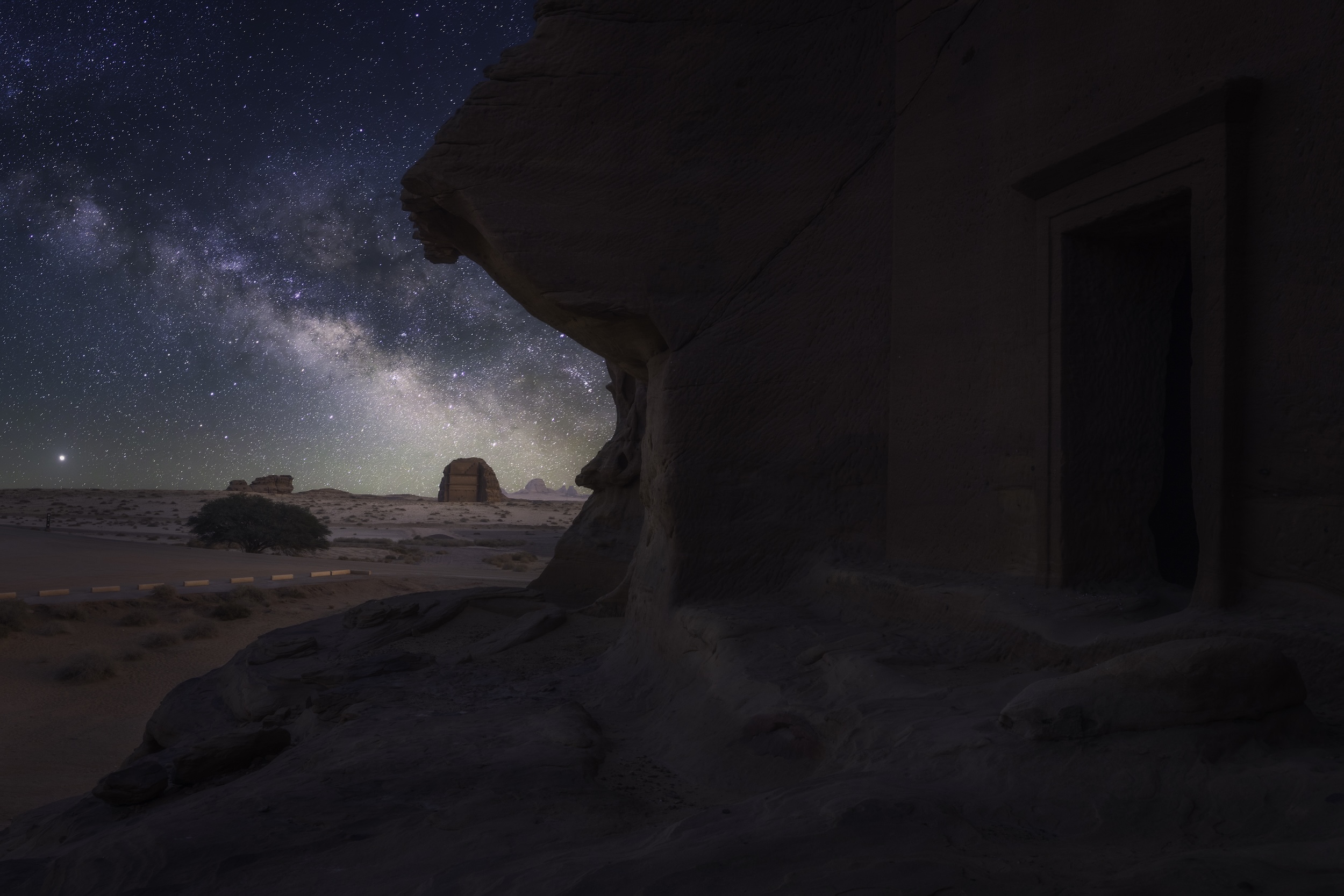
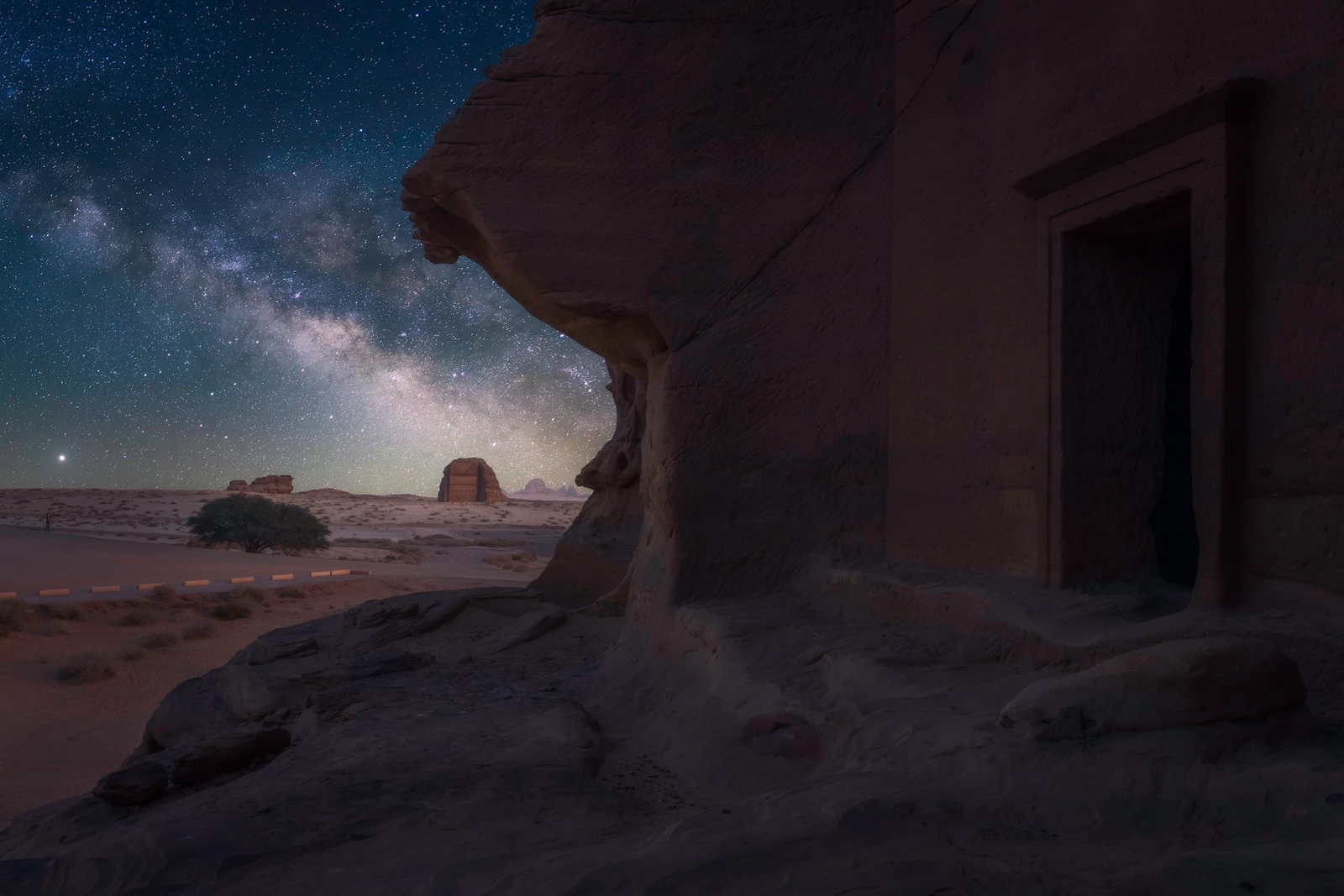
I took this in July, during a stargazing photography experience I led as a trainer in partnership with Manara AlUla. It’s shot from the edge of Jabal Al-Ahmar, which holds a number of Nabataean tombs — the door of one appears in the near side of the frame. This is the mountain where the remains of Hinat — a noble Nabataean woman who lived and died in the first century AD — were recently found. On the far horizon stands Qasr Al-Farid, the tomb of Lihyan, son of Kuza, with the Milky Way rising above the southern horizon. I wanted two of Hegra’s landmarks in a single frame, to show how close and how connected these sites are despite carrying different histories. Some have been discovered, but many remain a secret under the sand.
Al-Gharameel Nature Reserve

I took this during the same stargazing experience with Manara AlUla. Al-Gharameel is one of the darkest areas in the world according to the classification of DarkSky International. The Milky Way appears above these standing rocks, which are known locally as “gharameel” and are spread across a wide area. I took the picture in the “blue hour,” at the moment of sunset, and then waited four hours for the Milky Way to appear. That is normal for this kind of work. The Milky Way season runs right through the summer until October and November, when the rains start again, and the angle of the sun moves through the year as well, so we plan the shot and the direction of the light according to the season.
Sharaan Nature Reserve

Qa’ Al-Suna’i is a clay field that collects rainwater every year, and when it dries these deep cracks appear. The soil has a sheen to it, against the sandstone and Nafud sand that surround the place. Water shapes a lot of my calendar: December and January are the season for winter rain and flash floods, and February and March are when the wild flowers come. I wanted the picture to begin with these cracks, which extend for several kilometers, then move to a plateau of sandstone, and then to the Milky Way on the southern horizon. I care a great deal about the balance of forces inside a picture.
Bajdah, NEOM

I took this in January on a very cold morning — the temperature had reached zero celsius. Until a month earlier this field had been a lake of rainwater that started collecting in November. Then it dried. I was with my friend, the American landscape photographer Marc Adamus, who found the place through aerial maps. I tried to shoot from a low angle to show the depth of the cracks in the ground and the shape of the rock arch at the end, using a very wide lens. This is what I mean when I say I like to photograph the desert as it is.
Nayilat, Hail

Hail is my city. I was born there, lived there and grew up there. This is one of the pictures I love, because it brings together the dunes of the Nafud with the Aja mountains. I took it after a long wait — waiting is a big part of photography — and a lot of planning, because these lines need time to form without a person or an animal stepping on them. I kept going back over a long period until I found it clean of tracks. The repetition of the layers, the lines of the sand and the differences in the terrain are the main idea of the work.
Georgia

This was taken in July 2025. It’s a challenge, as a Saudi photographer used to shooting in the desert, to go and deal with completely different conditions. This work was made in the far north of Georgia, near the Russian border, where rivers pour out everywhere, flowers are scattered in every shape and color, and towering peaks rise in every direction. I chose this scene, and came back with it in my memory and in my camera.
Wadi Disah, Tabuk

Every year for more than five years myself and my fellow trainers Farhan Saud Alshammari and Faisal Al-Jerifani have run a landscape photography course in Wadi Disah in Tabuk. I took this picture in January 2024, in the morning, with a 70-200mm telephoto lens. The idea was a symbolic framing of this tree, centering it between the two rock towers that appear on either side. The concept was to distribute the visual weight equally between the three elements, in a wide panoramic frame. That’s how I work generally. I care about the visual weight between elements and the balance of forces inside the picture, through the structures of composition, the relationships between colors, and the direction of the elements and their arrangement within the frame.