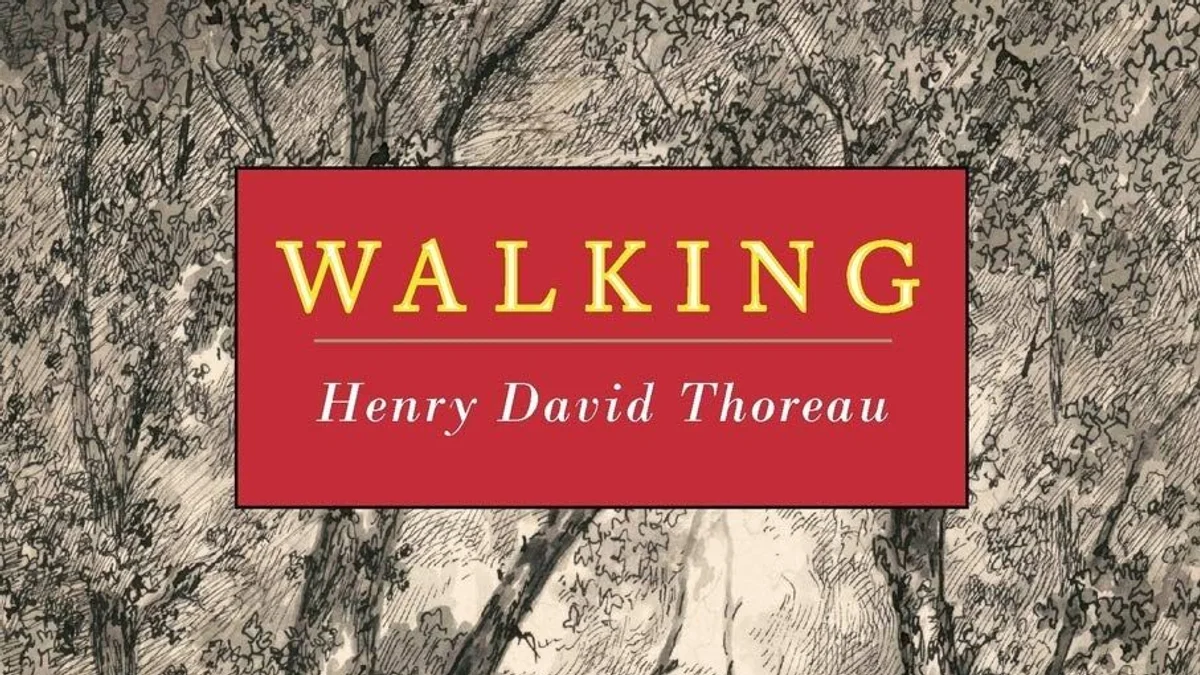
RIYADH: Henry David Thoreau’s essay “Walking” (first delivered as a lecture in 1851 and later published, in 1862) is often treated as a piece of American nature writing. But reading it in that way alone understates its ambition.
It is better understood as a philosophical argument that “walking” is a discipline of freedom — an act that tests whether a person belongs primarily to society or to the living world. It is a provocation; a demand that we measure modern life against something older than schedules and property.
Thoreau’s central claim is that modern life trains people to accept confinement as normal: the confinement of work schedules, property lines, routines, and even habits of thought.
Against that, he praises “absolute Freedom and Wildness,” insisting that the most important journeys are not for the purposes of transportation or exercise, but for a kind of moral and mental recovery.
The essay can sound religious at the beginning, and one reason for this is that Thoreau borrows imagery to describe the serious nature of the act of walking. The concept of a “Holy Land” that he pursues, however, is not doctrinal; it is wildness itself, a place and a condition of mind that civilization steadily narrows.
The religious vocabulary functions as metaphor and provocation: it dramatizes what Thoreau thinks is lost when walking becomes a recreational errand rather than an encounter with the unowned.
His method is notably associative. He moves from etymology (“saunterer”), to social critique (the sedentary courage of shop and office life), to political geography (roads as conduits of business), to a national imagination of the West.
The essay’s most durable insight is compressed into one sentence: “in Wildness is the preservation of the World.”
Thoreau treats forests and swamps as more than mere scenery; they are reservoirs of strength that keep human perception from becoming thin, secondhand and bureaucratic. Civilization, in his view, does not merely build, it also deforms.
The essay can, at times, overreach, especially when it blends spiritual certainty with national destiny, and when its generalizations about other peoples reflect the limits of its period.
Yet I found the essay difficult to dismiss, because its best lines don’t merely describe nature but accuse the reader of forgetting how to live.
Essentially, culture that cannot make room for the wild will eventually lose not only landscapes, but the inner capacity for independence, attention and joy.