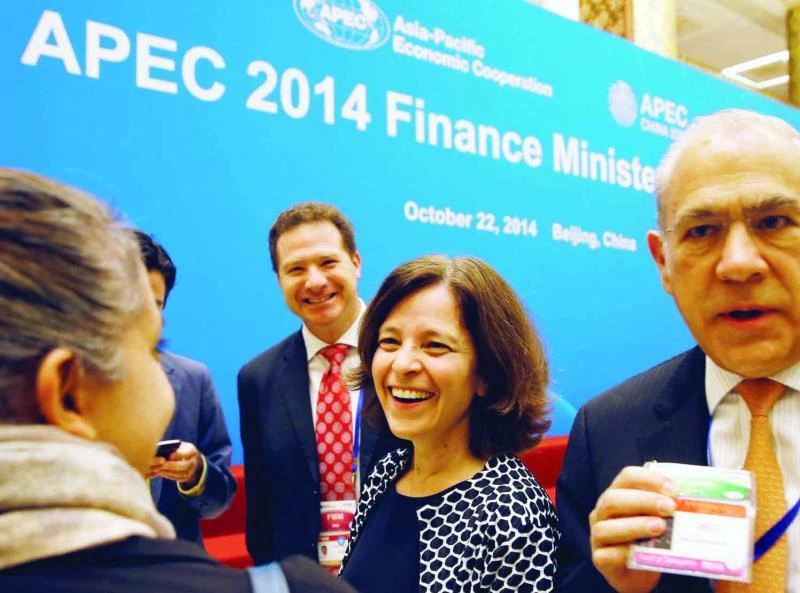
BEIJING: The global economy is beset by increasing “downside risks,” Asia-Pacific finance chiefs said on Wednesday, a day after growth in China hit a five-year low.
The meeting in Beijing of finance ministers from the Asia-Pacific Economic Cooperation (APEC) forum preceded the group’s annual summit next month, when Chinese President Xi Jinping will host leaders from the US, Russia and Japan amongst others.
“As the global economy still faces persistent weakness in demand, growth is uneven and remains below the pace necessary to generate needed jobs, and downside risks have risen,” the ministers said in a joint statement.
“The APEC region, as the engine of the world economy, should lead the global recovery toward strong, sustainable and balanced growth.”
The statement came after China, the world’s second-largest economy, said earlier that gross domestic product expanded 7.3 percent in the third quarter, its slowest pace since the depths of the 2008-2009 global financial crisis.
APEC, established in 1989, groups 21 economies spanning Asia, Oceania and North and South America. It includes the US, China, Japan and Russia, emerging economies such as Mexico and Indonesia and small nations such as Brunei and Papua New Guinea.
Chinese Vice Premier Zhang Gaoli opened the meeting by highlighting challenges the region faced, but stressed the importance of APEC’s economies which he said account for 40 percent of the world’s population, 70 percent of the global economy and 46 percent of world trade.
The gathering was attended by Chinese finance minister Lou Jiwei, Japan’s Taro Aso and others, though US Treasury Secretary Jacob Lew skipped the event, instead sending Deputy Secretary Sarah Bloom Raskin.
World Bank managing director Sri Mulyani Indrawati warned the meeting of global risks including weakening commodity prices, the Ebola outbreak in West Africa and political instability characterised by the rise of the Islamic State group and ongoing conflict in Ukraine.
“2014 could turn out to be a disappointing year for the global economy,” she said.
China’s Lou played down his country’s slowing growth, telling a post-meeting press conference that “singlehandedly” focusing on GDP expansion is insufficient.
“We should pay great attention to the quality of growth. Indeed, the quality is improving,” he said.
Alan Bollard, APEC executive director and former head of New Zealand’s central bank, said both near- and medium-range challenges were on APEC’s agenda.
“The general theme on the short-term monitoring side is very much how normalization of monetary policy in the US goes and what positive or negative spillovers there could be,” he told AFP on the meeting’s sidelines, referring to the US Federal Reserve winding down a vast bond-buying program put in place to help fight the global financial crisis.
Longer-term structural issues were also important, he added.
“We’ve relied on trade-driven growth in the past for APEC and it’s not going to be like that for the future,” he said.
APEC sees ‘downside risks’ to global recovery