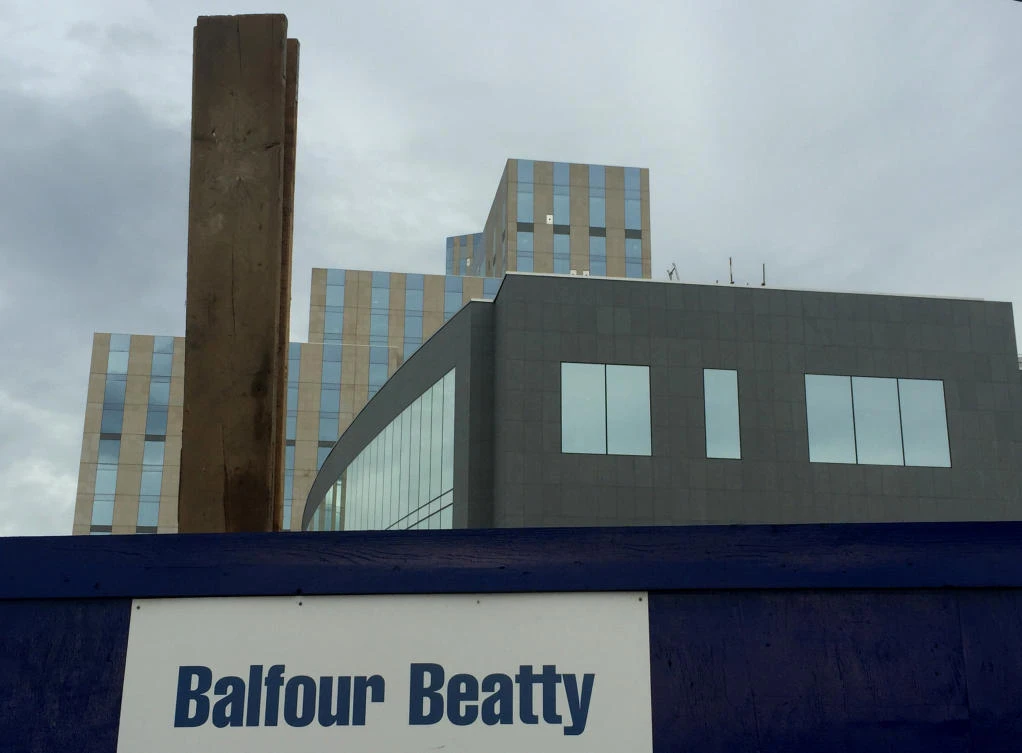
BENGALURU: Britain’s Balfour Beatty reported a tripling of annual profit on Wednesday and said the construction was returning to health after the high-profile collapse of Carillion this year.
The demise of Carillion came after construction companies took on major contracts at thin margins, leaving them nursing losses in the event of delays or problems.
“Companies are starting to recover from what effectively was very low pricing in 2013 and 2014,” Balfour Beatty Chief Executive Leo Quinn told Reuters.
“I wouldn’t brand the industry like Carillion,” he added.
Underlying pretax profit for the infrastructure and building company rose to £165 million in 2017, from £62 million a year earlier.
“The business increased bid margin thresholds ... coupled with a lower risk profile, so that the group wins work at appropriate terms and conditions,” the company said in a statement.
Its UK construction business reported an operating profit of £16 million last year, recovering from a £65 million loss in 2016.
Balfour Beatty has overhauled operations, in a turnaround dubbed “Build to Last,” after losses at its British construction division led to multiple profit warnings.
As well as selecting contracts more carefully, Balfour Beatty has also narrowed its focus to Britain and Ireland, the United States and the Far East.
It has pulled out of the Middle East, another problem region for Carillion, Indonesia and Australia.
Its order book fell 8 percent to £11.4 billion in 2017 and it said it saw a strong commitment from the British government toward the new high-speed railway (HS2) project and Highways England road programs.
The company said it was on track to achieve “industry-standard margins” in the second half of 2018 and added it will continue to sell assets in its infrastructure investments business.
One of Carillion’s joint venture partners on the Aberdeen Western Peripheral Route (AWPR) road project in northern Scotland, it took a one-off charge of £44 million in 2017 due to Carillion’s liquidation.
The demise of Carillion came after construction companies took on major contracts at thin margins, leaving them nursing losses in the event of delays or problems.
“Companies are starting to recover from what effectively was very low pricing in 2013 and 2014,” Balfour Beatty Chief Executive Leo Quinn told Reuters.
“I wouldn’t brand the industry like Carillion,” he added.
Underlying pretax profit for the infrastructure and building company rose to £165 million in 2017, from £62 million a year earlier.
“The business increased bid margin thresholds ... coupled with a lower risk profile, so that the group wins work at appropriate terms and conditions,” the company said in a statement.
Its UK construction business reported an operating profit of £16 million last year, recovering from a £65 million loss in 2016.
Balfour Beatty has overhauled operations, in a turnaround dubbed “Build to Last,” after losses at its British construction division led to multiple profit warnings.
As well as selecting contracts more carefully, Balfour Beatty has also narrowed its focus to Britain and Ireland, the United States and the Far East.
It has pulled out of the Middle East, another problem region for Carillion, Indonesia and Australia.
Its order book fell 8 percent to £11.4 billion in 2017 and it said it saw a strong commitment from the British government toward the new high-speed railway (HS2) project and Highways England road programs.
The company said it was on track to achieve “industry-standard margins” in the second half of 2018 and added it will continue to sell assets in its infrastructure investments business.
One of Carillion’s joint venture partners on the Aberdeen Western Peripheral Route (AWPR) road project in northern Scotland, it took a one-off charge of £44 million in 2017 due to Carillion’s liquidation.