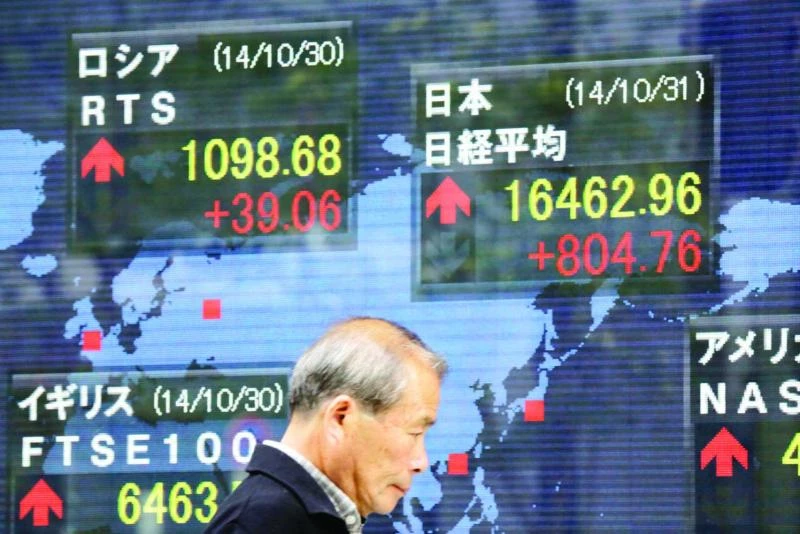
TOKYO: Japan’s central bank surprised the financial world and pleased investors Friday by intensifying its purchases of government bonds and other assets to try to revive a chronically anemic economy.
The Bank of Japan’s move to pump trillions more yen into the financial system is intended to stimulate spending in the world’s third-largest economy.
It’s an acknowledgement that Prime Minister Shinzo Abe’s government has so far failed in its broad efforts to revive growth, especially after a sales tax hike took effect in April. The latest data show consumer spending falling, unemployment rising and excessively low inflation dipping further.
By injecting more money into the economy, the government hopes to raise expectations of higher inflation and thereby encourage people to spend and fuel growth.
Coinciding with the central bank’s move, Japan’s $1.1 trillion public pension fund acted Friday to move money out of low-yielding bonds and into higher-yielding but riskier stocks to try to improve its investment returns and meet its obligations to a swelling number of retirees.
Abe said the move was needed to ensure that the fund can meet its future obligations. Japan is rapidly aging, and its population is shrinking as birth rates decline.
Across the world, investors responded by pouring money into stocks in anticipation that the Bank of Japan’s action would mean lower bond yields, higher stock prices and a cheaper yen, which would make Japan’s goods more affordable overseas.
After the government’s announcements, Japan’s Nikkei 225 stock index soared 4.8 percent to close at a seven-year high, and the dollar rose 2 percent against the yen. European stock markets also jumped, along with the Dow Jones industrial average.
The central bank said it will increase its purchases of government bonds and other assets by between 10 trillion yen and 20 trillion yen ($91 billion to $181 billion) to about 80 trillion yen ($725 billion) annually.
The move is striking in its timing: It comes two days after the US Federal Reserve did the reverse by ending its own asset-purchase program, which had pumped $3 trillion-plus into the US economy over the past six years. The Fed is pulling back because, in contrast to Japan’s, the US economy is showing consistent improvement.
The Bank of Japan’s move raises pressure on the European Central Bank to follow suit. The ECB has been considering aggressive steps to invigorate the ailing eurozone economy, which is suffering from weak growth and too-low inflation.
Ultra-low inflation can hurt an economy because it typically leads people to postpone purchases in expectation that prices will go even lower. It also makes the inflation-adjusted cost of loans more expensive. And it raises the risk of deflation — a drop in prices, wages and the value of stocks, homes or other assets that can further slow spending and tip an economy into recession.
Japan has been stuck in a deflationary trap for most of two decades — a big reason its economy has barely grown.
It’s far from clear that Japan’s latest move will succeed where Abe’s government has so far failed in a multi-pronged effort to boost growth and inflation.
BOJ Gov. Haruhiko Kuroda said the action was need to prevent a reversal into a “deflationary mindset” that has stymied growth by discouraging spending.
Countering such a trend is “the most important thing we can do,” Kuroda said. “Whatever we can do, we will.”
Bank of Japan redoubles efforts to revive economy