BRUSSELS: A British plan to guarantee the price of power from its first new nuclear project in decades won European Union backing in a landmark ruling that now faces legal challenges.
Seen as market-distorting state aid by opponents, the price guarantee was approved in a 16-to-5 vote with one abstention in a tense meeting of the College of Commissioners, sources said. Not all 28 members were present.
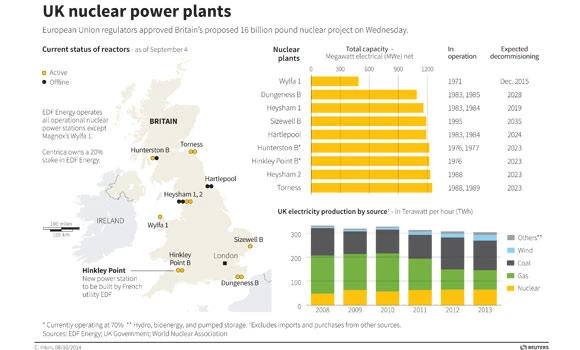
The ruling clears the way for the 16-billion-pound ($26 billion) Hinkley Point C nuclear power station in southwest England to be operated by French utility EDF.
Britain pressed hard for approval, arguing that replacing its ageing nuclear reactors was vital to meeting its environmental goals.
The British government helped to secure the deal by agreeing to a lower subsidy and a smaller share of windfall profits for EDF, the European Commission said.
The case serves as a precedent for countries such as the Czech Republic, Lithuania and Poland that have sought guidance on the level of state aid allowed.
The commission, the EU executive, has never before approved state aid for a new nuclear plant. “We have concluded that a market failure exists. Without support, this investment would not take place,” Competition Commissioner Joaquin Almunia told reporters.
Austria, which has ruled out the use of nuclear power in its own energy mix, plans to submit a legal challenge against the Commission’s decision.
A group of academics, energy associations and corporations, led by UK-based academic Paul Dorfman, also intends to challenge the decision at the European Court of Justice.
Claude Turmes, Luxembourg Green Member of the European Parliament, deemed the decision “the most outrageous EU Commission decision of the last 15 years. It is economic nonsense.”
EDF will receive a guaranteed power price of 92.50 pounds($148.64) per megawatt-hour for 35 years, more than twice the current market rate, once the plant begins operations in 2023.
The Commission said British authorities had agreed to cut the subsidy by more than 1 billion pounds and that Britain’s share of any windfall profits over the plant’s lifetime would amount to billions of pounds.
The British government said further discussions with EDF were needed over full terms of the guaranteed power price contract and project financing.
“This decision shows the European Commission agrees that this is a good deal for consumers and enables us now to proceed to the next stage,” said British Energy Secretary Edward Davey, adding new nuclear plants would help reduce household bills.
British nuclear plant wins EU funding fight