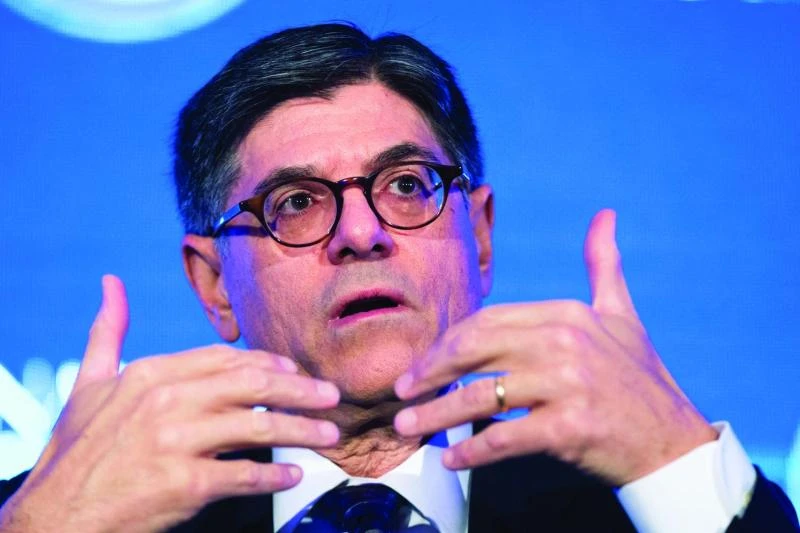
LIMA: China needs to show the world it is going to follow through on reforming its economy to a more market and consumption-based model, US Treasury Secretary Jack Lew said.
“China has undertaken a reform program... that would address many of the important challenges that China is facing. The question now is, do they have the will to stick with that and to demonstrate through their action that they’re sticking with that,” Lew told journalists on the sidelines of the IMF and World Bank meetings in Lima, Peru.
The world’s second-largest economy has begun transitioning from an export-based economic model toward a lower-growth, more consumption-driven model.
China has also announced reforms in how it manages the yuan, allowing its currency to float more freely after years of US criticisms that it is artificially undervalued to dope exports.
Lew also welcomed a new plan due to be adopted at the Lima meeting that aims to crack down on multinational corporations’ use of tax havens to avoid paying taxes in the countries where they actually do business.
“We can’t get into a beggar-thy-neighbor kind of economic policy making,” he said.
He also urged his own country to avoid jeopardizing its budding economic recovery with gridlock in Congress, which must raise the US borrowing limit again by November 5 or risk a credit default.
Congress, which is controlled by President Barack Obama’s Republican opponents, must also craft a budget agreement before December 11 or face a government shutdown.
“We have stable growth right now and we’d certainly love stronger growth... but the question is will we muster the political will to avoid self-inflicting wounds that come from political stalemates,” Lew said.
His remarks came as the International Monetary Fund chief Christine Lagarde said the global lender may push ahead with interim steps to give emerging markets a bigger say, despite a stalemate in the US Congress over approval of broader governance reforms.
Reforms agreed in 2010 would put Brazil, China, India and Russia among the fund’s top 10 shareholders, but they still need approval from the US Congress, frustrating emerging markets that pushed hard for more voting power, and prompting warnings from Europe about the dangers of US isolation.
IMF policymakers have said they will come up with ideas on how to push ahead with reform by mid-December. Lagarde said time was slipping by.
“If it lasts for a little longer, we will have to look at an alternative solution,” she told a news conference, adding that this would not be a substitute for full-fledged reform.
One option is an ad hoc increase to the quota for key emerging economies, without requiring any change in the US position, although the Group of 24 developing economies kept up pressure for a more radical alternative. Taking halfway steps would reduce pressure on Congress to ratify the changes.
The Bank of Mexico’s governor, Agustin Carstens, who chairs the IMF’s advisory panel, told Reuters: “The best possible result would be for the US to deal with it .. that’s the first-best option and we are hoping for it to materialize.”
Even an ad hoc increase would need backing from Washington. Asked if the US would support interim measures, Treasury Secretary Jack Lew said there were no second-best options.
“I think there is both an understanding of the necessity, and a growing comfort with an approach, and a sense of necessity, to deal with it,” he said. “Normally when things are hard to do, it is when they are seen as necessary that they get done.”
Jeroen Dijsselbloem, who chairs monthly meetings of the euro zone finance ministers, said the US had to take responsibility again for international financial institutions.
“I would say it is in the US interest to do that,” he said. “They should not be isolated, especially not as China is becoming more and more active in our institutions, which is welcome.”
China must show ‘will to reform economy’: US