RIO DE JANEIRO: Chinese oil giants CNOOC and CNPC will be in pole position in next week’s first auction of deep-water concessions in Brazil’s coveted Libra oilfield, experts say.
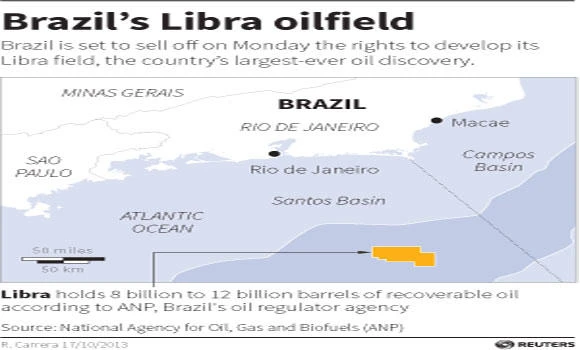
Making Monday’s auction highly anticipated is Libra’s estimated eight to 12 billion barrels of recoverable crude, which translates into nearly a million barrels a day production for five years, according to Brazil’s National Petroleum Agency.
“Markets expect Asian companies will be the stars of these auctions as the US ‘majors’ are not at the table and will merely sit back,” said Carlos Assis, who heads Ernst&Young’s Americas oil and gas advisory unit.
With state-owned Brazilian giant Petrobras leading the pack, 11 companies have anted up more than two million reais ($900,000) each to take part in the auction in which the Brazilian state is assured of at least a 41.6 percent production stake.
Seven bidders rank among the world’s 11 biggest oil companies by market capitalization: second-ranked China National Petroleum Corporation, number three Anglo-Dutch Shell, Colombia’s Ecopetrol (6), Petrobras (7), France’s Total (8), China National Offshore Oil Corporation (10) and Spain’s Repsol/China’s Sinopec (11).
The sale of deepwater concessions to foreign companies is not without opposition here.
Petrobras workers have launched an indefinite strike to demand the “immediate suspension” of the auction, the National Oil Workers Federation (FUP) said.
The federation, which groups 12 Petrobras oilworkers’ unions, also called for nationwide demonstrations to “denounce the threat to (national) sovereignty and the losses the Brazilian nation will suffer if multinationals grab Libra.”
Petrobras will automatically be sole operator of any wells and will have a minimum 30 percent stake in any consortium under the terms of a 2010 law brought in under the rule of then president Luiz Inacio Lula da Silva.
The law aimed to earmark some of the oil royalties for education and health.
The National Petroleum Agency, or ANP, will oversee the sale of the remaining 70 percent, for which Petrobras can also bid alone or as part of a consortium.
The winner will be the company or consortium that offers the most oil to the Brazilian state.
An Ernst&Young study concluded that “market expectations are that the Chinese companies will propose at least 50 percent of the oil produced” go to the Brazilian government, Assis said.
The Libra field is in the Atlantic off Rio de Janeiro where Brazil discovered huge “pre-salt” deep water oil reserves in 2007.
Buried under layers of salt, these deposits cover 149,000 square kilometers and lie 183 kilometers off the coast.
Currently, Brazil produces two million barrels a day but hopes to boost output to five million a day by 2020, thanks in large part to the pre-salt reserves.
“With the exception of Shell and Total, the ‘majors’ are not taking part owing to a number of risk factors,” said Assis.
These include “a geological risk, the difficulty of extraction (and) the percentage of oil to hand over to the state,” he said.
Private investors are also turned off by ” the creation of a new state company, PPSA — which enjoys right of veto -— to oversee pre-salt,” he added.
But Assis said the auction might lead to an easing of the rules.
“Those looking for a quick return such as the US companies are staying away; the (energy hungry) Asians are above all looking for access to reserves” to feed rising demand and ensure energy security further down the road, he said.
Alexandre Szklo, an energy expert at Rio Federal University (COPPE/UFRJ), said: “Libra is a very promising field and as the geological risk is low there is larger than usual state intervention.”
Chinese firms to star in oil auction