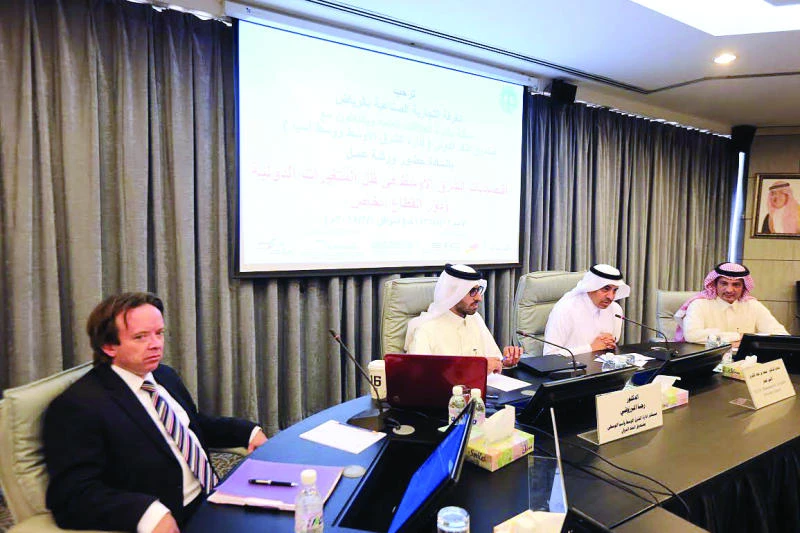
Economic growth in the six-nation Gulf Cooperation Council (GCC) will not be affected by the falling oil prices as these countries have abundance of financial reserves, which will allow them to keep on moving with the level of spending, said an expert from International Monetary Fund (IMF) here at a workshop.
The Riyadh Chamber of Commerce and Industry (RCCI) organized the workshop in cooperation with the IMF.
Speaking on the Middle East economy in light of the global changes and the role of the private sector, Raja Al-Marzouqi, IMF adviser for the Middle East and Central Asia Department, said: "Losses of the GCC countries are estimated at $300 billion in the wake of the oil price drop, however, economic growth in the GCC countries will not be affected by the price fall due to the abundance of financial reserves, which will make the GCC countries keep the level of spending."
However, he observed that the oil price fall makes it imperative for the oil exporting countries reconsider their economic policies in the coming period through cuts in government spending and improvements in investment environment, so as to create new financial sources in a way to make them keep up the targeted economic growth rates.
Al-Marzouqi added that the IMF is expecting the price per barrel of oil will be reaching $72 by 2019. He attributed the price fall to the unpredictable sluggish economic growth in Europe and Asia.
Referring to the role of the private sector, the IMF expert on the region said governments alone cannot achieve a sustainable growth in the absence of the private sector.
"The interaction between the government, private and non-profitable sectors in these countries will considerably contribute to the achievement of the required economic growth," he underlined.
He stated that the governments in the region have to make concerted efforts for employment generation as the unemployment rate among young generations in the Middle East, which stands at 25 percent, is the highest when compared to other countries of the world.
Timothy Cline, another expert from the IMF, said the oil price fall has cut revenues in the Saudi economy.
He added that the government should diversify its sources of income to provide more job opportunities to its citizens. "The Kingdom should also work to make the private sector more attractive to its citizens by giving more care to training and educational development to cope with labor market needs in addition to partnerships between the public and private sectors in this regard," he pointed.
Earlier, RCCI Secretary General Mohammed Al-Kathairi in his welcome address said the workshop was meant to serve the business sector through the provision of proper and correct information, which will allow businessmen run their investments safely and smoothly.
The workshop discussed several related topics focusing on expectations and developments in the region following the reduction of oil prices.
Economic issues in the region were also discussed along with topics such as methods of economic analysis and policies of observation in the fund to encourage open discussions about the role of IMF in enhancing safe policies toward sustainable economic development.
GCC growth 'to remain unaffected by oil price fall'