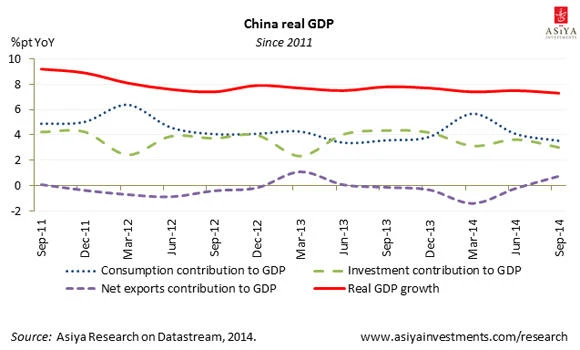
The Chinese economy resumed its deceleration in the third quarter, slowing from 7.5 percent to 7.3 percent.
Both investment and consumption suffered.
Retail sales continued to ease in the third quarter, from 12.3 percent to 11.9 percent YoY.
Industrial output growth fell, from 8.9 percent to 8.0 percent YoY, despite resilience in export-linked manufacturing output.
Fixed asset investments also weakened, from 17.2 percent YoY to as little as 13.4 percent YoY in the last three months, in infrastructure, manufacturing and property.
Property prices are also falling: each of China’s ten largest cities posted month-on-month declines. China’s domestic economy is getting in worse shape.
Increasing net exports were the only upside for China in the third quarter, posting the first surplus in over a year. Real GDP growth is gradually approaching 7 percent, coming down from more than 12 percent YoY in 2010.
Growth has been trending down since 2010 despite the government spending swiftly in large infrastructure projects.
However, as it became obvious that new investments were becoming less profitable and beneficial to the economy, authorities started to reconsider their approach, supporting the economy in a more measured and cautious manner.
This year, the government introduced a mini-fiscal stimulus program that included spending on railway in less developed areas and housing investments for low-income groups.
Liquidity has also been injected into the country’s largest banks.
Additionally, and unlike in previous periods, the government has been undertaking structural reforms even at the cost of hampering growth.
Reforms and more cautious stimulus are lowering the likelihood of a systemic failure, but more action is required by the government. As time passes, the more urgent it becomes.
Short-term solutions such as undertaking more infrastructure projects will merely delay what only serious reforms can solve.
China’s previous model was focused on investments and exports, its next model on domestic consumption and services.
The recovery in exports and the slowdown in domestic consumption means that the economy is turning to its old model for temporary relief.
This is an easy solution to today’s problems, but the economy is diverting from its optimal growth path.
Reforms should continue, and markets are optimistic that they will as the stock market continues to perform robustly.
The health of the global economy, including that of the GCC, depends on China’s capacity to handle this situation as today’s low prices would collapse if the country was unable to navigate its deceleration.
— Prepared by Camille Accad, economist at Asiya Investments
GCC trade expansion linked to Chinese reforms success