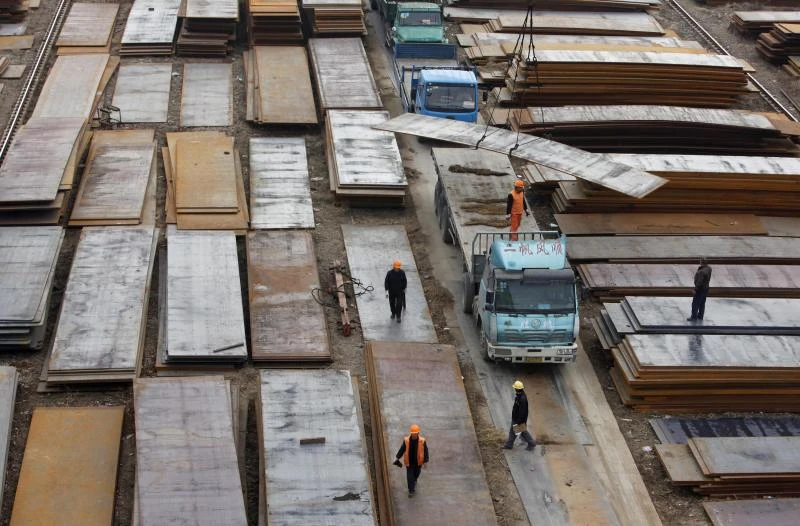
LONDON: Global steel production last year set a new volume record of 1,548 million tons, according to figures from the World Steel Association (WSA).
But the rate of growth braked sharply to just 1.2 percent from 6.8 percent in 2011, mirroring slowing growth in China, the engine room of the global steel market.
China’s leviathan steel sector is now once again cranking up through the gears in anticipation of resurgent demand resulting from more government infrastructure spending.
That renewed sense of optimism has already had repercussions all the way through the steel supply chain — witness the spectacular recovery in the iron ore price since last September’s implosion.
Whether that optimism is justified will be the single most important factor in the global steel market this year.
Even if it is, though, it is unlikely to be enough to transform the fortunes of a margin-compressed industry.
For the other key take-away from the WSA data is the steady slide in the global capacity utilization rate. It averaged 78.8 percent in 2012, compared with 80.7 percent in 2011.
In December itself, a month characterized by a normal seasonal slowdown in the northern hemisphere, capacity utilization was running at 73.2 percent, compared with 73.5 a year earlier.
The WSA’s global figures mask a highly variable regional performance last year, as shown in the next graphic.
The obvious stand-out was China, where steel production grew by 3.1 percent. Although low by recent Chinese standards, it was still the fastest growth rate of any major steel-producing region.
And because of the size of the Chinese steel sector, which accounted for 46 percent of world production last year, the output rise was the main reason why global run-rates grew at all last year.
Output in the rest of the world actually fell by 0.5 percent, the first shrinkage since the depths of the Great Financial Contraction in 2008-2009.
But 2012 was not a simple binary dynamic between a positive China and a negative Rest of the World.
Outside of China, output performance was also highly mixed. Witness the contrast between a 4.7 percent decline in the core European Union area and a 1.9 percent growth registered by other parts of Europe, particularly Turkey, where output rose by 5.2 percent.
The negative stand-out on the graphic is the 20 percent collapse in steel production in the Oceania region.
But it’s worth remembering that it is the smallest steel-producing region in the world and that last year’s slump largely reflected the trials and tribulations of Australia’s Bluescope Steel.
Production in Oceania has since stabilized, as shown in the next graphic of annualized regional production in December compared with that in December 2011.
This December snapshot of annualized production shows output just about everywhere else deteriorating, including in North America where the 2012 positive growth momentum dissipated over the closing months of the year.
That leaves China looking even more of a stand-out in terms of production growth this year, given the country’s annualized production last month was up 7.7 percent on December 2011.
This should come as no surprise.
China’s finely poised economic balancing act between soft and hard landing undermined prices of industrial raw materials across the board last year.
The anticipated re-acceleration of growth this year has equally fanned bullish enthusiasm across the board, tempered only by perceptions of where each commodity is placed in terms of the country’s inventory cycle.
Copper, for example, has so far seen little price impact because of collective concerns about the large inventories accumulated in Shanghai over the past year.
Iron ore, by contrast, has been on a roller-coaster ride. The spot price plunged to a three-year low of $ 87 per ton in August/September, only to ricochet back to almost $160 earlier this month.
It is part of a broader restocking impetus that has spread all the way down the steel supply chain in China.
This is partly seasonal.
Northern hemisphere steel production always troughs over the winter months and kicks back in once construction activity revives with warmer weather.
This year the process in China is being given extra oomph by expectations that government infrastructure spending will pick up any slack from a still problematic commercial real estate sector.
Much rests on the scale and scope of that promised infrastructure boom.
Consider the next graphic, which tracks Chinese steel production against the purchasing managers index (PMI) for the manufacturing sector.
Whereas in the past, steel production growth has lagged positive turning points in the PMI, this time around it is leading it.
That’s fine as long as the Chinese government delivers what the steel sector expects it to deliver. That would reinvigorate a recovery in Chinese steel prices that looks at risk of stalling.
Without higher prices for their products, mills are going to experience another round of severe margin compression similar to that which triggered the iron ore rout of last year.
The China Iron and Steel Association (CISA), which is forecasting 3.1 percent demand growth in China this year, pointedly warns that the surging iron ore price has put steel firms under heavy pressure, with the rise in costs “far exceeding” any increase in domestic steel product prices.
The root problem is one of excess production capacity, a long-standing target of official criticism in China.
And a long-standing problem in the global steel sector, as shown by that low capacity utilization rate.
The problem is most acute in Europe. Production in the core EU-27 area slid by 4.7 percent last year, but demand is widely assessed as having fallen by far more.
ArcelorMittal, for example, said southern European demand has contracted by 25 percent. In an ironic twist, it gave out that number in an announcement about the restart of capacity at its Gijon plant in Spain.
The extra steel production is aimed at the export market, which is not surprising given the collapsed state of the Spanish construction sector.
Elsewhere, commodity economics are trumped by politics — witness ArcelorMittal’s battle with the French government over the future of its Florange plant.
The net result is the proliferation of “zombie” mills, which are kept alive out of political rather than market necessity, to borrow a term coined by Mike Elliott, an analyst at Ernst and Young, in a recent interview.
Escaping the curse of the zombies will require either a synchronized global economic recovery or a wholesale cull of redundant capacity.
In the absence of either, capacity utilization will remain low, pricing power fragile and margins compressed.
And what Wolfgang Eder, chief executive officer of Austrian steelmaker Voestalpine, called the steel “price wars” will continue.
— Andy Home is a Reuters columnist.
The opinions expressed are his own.
Global steel data masks a variable regional performance