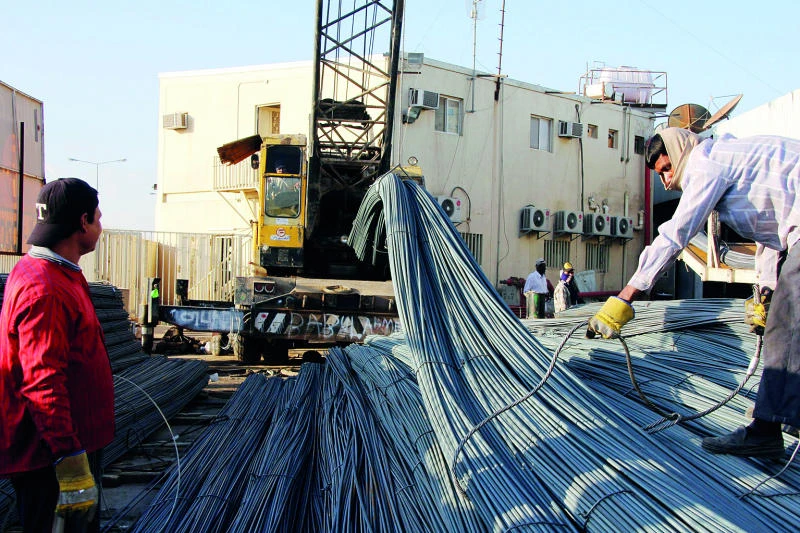
The volume of hidden (underground) economy in the Kingdom is poised to hit SR330 billion in the current year in light of the existence of more than 10 million foreign workers and ineffectiveness of wage control program and anti cover-up business campaign, local media said quoting economic experts.
The experts cited a number of reasons that make it difficult to fight the hidden economy phenomenon, at least in the foreseeable future, such as the availability of high liquidity, dependence on foreign workers in professional, service jobs and retail sector and hand-cash transactions.
The Ministry of Labor’s wage control program will not be enough to put an end to losses of the national economy emerging from irregular financial practices of foreign workers in light of the spread of irregular money transfer offices run by the expatriates in certain popular neighborhoods who used to break up large sums of money and transfer them to abroad using multiple names and beneficiaries, the experts were quoted by Al-Riyadh daily as saying.
Economic expert Fahad bin Juma’a predicted that the volume of the hidden economy in the Kingdom will reach SR330 billion, or 17 percent of the Kingdom’s gross domestic product (GDP) based on the UN data.
The loss of Saudi economy will likely continue in the coming years as a result of adverse economic environment created by the shadow (hidden) economy as the Ministry of Labor and other governmental agencies are enforcing strict measures to fight such phenomenon, he was quoted as saying.
He said the Kingdom can avail the experience of Italy which decided in 2011 that e-payments be obligatory for any amounts exceeding 1,000 euros associated with tax incentives for e-payments at points of sales (POSs). He said reducing the shadow economy calls for intensification of e-payments and ordering all retail stores, including gas stations, to use cashier machines, a step that will relatively reduce the size of the hidden economy.
For his part, financial analyst Walid Al-Sibaie attributed the increased volume of hidden economy in the Kingdom to the existence of more than 10 million expatriate workers.
The outflow of remittances from the Kingdom grew by 14.9 percent during the last seven months, or SR23 billion, compared to the same period last year, according to a report released by Jadwa Investment.
Economic analysts said the remittance growth was attributed to the “correction” campaign launched by the Ministry of Labor against work irregularities. They said some 700,000 foreign workers have already left the Kingdom in the aftermath of the campaign after having remitted their savings and, hence, led to the substantial growth of the remittances.
Economic expert Mohamed Al-Dhahayyan said the volume of outbound remittances will gradually decrease, possibly in the beginning of 2014, due to the application of wage protection program and departure of considerable number of foreign workers.
Bashir Bakhait, another economic analyst, shared views of other analysts over the point that the expatriates have increased the pace of remittances on the feeling that they are about to leave the Kingdom on the final exit as soon as the correction period is over.
The geopolitical tensions in the region have also immensely contributed to increase the rate of remittances to their respective countries. However, the increase in remittances will not continue in the long-term in light of the proposed plans to lessen dependence on foreign workers which will curb remittances, he said.
Hidden economy is poised to hit SR330bn mark in 2013