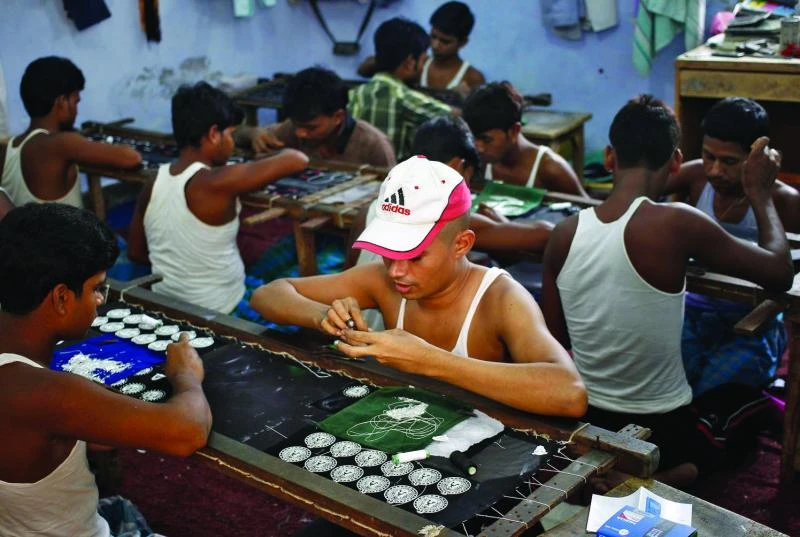
NEW DELHI: India’s manufacturing shrank in August for the first time in over four years, dealing a fresh blow to efforts to boost a slumping currency, as rival China’s factory activity rebounded, figures showed.
HSBC’s Purchasing Managers’ Index (PMI) for India, which gives a snapshot of manufacturing health, tumbled to a surprise low of 48.5 in August from 51.1 in July, amid a slump in orders.
India’s economy has not yet hit bottom, said HSBC economist Leif Eskesen.
The PMI index is seen as a leading signal of economic momentum. A reading below 50 signals contraction while anything above suggests expansion.
The Indian data came amid a flurry of growth forecast downgrades for the country for this financial year to March 2014, amid worries Asia’s third-largest economy could be on the brink of a full-blown crisis.
HSBC cut its growth forecast to four percent from 5.5 percent while Nomura India reduced its projection to 4.2 percent from five percent.
The most bearish was BNP Paribas, which slashed its forecast to 3.7 percent from 5.2 percent target, saying India’s “macro muddle” was nearing “crisis” proportions.
BNP Paribas said the economy appeared to be entering a “tailspin” as business confidence collapses under the rupee’s rapid slide, rising energy costs, tighter financial conditions and policy confusion.
Last week, figures showed India’s economy grew by 4.4 percent in the first three months, the slowest quarterly pace since the onset of the 2008 global financial crisis.
The Indian government expects growth of around 5.5 percent after expansion slowed to a decade low of 5.5 percent last year.
The rupee weakened Monday to 66.11 to the dollar from Friday’s 65.70, snapping a two-day rally, as investors worried the negative data would deter foreign capital inflows.
But the Bombay Stock Exchange’s benchmark Sensex finished up 1.43 percent at 18,886 points on bargain-hunting.
India’s PMI reading, the lowest since a below-50 level in March 2009, contrasted with figures showing Chinese factory activity shifted to expansion from contraction — surging to 50.1 in August from 47.7 in July — after three months of shrinkage.
“We expect some upside surprises to China’s growth in the coming months,” said HSBC’s chief economist for China, Qu Hongbin.
Chinese authorities are targeting 2013 growth of 7.5 percent as they seek to shift the economy’s growth engine from big-ticket investment to consumer demand.
The Chinese government’s official PMI for August, released Sunday, was a 16-month high of 51.0, driven by recent stimulus steps and companies restocking goods.
The upbeat Chinese data coincided with PMI figures suggesting a recovery in the eurozone manufacturing sector was broadening, cheering global stock markets.
But manufacturing activity shrank sharply in Southeast Asia’s largest economy Indonesia on lower orders, falling to a 15-month low of 48.5 in August from 50.7 in July.
“Weaker demand both domestically and externally appeared to be behind the worsening in manufacturing conditions,” said HSBC economist Su Sian Lim.
South Korea’s manufacturing activity shrank for a third straight month in August, though at a slower pace than in July.
Taiwan’s manufacturing, meanwhile, was unchanged at 48.6 in July, suggesting activity is stabilising. But stronger orders are needed to ensure the electronics exporter avoids a recession, HSBC said.
The fall of the Indian rupee and other emerging-market currencies has been greased by expectations of a tapering of US economic stimulus that has prompted large funds flows into emerging markets.
Credit Suisse economist Robert Prior-Wandesforde said India’s economic performance reflected a loss of its “normally strong animal spirits.”
India has “lost its mojo,” he said, but added the economic gloom might be overdone and Credit Suisse was keeping its growth forecast unchanged at six percent.
India manufacturing hits over 4-year low