The lending activity in Saudi banks remains at healthy double-digit levels as low risk premiums are translating into attractively low interest rates, says a report from National Commercial Bank. (NCB)
“However, factors such as the US policy rate expectations and Saudi domestic credit growth are key drivers of the Saudi Interbank Rate (SAIBOR), currently standing at 0.95 percent,” states the NCB Saudi Economic Review for May 2014.
It said the the decoupling from the London Interbank Offered Rate (LIBOR) as of late implies that Saudi banks are relatively safer from external shocks compared to the 2008-2009 financial crisis, thanks to SAMA’s substantial accumulation of foreign assets, geared toward providing ample cushioning.
“This leaves SAIBOR influenced mostly by internal dynamics, manifested in domestic credit activity. In this regard, we observe that the base rate of 0.25 percent, often called the reverse repo rate, which SAMA used to influence the short-term interest level has been fixed since 2009,” said the report.
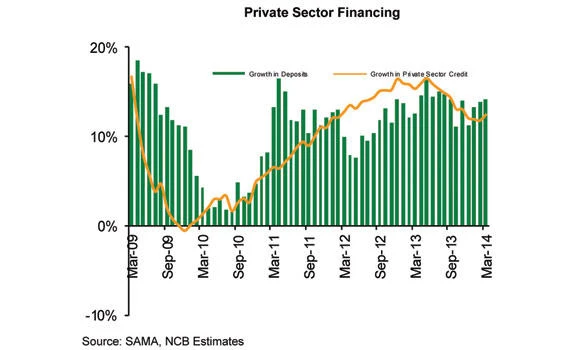
“Despite that, SAIBOR has been trending higher by influence of strong demand for credit. Therefore, the rise in SAIBOR was found to be correlated with the double-digit growth in credit extended to the private sector, which, not including T-bills, grew by 11.7 percent Y/Y in March,” it said.
The report said that the conducive macroeconomic conditions in the Kingdom have created an investment-friendly environment which allows the financial system to flourish through plentiful viable opportunities as local businesses grow.
The tangible efforts of the Ministry of Commerce and Industry, Capital Market Authority, and the General Investment Authority significantly contributed to boosting consumer confidence via enforcing market regulation, competitiveness protection, and fair pricing, according to the NCB report.
Since January of 2013, credit growth decelerated while deposits grew rapidly reaching 14.1 percent in March, leading to a loan-to-deposit ratio of 78.8 percent.
The expansionary fiscal policy pursued by the Saudi government as an attempt to diversify the economic base amid prospects of softer oil revenues has its hopes hinging on higher growth coming from the private sector, which in turn holds SMEs at the core.
“Furthermore, we expect demand for credit to ease throughout 2014, pushing SAIBOR down to 0.8 percent while SAMA, on the other hand, will most likely follow suit with the Fed as policy rate hikes are expected in mid-late 2015,” said the report.
Consequently, the reverse repo rate will rise, absorbing some liquidity from the market, effectively bringing SAIBOR back close to 1 percent.
In March, the combined loans portfolio for Saudi banks reached an all-time high of SR1.16 trillion, surging by 11.7 percent on an annual basis.
The pace of credit growth continues to slow for the 11th consecutive month to below pre-crisis levels, according to the Economic Review.
It said that nonoil trade balance deficit in the kingdom continued to shrink in March, completing a quarter of improvement.
Exports recorded an annualized 12.5 percent increase in value terms, reaching SR19.2 billion.
Kingdom’s banks remain safe from external shocks