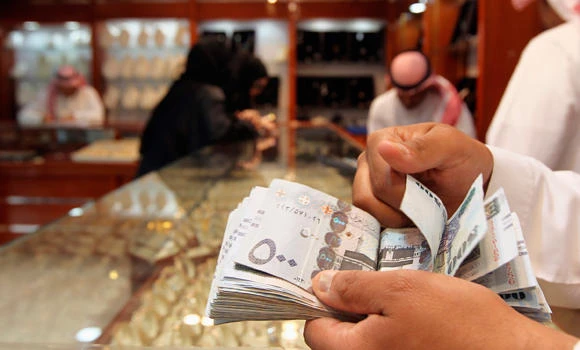
The Saudi economy continues to maintain an upward trajectory and record robust growth figures despite the fragility of the global economy. The monetary base (M0) recorded a 5.6 percent growth on an annual basis to settle at SR 310 billion by the end of February, the National Commercial Bank (NCB) says in its Saudi Economic review.
Currency outside banks, cash in vault, and deposits with SAMA (Saudi Arabian Monetary Agency) grew on an annual basis of 11.2 percent, 6.6 percent, and 1 percent, respectively. However, on a monthly basis, M0 recorded a second consecutive monthly decline of 8.6 percent, declining by SR 29.3 billion over the previous month. The monthly contraction was mainly due to the reduction in deposits with SAMA as it recorded a decline of 16 percent M/M totaling SR 155.2 billion. The decline was also due to the reduction of cash in vault by 5.2 percent M/M amounting to SR 19.2 billion. The third component of M0, currency outside banks, has reversed the negative trend to rise by SR 1.5 billion (1.1 percent M/M) to reach SR 135.6 billion during February. It is important to note that currency outside banks and has increased its contribution in the total monetary base from 39.5 percent in January to 43.8 percent in February.
Although broad money (M3) edged slightly lower than the all-time high recorded in December, the NCB report said M3 posted an annual growth of 12 percent during the month of February reaching SR 1.39 trillion. Representing the largest share of broad money, demand deposits have witnessed a growth of 15 percent on an annual basis to reach SR 769.5 billion during February. Time and savings deposits decelerated to an annual growth of 6.6 percent during February as opposed to January's 9 percent rise, reaching SR 324.6 billion. Additionally, other quasi-monetary deposits rose by 9.7 percent Y/Y. On a monthly basis, demand deposits expanded by less than one percent and time and savings deposits gained 0.4 percent M/M. Other quasi-monetary de- posits continued to drop for the second month by 6.4 percent M/M. The lack of attractive yields continues to persuade investors away from time and savings deposits and to look more into equity markets. The option to have quick access to liquidity in order to grasp investment opportunities will hold back the appetite for the currently low interest rate products. The composition of M3 is still dominated by demand deposits with 55.0 percent, followed by time and savings deposits with 23.2 percent, other quasi-monetary deposits with12.1 percent, and currency outside banks with 9.7 percent.
As for inflation, the annual inflation rate remained stable at 3.9 percent. Foodstuff is one of the influential categories in the benchmark inflation rate as Saudi is import oriented. In February, food prices maintained its upward trend since December 2012, increasing by 5.5 percent Y/Y. Most of the increase is due to the rise in the fruit and nuts category by 11.5 percent Y/Y, meat and poultry category by 6.9 percent Y/Y. Additionally, the bread and cereal category rose by 6.3 percent Y/Y as a result of the increasing prices of Indian rice (basmati) in response to the high demand from several countries following their preferences' switch to import Indian rice instead of Pakistani rice. Rental prices continued their decelerating trend which lowered the category's inflation rate to 2.9 percent Y/Y during February in anticipation of codifying of the mortgage law. The liquid state of the economy suggests that prices should remain somewhat contained while raising concerns for policy makers.
Kingdom’s monetary base grows 5.6% to SR 310 bn