The National Commercial Bank (NCB) had projected in its report Saudi Economic Perspectives titled “Growth Moderation on the Horizon” issued in June, that the Kingdom will face a moderate business cycle during 2014 and 2015, growing around 4 percent in real terms.
The bank’s assumptions centered on lesser contribution from the oil sector and moderation in the nonoil sector. It expected the weighted average Arab light prices to fall from $106.4 per barrel in 2013 to an estimated $102 per barrel in 2014, a wild call at the time especially that oil peaked in the summer as the benchmark Brent broke the $110 per barrel threshold.
The second half of this year was to exhibit weakness in oil markets on the back of sluggish demand and resurging supply, with a firm believe that geopolitics had been factored in. The latest figures released by the Central Department of Statistics and Information (CDSI) pertaining to the second quarter lend support to the above mentioned assumptions.
The real GDP registered a 3.8 percent annual growth rate, which was the second lowest figure since data going back to Q1, 2011 and it is expected to decline further if OPEC decided in its November meeting to cut production to prop up crude prices that fell precipitously in early October.
Although the contribution of oil remained positive, it was a mere 2.5 percent Y/Y that is much lower than the previous quarter’s 6.1 percent. Meanwhile, nonoil GDP remained within the 4 percent range for the fourth quarter in a row, posting 4.2 percent, the slowest in more than 3 years.
The deceleration in nonoil vibrancy is attributed to both the private and public sectors that respectively grew by 4.7 percent and 2.6 percent, near three-year lows. Analyzing the breakdown of nonoil private GDP by sector reveals that private services composed of commerce, transport & communication, finance and insurance and that weigh around 48 percent was the biggest drag last quarter, growing by just 4.1 percent. Meanwhile, surprisingly enough, manufacturing and utilities seem to have limited the overall deceleration, expanding by 6.5 percent and 8 percent. In the case of manufacturing this was near the highest record since Q1, 2012 while for utilities it was the largest expansion since Q3, 2012.
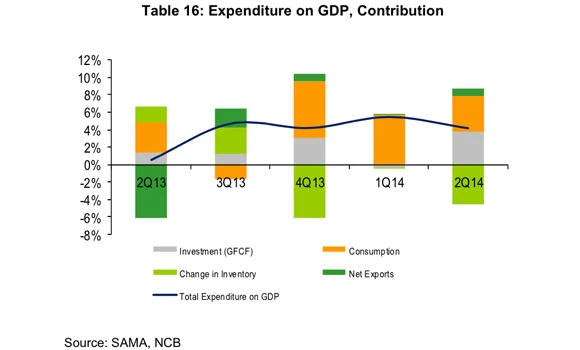
The NCB report said nominal GDP under the expenditure approach reflects a slowdown in consumption that represents 53.6 percent of total spending in the Kingdom. After two quarters of double-digit growth, total consumption grew annually by 7.9 percent, with private and public consumption growing by 7 percent and 9.2 percent, respectively. The single-digit growth in public consumption was significantly lower compared to the previous two quarters that grew on average by 20 percent Y/Y. On the contrary, investment spending was robust, rising by 17.4 percent, the highest since Q3, 2012.
All of the above mentioned data illustrates that projections about a 4 percent growth rate for this year is materializing, and given the current dynamics a similar performance next year is the most likely scenario, with oil prices suppressed and crude production gains contained.
Kingdom’s nonoil GDP remains within 4% range